
LSA-137
Inscribed block, probably marking a statue for Herculius, praetorian prefect. Athens (Achaea), library of Hadrian. 407-412
Record details
Photographs
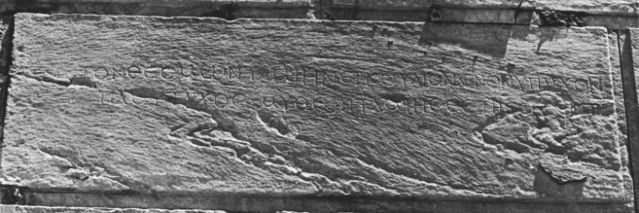

Inscription
τὸν θεσμῶν ταμίην, Ἑρκούλιον, ἁγνὸν ὑπάρχον, / Πλουτάρχος, μύθων ταμίης, ἔστησε, σοφίστης.
Inscription translation
The treasurer of the laws, Herculius, the worthy prefect, / Plutarchus set up, the treasurer of the myths, the sophist.
Bibliography
- Inscriptiones Graecae, II/III 4224
- Inscriptiones Graecae, II/III(2) 13283
Discussion
INSCRIPTION
Elegiac distich laid out in two lines:
τὸν θεσμῶν ταμίην, Ἑρκούλιον, ἁγνὸν ὑπάρχον,
Πλουτάρχος, μύθων ταμίης, ἔστησε, σοφίστης.
'The treasurer of the laws, Herculius, the worthy prefect, / Plutarchus set up, the treasurer of the myths, the sophist.'
Letter height 3.5-4.5 cm.
DESCRIPTION
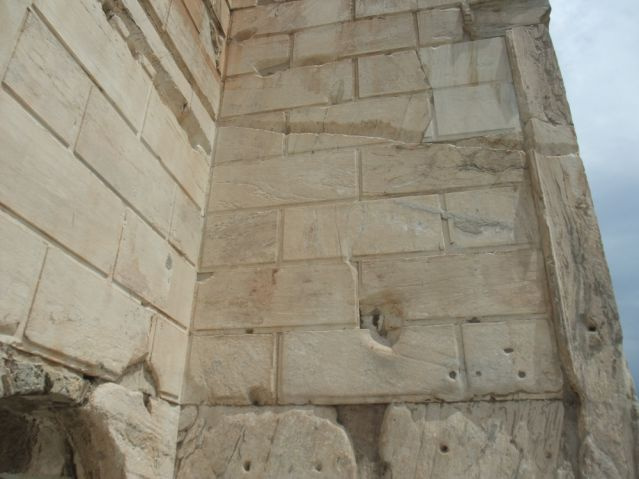
The inscription in two hexameters is carved on a block high on the porch of the west entrance of the library of Hadrian, which was also 'one of the main gates to the city's inner fortified core' in the post-Herulian city walls (quotation from Fowden 1995, 555). H 57, W 153 cm.
LOCATION
Built into the wall at the left side of the original entrance (the western facade) to the Library of Hadrian, 4.5 m above the level of the stylobate. This is a highly unusual position for a statue-inscription; but the block appears to be in its original location, and the text seems to refer to a statue (with the honorand, in the accusative, being 'set up' by an awarder, in the nominative - the standard features of Greek statue-inscriptions) . Presumably it was sited above a statue which stood on a base at stylobate level. It has been proposed recently that the so-called 'Library of Hadrian' served as the forum of Athens in the post-Herulian era, possibly as the praetorium recorded in Himerius' Oratio 38 (Deligiannakis 2010, 12-13).
HONORAND, AWARDER, AND DATE
The honorand, Herculius, held the praetorian prefecture of Illyricum in 408-10 (PLRE II, 545 Herculius 2). A. Frantz argued for a possible extension of these dates to 407-12 (Frantz 1988, 63 n. 39). He is known from two further inscribed bases, one from the Acropolis in Athens (LSA-138), the other one in Megara (LSA-55). Large-scale repairs to the Library of Hadrian have been attributed to him on the basis of this inscription and the chronology provided by the excavation data (Deligiannakis 2010, 12; Choremi et alii 2008). Fowden 1995, 555 argues that Herculius restored the fortifications of Athens, of which the 'Library of Hadrian' formed a part.
E. Sironen identified the awarder of our statue with a Plutarchus who was himself honoured with a statue by the people of Athens (LSA-134), but distinguished this sophist Plutarchus from the philosopher Plutarchus, the famous head of the neo-platonist school in Athens in the late 4th and early 5th century, to whom Sironen attributes the honorific statue LSA-136 (Sironen 1994, 47-8, 49-50, 50-51). It remains however possible that all three inscriptions refer to the same man, the head of the neo-platonist school (cf. Frantz 1988, 64).
Plutarchus is styled 'treasurer of the myths', alluding to his education and possibly his paganism.
Discussion references
- Choremi, A. & alii, Η Βιβλιοθήκη του Αδριανού στην Αθήνα. Τα ανασκαφικά δεδομένα, Athens during the Roman period. Recent discoveries, new evidence (Museio Benaki, 4th Supplement , ed. St. Vlizos) 115-131, Athens 2008
- Fowden, G., Late Roman Achaea: identity and defence , Journal of Roman Archaeology 8, 549-567, Ann Arbor, Mich. 1995, 555
- Frantz, A., Late Antiquity A. D. 267 - 700: The Athenian Agora XXIV, Princeton 1988, 63-4
- Martindale, J. R., The Prosopography of the Later Roman Empire. Vol. II A.D. 395-527, Cambridge 1980, 454 Herculius 2
- Sironen, E., The late Roman and early Byzantine inscriptions of Athens and Attica, Dissertation - University of Helsinki 1997, 50-1 no. 31
- Sironen, E. , 'Life and administration of late Roman Attica in the light of public inscriptions'
P. Castrén, Post-Herulian Athens : aspects of life and culture in Athens, A.D. 267-529 , Helsiniki 1994, 15-62, 50-1 no. 31
Cite: Last Statues of Antiquity, LSA-137 (Ulrich Gehn).