
LSA-138
Base for statue of Herculius, praetorian prefect. Athens (Achaea), from Acropolis. 407-412
Record details
Photographs
Inscription
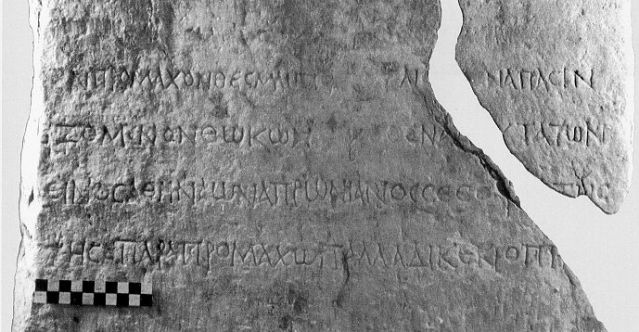
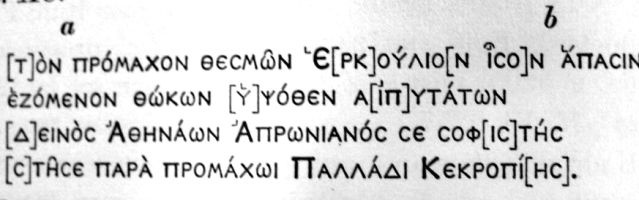
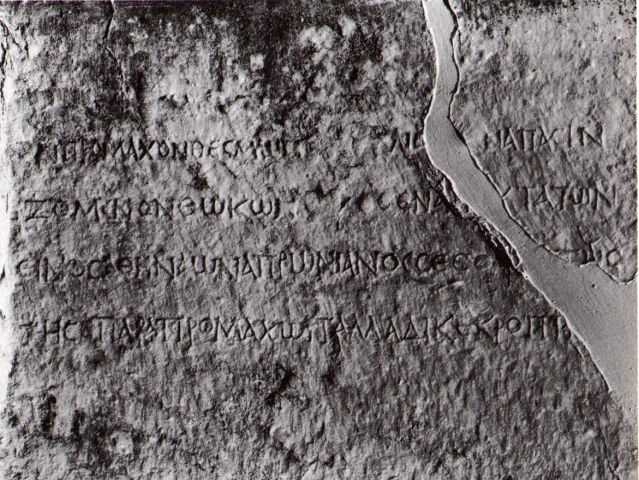
τ̣ὸν πρόμαχον θεσμῶν, Ἑ[ρκ]ούλιο[ν ἶσο]ν ἄπασιν,
ἑζόμενον θώκων ὑψόθεν αἰ̣π̣υτάτων,
δ̣εινὸς Ἀθηνάων Ἀπρωνιανός σε σοφ[ι]σ̣τὴς
στῆσε παρὰ προμάχῳ Παλλάδι Κεκροπίη̣[ς].
Inscription translation
Apronianus, the skillful sophist at Athens, set you up, Herculius, the defender of laws and equitable to all, you who sit above the highest seats (of office), beside Athena, the defender of the city of Cecrops (= Athens). (trans. E. Sironen)
Bibliography
- Inscriptiones Graecae, II/III 4225
- Inscriptiones Graecae, II/III(2) 13284
Discussion
INSCRIPTION
Verse inscription of two elegiac distichs laid out in four lines:
τ̣ὸν πρόμαχον θεσμῶν, Ἑ[ρκ]ούλιο[ν ἶσο]ν ἄπασιν,
ἑζόμενον θώκων ὑψόθεν αἰ̣π̣υτάτων,
δ̣εινὸς Ἀθηνάων Ἀπρωνιανός σε σοφ[ι]σ̣τὴς
στῆσε παρὰ προμάχῳ Παλλάδι Κεκροπίη̣[ς].
‘Apronianus, the skillful sophist at Athens, set you up, Herculius, the defender of laws and equitable to all, you who sit above the highest seats (of office), beside Athena, the defender of the city of Cecrops (= Athens).’ (trans. E. Sironen).
Letter height 1-2.5 cm.
DESCRIPTION (from Sironen 1997 and the published photograph)
Rectangular white marble base (Pentelic, according to Sironen 1997, 82), with moulding at the top: H 105, W 60, D 72 cm. On the front face there are traces of two earlier inscriptions; the back side is only roughly finished. On the top there are four small sockets for fixing the statue. Broken obliquely across the upper right corner, but repaired.
PROVENANCE AND LOCATION
The base was found before 1863 in or near the Stoa of Attalus, in the Agora (Sironen 1997, 82; Fowden 1995, 555 n. 30, however, asserts that is was found in the early 1870s in front of the Library of Hadrian). However, the inscription tells us that the monument was set up 'near Athena Promachos (παρὰ προμάχῳ Παλλάδι)', in other words, almost certainly on the Acropolis, close to the giant statue of Athena Promachos. Today the base is in the Epigraphic Museum, inv. no. 10516.
HONORAND, AWARDER, AND DATE
The honorand, Herculius, held the praetorian prefecture of Illyricum in 408-10 (PLRE II, 545 Herculius 2); A. Frantz has argued for a possible extension of these dates to 407-412 (Frantz 1988, 63 n. 39). Herculius was honoured with two further inscribed bases, one at the entrance of the Library of Hadrian in Athens (LSA-137), the other one in Megara (LSA-55). On the basis of the inscription at the Library of Hadrian, he is credited with major repairs to that building, probably when it had become part of the defenses of Athens (Deligiannakis forthc. 12; Choremi et alii 2008; Fowden 1995, 555).
The awarder, Apronianus, is known only from this inscription (PLRE II, 124 Apronianus 1; Traill 1994). The description of him as a 'sophist' shows that, like Plutarchus, the awarder of the other statue for Herculius in Athens (LSA-137), Apronianus was a member of the Athenian intellectual elite.
FURTHER DISCUSSION
The inscription suggests that the statue of Herculius was set up on the Acropolis. Here it would have been 'surrounded by a panorama of important monuments, images, historical official decrees, and famous works of arts, all commemorating the glory [of] Athens'. The text parallels Herculius, the 'defender (promachos) of laws', with Athena, the 'defender of Athens'. Setting and wording associate Herculius with the great figures of Athenian mythology and history (Deligiannakis 2010, 16).
Discussion references
- Deligiannakis, G., Late Antique Honorific Statuary from the province of Achaia, A.D. 300-600: A contribution to the topography and public culture of late antique Greece, Psaroudakes, K. & E. Sioumpara (eds.), Festschrift for Professor P.G. Themelis, Athens, 2010, 10-17
- Fowden, G., Late Roman Achaea: identity and defence , Journal of Roman Archaeology 8, 549-567, Ann Arbor, Mich. 1995, 553-556
- Frantz, A., Late Antiquity A. D. 267 - 700: The Athenian Agora XXIV, Princeton 1988, pl. 47 f
- Martindale, J. R., The Prosopography of the Later Roman Empire. Vol. II A.D. 395-527, Cambridge 1980
- Sironen, E., The late Roman and early Byzantine inscriptions of Athens and Attica, Dissertation - University of Helsinki 1997, 82-4 no. 23
- Sironen, E. , 'Life and administration of late Roman Attica in the light of public inscriptions'
P. Castrén, Post-Herulian Athens : aspects of life and culture in Athens, A.D. 267-529 , Helsiniki 1994, 15-62, 51 no.32 - Traill, J. S., Persons of Ancient Athens. Volume 2, Alexarchos to Aponius, Toronto 1994, 463 no. 150530
Cite: Last Statues of Antiquity, LSA-138 (Ulrich Gehn).