
LSA-139
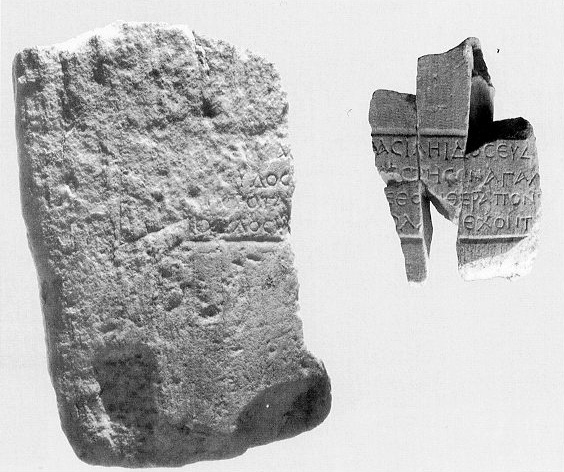
Two parts of a columnar base for statue of Eudocia, empress. Athens (Achaea), Agora. 421-439
Record details
Photographs
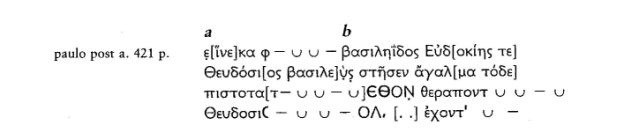
Inscription
ε̣[ἵνε]κα φ ---βασιληΐδος Εὐδ[οκίης τε] / Θευδόσι[ος βασιλε]ὺ̣ς̣ στῆσ̣εν ἄγαλ[μα τόδε] / π̣ι̣σ̣τ̣οτα[τ ----]ΕΘΟΝ̣ θεραποντ --- / ΘευδοσιΣ --- ΟΛ [..] ἐχοντ· -- .
Inscription translation
Because of the ... and (?) of the empress Eudocia, Theodosius the emperor set up this statue. The most loyal ... servant ... Theodosius ... having (?) ... (trans. E. Sironen).
Bibliography
- Inscriptiones Graecae, II/III(2) 13285
Discussion
INSCRIPTION
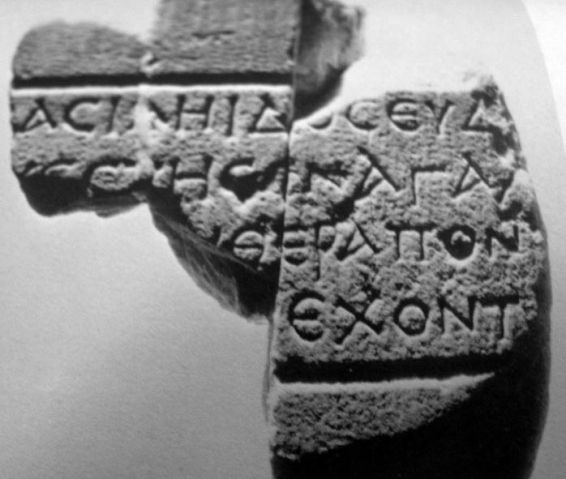
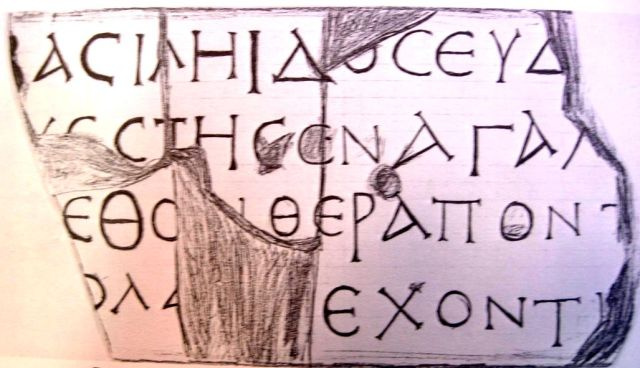
Verse inscription of two elegiac distichs, partly preserved in four lines:
ε̣[ἵνε]κα φ ---βασιληΐδος Εὐδ[οκίης τε]
Θευδόσι[ος βασιλε]ὺ̣ς̣ στῆσ̣εν ἄγαλ[μα τόδε]
π̣ι̣σ̣τ̣οτα[τ ----]ΕΘΟΝ̣ θεραποντ ---
ΘευδοσιΣ --- ΟΛ [..] ἐχοντ· -- .
'Because of the ... and (?) of the empress Eudocia, Theodosius the emperor put up this statue. The most loyal ... servant ... Theodosius ... having (?) ...' (trans. E. Sironen).
Letter height 1-2 cm.
DESCRIPTION
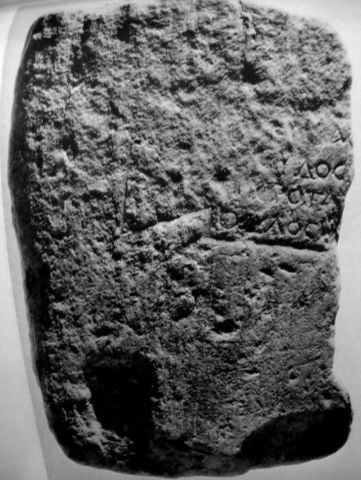
What survives of this monument are two non-joining parts: fragment A preserves the bottom left corner of the epigraphic field which is framed by a simple incised line. Fragments B, C & D are conjoining; they preserve the frame of the epigraphic field at top and bottom. Fragment E does not join, but can be located in relation to fragments B-D (see images). Heights: 47 (fragment A), 28 (B, C, D and E, as joined); Width: 30 (A), 19 (B, C, D and E, as joined); Thickness 16 cm. On fragment A, traces of fine chisel-marks are preserved at the bottom right; the rest of the surface is badly damaged. Fragments B, C and D show that the surface was originally finished with a fine claw .
PROVENANCE AND LOCATION
All the fragments were found on the Agora in Athens, fragment A at the Stoa of Attalos, fragments B-E north of the 'Palace of the Giants'. Today in the Agora-Museum, inv. no. I-3558.
HONORAND, AWARDER, AND DATE
The honorand, the Athenian Athenais, married the emperor Theodosius II in 421, and after her marriage was officially called 'Aelia Eudocia' (PLRE II, 408-9 Aelia Eudocia (Athenais) 2).
The name 'Theodosius' in the second line of the inscription, together with the title basileus (in the nominative, if this is the correct expansion of two surviving letters), suggests that the emperor Theodosius II himself was the awarder of this monument. It would, of course, have been very appropriate (and politic) for the Athenians themselves to have encouraged the erection of a statue to their fellow citizen who had now risen so high.
The marriage of Athenais/Eudocia and Theodosius in 421 provides a secure terminus post quem for our dedication. Theodosius died only in 450; however Eudocia retired in disgrace from the court in Constantinople in 439, to return to power only after the death of her husband (Burman 1994, 67-9). A date for the erection of this statue after 439 can therefore be excluded. The most probable reason, and date, for this monument was the marriage itself in 421. That Aelia Eudocia is not entitled 'Augusta' - a title which she adopted in 423 - supports, but does not prove, this early date in her reign (Sironen 1994, 54).
FURTHER DISCUSSION
Sironen's discovery of this inscription for Eudocia provided the first evidence for an enduring connection of the empress Aelia Eudocia with her hometown (Sironen 1990). The find spot, in the area of the so-called 'Palace of the Giants', has led to speculation that this palace-like late antique building on the Athenian Agora was erected by the empress (Sironen 1990, 374 n. 11; Fowden,1990; Sironen 1994, 53; for the Palace of the Giants: Frantz 1988, 95-116).
The Greek verse inscription is unusual for imperial dedications of the fourth and early fifth centuries, but has a parallel in the Greek inscription set on the porphyry column of the empress Eudoxia in Constantinople (LSA-27), which is there combined and juxtaposed with a Latin prose inscription.
Discussion references
- Burman, J., The Athenian Empress Eudocia, P. Castrèn, Post-Herulian Athens: aspects of life and culture in Athens, A.D. 267-529 , Helsinki 1994, 63-87, esp. 67-9
- Feissel, D. & Philippidis-Braat, A., Inventaires en vue d’un recueil des inscriptions historiques de Byzance, 3. Inscriptions du Péloponnèse, (à l’exception de Mistra)., Travaux et mémoires, 9, Paris 1985, 267-395
- Fowden, G., The Athenian Agora and the Progress of Christianity, Journal of Roman Archaeology 3, 1990, 494–501, esp. 497-9
- Sironen, E., The late Roman and early Byzantine inscriptions of Athens and Attica, Dissertation - University of Helsinki 1997, 84-5 no. 24
- Sironen, E. , 'Life and administration of late Roman Attica in the light of public inscriptions'
P. Castrén, Post-Herulian Athens : aspects of life and culture in Athens, A.D. 267-529 , Helsiniki 1994, 15-62, 52 no. 33 - Sironen, E., An Honorary Epigram for Empress Eudocia in the Athenian Agora, Hesperia 59, 1990, 371-4
Cite: Last Statues of Antiquity, LSA-139 (Ulrich Gehn).