
LSA-14
Base for statue of Diocletian, emperor. Gerasa (Arabia). 284-305
Record details
Photographs
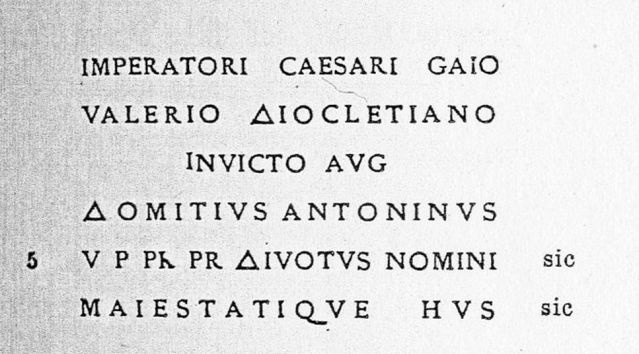
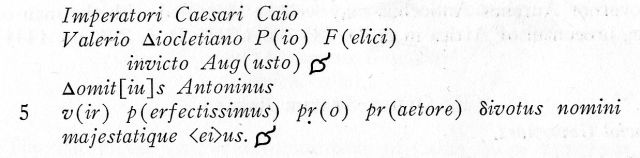
Inscription
Imperatori Caesari, Gaio / Valerio Diocletiano, / invicto Aug(usto), / Domitius Antoninus, / v(ir) p(erfectissimus), pr(aeses) pr(ovinciae), divotus (sic) nomini (sic) / maiestatique hus (sic).
Inscription translation
To the emperor Caesar, Caius Valerius Diocletianus, the unconquered Augustus, Domitius Antoninus, of perfectissimus rank, governor (praeses) of the province [of Arabia], devoted to his divine spirit and majesty, [set this up].
Bibliography
- Corpus Inscriptionum Latinarum; , III suppl 2, 14156(2)
- Welles, C. B., The Inscriptions, Gerasa. City of the Decapolis (ed. by C. H. Kraeling), New Haven 1938, 355-616
Discussion
INSCRIPTION
In six lines:
Imperatori Caesari Gaio / Valerio Diocletiano / invicto Aug(usto) / Domitius Antoninus / v(ir) p(erfectissimus) pr(aeses) pr(ovinciae) divotus (sic) nomini (sic) / maiestatique hus (sic! for eius).
'To the emperor Caesar, Caius Valerius Diocletianus, the unconquered Augustus, Domitius Antoninus, of perfectissimus rank, governor (praeses) of the province [of Arabia], devoted to his divine spirit and majesty, [set this up].'
Letter height not recorded.
The strikingly poor rendition of the closing formula, which ought to read 'devotus numini maiestatique eius', can be explained by the fact that Latin was not a day-to-day language in Gerasa, though it was at this date thought to be appropriate for imperial statue dedications.
DESCRIPTION (from Brünnow 1897)
No detailed description of the block is given by any of the editors, but it is clear from Brünnow's scant account that it must be a rectangular base. It was originally used in the mid-2nd century for an honorific inscription to the provincial governor (legatus Augusti pro praetore) of Arabia, Caius Allius Fuscianus. Our inscription is on the original back side of the block. No measurements are published, and there is no published photo.
PROVENANCE AND CURRENT LOCATION
Recorded in 1897 in a private house north of the great baths by Brünnow (Brünnow 1897); the same information was given in 1902 by CIL III suppl. II, ('in hortis Bakiri, iuxta thermas q.d. maiores'). There is no published record of its present location.
HONORAND, AWARDER AND DATE
The honorand, Diocletian, was Augustus 284-305.
The awarder Domitius Antoninus, governor (praeses) of the province of Arabia, is known only from this inscription (PLRE I, 75 Domitius Antoninus 9). According to PLRE I, 75 Domitius Antoninus 9, Diocletian used the name 'Caius Valerius Diocletianus', as on our inscription, only before Maximian became Augustus, i.e. before 286. PLRE therefore dated Domitius Antoninus' governorship to 284/6. However a milestone in Verona (Dessau 636 ) uses exactly the same form of the name together with those of the other tetrarchs, hence after 293. We have therefore left the date range as the whole reign of Diocletian.
Discussion references
- Brünnow, R. Inschriften aus dem Ostjordanlande, Mittheilungen und Nachrichten des deutschen Palästina-Vereins 3, 38-40, Leipzig 1897, pp. 38-9 no. 1
Cite: Last Statues of Antiquity, LSA-14 (Ulrich Gehn).