
LSA-140
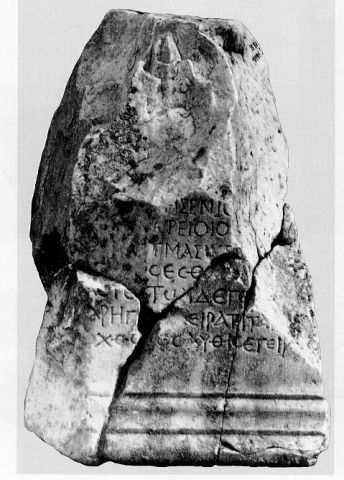
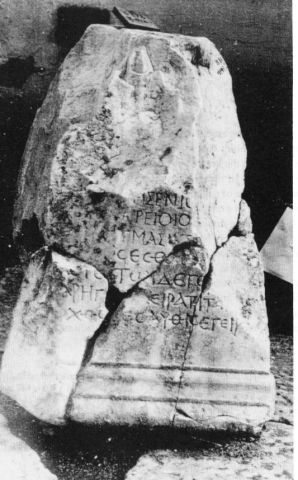
Four fragments of base for statue, perhaps of 'Ioannes'. Athens (Achaea). Later fifth to sixth century (?)
Record details
Photographs
Inscription
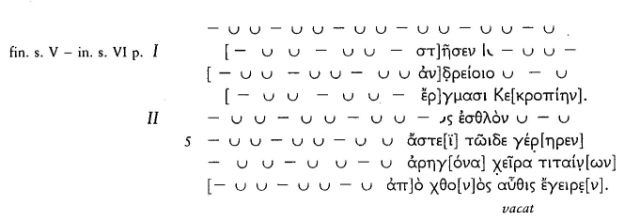
[-----στ]ῆσεν ΙΟ̣---- /
[------ἀν]δ̣ρείοιο --- /
[----- ἔρ]γμασι Κε[κροπίην]. /
(4) --------ς ἐσθλὸν --- /
( ------ἄστε[ϊ] τῶιδε γέρ̣[ηρεν] /
------ ἀρηγ[όνα] χεῖρα τιταιν̣[ων] /
[------ ἀπ]ὸ χθο[ν]ὸς αὖθις ἔγειρε̣[ν]
Inscription translation
‘... set up Ioannes (?) ... of the courageous ... Athens (?) with (building) works (?) (4) ... the good ... he (?) gave as a reward to his city stretching (?) out his helping hand ... he (?) raised up. Once again, from the ground.' (trans. E. Sironen)
Bibliography
- Inscriptiones Graecae, II/III(2) 13288
Discussion
INSCRIPTION
Verse inscription. Parts of the final seven lines of the inscription survive:
[-----στ]ῆσεν ΙΟ̣---- /
[------ἀν]δ̣ρείοιο --- /
[----- ἔρ]γμασι Κε[κροπίην]. /
(4) --------ς ἐσθλὸν --- /
( ------ἄστε[ϊ] τῶιδε γέρ̣[ηρεν] /
------ ἀρηγ[όνα] χεῖρα τιταιν̣[ων] /
[------ ἀπ]ὸ χθο[ν]ὸς αὖθις ἔγειρε̣[ν]
‘... set up Ioannes (?) ... of the courageous ... Athens (?) with (building) works (?) (4) ... the good ... he (?) gave as a reward to his city stretching (?) out his helping hand ... he (?) raised up. Once again, from the ground.' (trans. E. Sironen)
Letter height 2-2.5 cm (lines 1-3), 1.6-3.3 cm (lines 4-7).
From the surviving text, Sironen reconstructs two epigrams, consisting of two distichs each (Sironen 1995, 166-7) - with one whole line missing at the top. The two epigrams are clearly carved by two different hands (lines 1-3, and 4-7), but in roughly the same period (Sironen 1995, 167).
DESCRIPTION (from Sironen and the published photo)
Four conjoined fragments of a rectangular base of white marble (Pentelic according to Sironen 1995, 165): H 68, W 44, D 80 cm. The bottom of the base is better preseved than the top, and preserves the remains of a lower moulding which carries round onto the right side. The upper part of the base is broken on all sides; but part of the roughly picked top face is preserved. The epigraphic field is smoothly finished.
PROVENANCE AND LOCATION
The fragments were found built into the walls of various houses at the north foot of the Areopagus. The pieces were reassembled in 1948, and are now in the Agora Museum, inv. no. I-5661.
HONORAND AND DATE
On the basis of the letter forms, Sironen proposes a date from the later 5th to the 6th century (suggested by Sironen 1995; slightly modified to the 2nd half of the 5th century in Sironen 1997, 89; re-established in IG II/III(2)). The building activities to which the text alludes could then be the restoration of the fortification walls after the Vandalic raid of AD 457/67 (Sironen 1995, 167-9) or other building activity in Athens after that event (Frantz 1988, 78-82). No name of an honorand or awarder is preserved in the extant text. Sironen tentatively completes the final letters of the first surviving line to Ioannes (Sironen 1995, 166 with critical apparatus), and proposes as honorand, likewise tentatively, the Iohannes consul of 467 and praetorian prefect of Illyricum in 479 (Sironen 1995,172; PLRE II, 600-1 Ioannes 29). The tentativeness of this ascription, which carries consequences for the date, must be underlined, cf. Sironen 1995, 172-3. If it is this late, it is a rare monument from post-Vandalic times in Athens.
Discussion references
- Sironen, E., The late Roman and early Byzantine inscriptions of Athens and Attica, Dissertation - University of Helsinki 1997, 87-9 no. 26
- Sironen, E., Statue Base Epigrams in Honor of a Restorer from Early Byzantine Athens, Arctos 29, 1995, 163-73
Cite: Last Statues of Antiquity, LSA-140 (Ulrich Gehn).