
LSA-1407
Base for gilded bronze statue of Flavius Olbius Auxentius Draucus, prefect of the City; commanded by the emperors. Rome, Forum of Trajan. 425-450.
Record details
Photographs
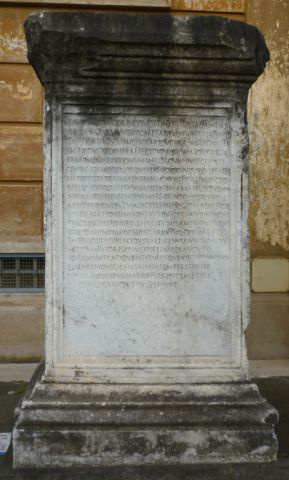
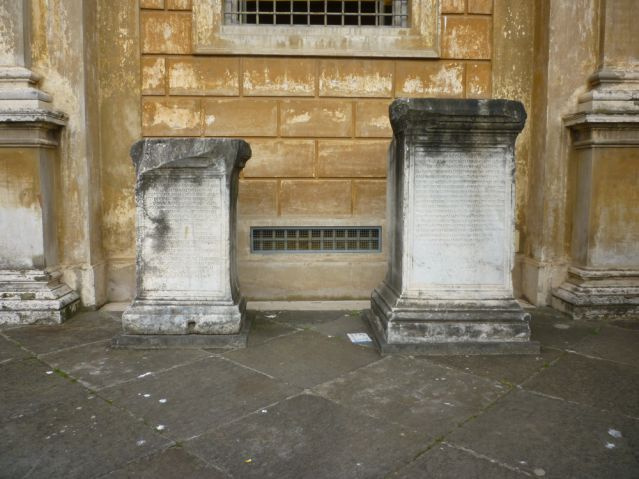
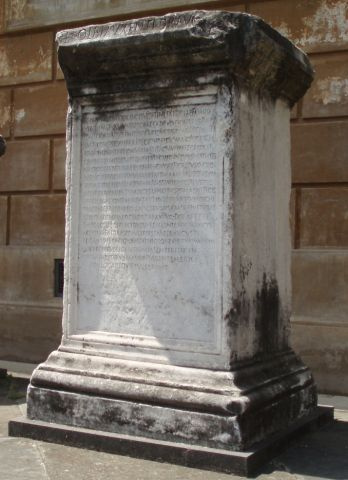
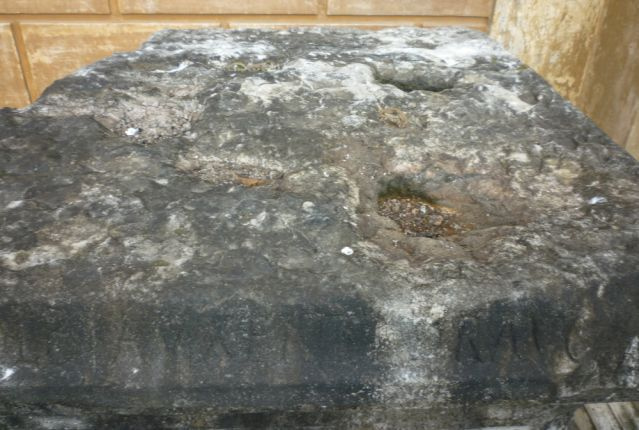
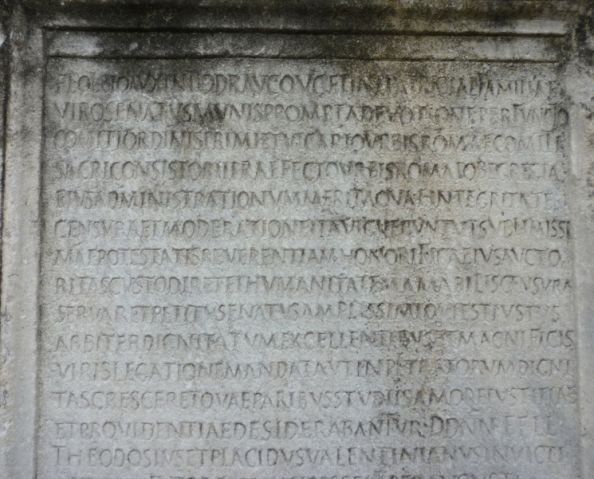
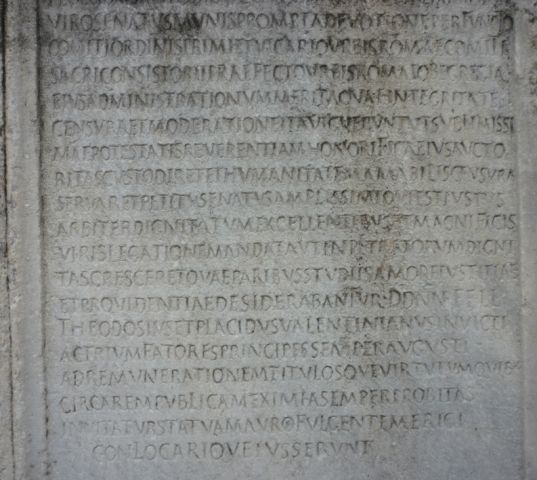
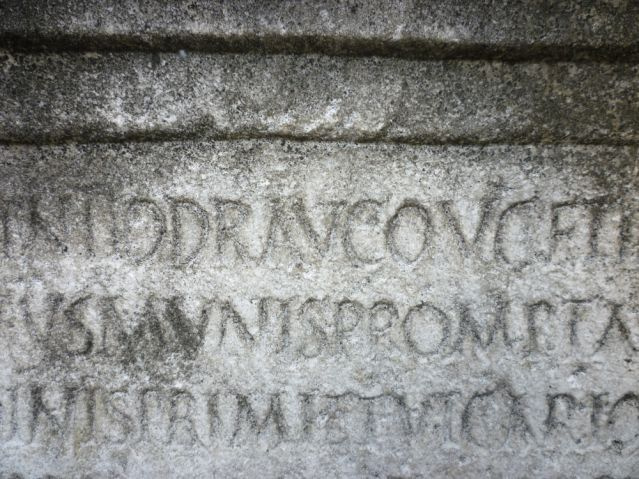
Inscription
Fl(avi) Olbi Auxenti Drauc[i]. / Fl(avio) Olbio Auxentio Drauco, v(iro) c(larissimo) et inl(ustrissimo), patriciae familiae / viro, senatus munis prompta devotione perfuncto, / comiti ordinis primi et vicario urbis Romae, comiti /(5) sacri consistorii, praefecto urbis Romae. Ob egregia / eius administrationum merita, quae integritate, / censura et moderatione ita viguerunt, ut sublimissi/mae potestatis reverentiam honorifica eius aucto/ritas custodiret, et humanitatem amabilis censura /(10) servaret, petitu senatus amplissimi, qui est iustus / arbiter dignitatum, excellentibus et magnificis / viris legatione mandata, ut inpetratorum digni/tas cresceret, quae paribus studiis amore iustitiae / et providentiae desiderabantur, dd(omini) nn(ostri) Fl(avii) /(15) Theodosius et Placidus Valentinianus, invicti / ac triumfatores principes, semper Augusti, / ad remunerationem titulosque virtutum, quib(us) / circa rem publicam eximia semper probitas / invitatur, statuam auro fulgentem erigi conlocarique iusserunt.
Inscription translation
[Statue of Flavius Olbius Auxentius Draucus. To Flavius Olbius Auxentius Draucus, of clarissimus and inlustris rank and patrician family, having performed the duties of the Senate with ready devotion, count of the first order and vicar of the City of Rome, companion of the imperial council (comes sacri consistorii), prefect of the City of Rome. On account of the outstanding merits of his administrations, which were so strong in integrity, judgement, and moderation, that his honour-inspiring authority safeguarded the reverence for [our] most sublime ruler, while his benevolent judgement guarded humanity. After an embassy of excellent and magnificent men was sent at the request of the most distinguished Senate, which is a just arbiter of worthiness, so that the worth of [his] accomplishments might grow, as was desired equally by enthusiasm and love for justice and providence, our lords Flavius Theodosius and Flavius Placidus Valentinianus, unconquered and triumphant emperors, forever Augusti, ordered as recompense and record of his virtues, which always attract exceptional honesty around [our] commonwealth, that a statue shining in gold be erected and placed [here].
Bibliography
- Corpus Inscriptionum Latinarum; , VI, 1725 (+p.4744)
Discussion
INSCRIPTION
In 19 lines. Letter height 4.5-2 cm (signum 5 cm)
Fl(avi) Olbi Auxenti Drauc[i]. / Fl(avio) Olbio Auxentio Drauco, v(iro) c(larissimo) et inl(ustrissimo), patriciae familiae / viro, senatus munis prompta devotione perfuncto, / comiti ordinis primi et vicario urbis Romae, comiti /(5) sacri consistorii, praefecto urbis Romae. Ob egregia / eius administrationum merita, quae integritate, / censura et moderatione ita viguerunt, ut sublimissi/mae potestatis reverentiam honorifica eius aucto/ritas custodiret, et humanitatem amabilis censura /(10) servaret, petitu senatus amplissimi, qui est iustus / arbiter dignitatum, excellentibus et magnificis / viris legatione mandata, ut inpetratorum digni/tas cresceret, quae paribus studiis amore iustitiae / et providentiae desiderabantur, dd(omini) nn(ostri) Fl(avii) /(15) Theodosius et Placidus Valentinianus, invicti / ac triumfatores principes, semper Augusti, / ad remunerationem titulosque virtutum, quib(us) / circa rem publicam eximia semper probitas / invitatur, statuam auro fulgentem erigi conlocarique iusserunt.
'[Statue of Flavius Olbius Auxentius Draucus. To Flavius Olbius Auxentius Draucus, of clarissimus and inlustris rank and patrician family, having performed the duties of the Senate with ready devotion, count of the first order and vicar of the City of Rome, companion of the imperial council (comes sacri consistorii), prefect of the City of Rome. On account of the outstanding merits of his administrations, which were so strong in integrity, judgement, and moderation, that his honour-inspiring authority safeguarded the reverence for [our] most sublime ruler, while his benevolent judgement guarded humanity. After an embassy of excellent and magnificent men was sent at the request of the most distinguished Senate, which is a just arbiter of worthiness, so that the worth of [his] accomplishments might grow, as was desired equally by enthusiasm and love for justice and providence, our lords Flavius Theodosius and Flavius Placidus Valentinianus, unconquered and triumphant emperors, forever Augusti, ordered as recompense and record of his virtues, which always attract exceptional honesty around [our] commonwealth, that a statue shining in gold be erected and placed [here].'
DESCRIPTION (CIL and personal inspection)
Marble base, 164 x 100 x 90 cm. The base has mouldings on top and bottom. The epigraphic field measures 64 x 63 cm, and it is framed by moulding. Its surface is irregular, indicating re-use. There is a large blank space between the last line of the inscription and the bottom of the epigraphic field. The sides of the base are smooth, well preserved. The top of the base has fittings for statue.
PROVENANCE AND CURRENT LOCATION
Our base was discovered in 1856 in the foundations of Palazzo Muti-Savorelli, on Piazza dei SS. Apostoli. However, the text of the dedication, together with the identity of the awarders and honorand (see below), indicate that it was originally set up in the Forum of Trajan. The base is now in the Vatican Museums, at the Cortile della Pigna (inv. n. 22647).
HONORAND, AWARDER AND DATE
Our monument was dedicated dedicated by the emperors Theodosius II and Valentinian III, who ruled together between 425 and 450. It was dedicated after an embassy of the Senate.
Flavius Olbius Auxentius Draucus, was a descendant of a prestigious family, and he had a successful career in the imperial court and was prefect of Rome in the first half of the fifth century (PLRE II, 380 Draucus). He may be identical with the Auxentius who was prefect of the City in 441 and then again in 445 (PLRE II, 205 Auxentius 6). If this is correct, our base should be dated to the earliest date, as it does not mention his second term as prefect.
Honorand, Awarder and Date:
Flavius Olbius Auxentius Draucus was urban prefect some time between 425 and 450 (PLRE II, Draucus).
Discussion references
- Martindale, J. R., The Prosopography of the Later Roman Empire. Vol. II A.D. 395-527, Cambridge 1980, pp. 205 (Auxentius 6) and 380 (Draucus)
Cite: Last Statues of Antiquity, LSA-1407 (Carlos Machado).