
LSA-141
Base for statue of Dexippus, local notable and benefactor. Athens (Achaea), library of Hadrian. Mid third to fifth, possibly late fourth to early fifth century
Record details
Photographs
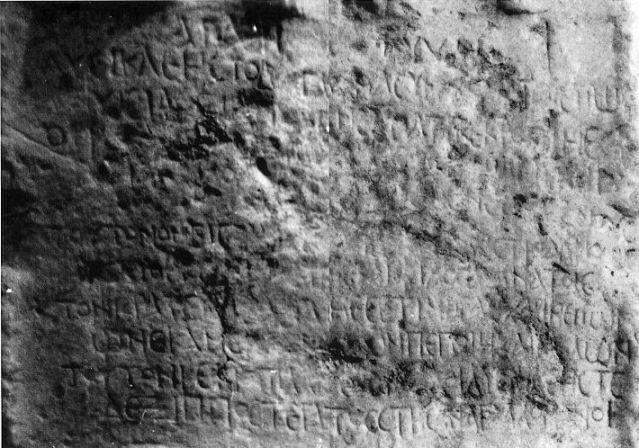
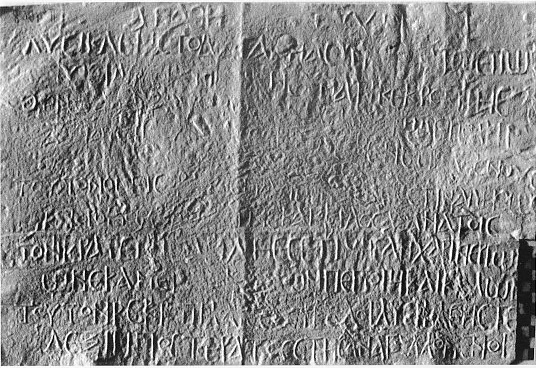
Inscription
Ἀγαθῇ τύχῃ.
Λυσικλέης τόδ’ ἄγαλμα σὺν Υ[...]ΑΙΑΤΟ πέτρῳ
υἱέϊ Δεξίππῳ νεύματι Κεκροπίης·
οὕνεκα [μυ]ρία καλὰ̣ ἐ̣πή̣σκ[ε]ε τῇδε πόληϊ
ἄξια καὶ δολιχοὺς [vac. παν]τ’ ἔμ̣εν ἔστε χρόνους.
(6) τοῦτον, ὅν εἰσοράᾳς παριών, ξένε, ἔστιν ἀληθῶς
Κέκροπος ἐ[κ γεν]ετῆς καὶ φίλος ἀθανάτοις.
τὸν κρατεροὶ βασιλῆες ἐτίμησαν χάριν ἔργων,
ὧν ἔκαμεν θ̣υ̣μ[ῷ vac.] ὧν πεποίηκαι καλῶν·
τοῦτον Κεκροπίδαι θεο̣είκελοι Λυσικλέης τε
Δέξιππός τ’ ἐρατὸς στῆσαν ἀγαλλόμενοι.
Inscription translation
To good fortune. Lysikles ... [set up] this statue in stone to his son Dexippus with the consent of Athens. Because he carried out so many good deeds for the city, that will all be worthy into the distant future. (6) The one that you see standing here, stranger, is truly an Athenian by descent and a friend of the immortals. The mighty emperors esteemed him because of his deeds, which he did with all his heart, and those he did were good. The godlike Athenians Lysikles and Dexippus the beloved set him up to glorify him.
Bibliography
- Inscriptiones Graecae, II/III(2) 13282
Discussion
INSCRIPTION
Verse inscription in five elegiac distichs laid out in ten lines, and an introductory formula, in all eleven lines:
Ἀγαθῇ τύχῃ.
Λυσικλέης τόδ’ ἄγαλμα σὺν Υ[...]ΑΙΑΤΟ πέτρῳ
υἱέϊ Δεξίππῳ νεύματι Κεκροπίης·
οὕνεκα [μυ]ρία καλὰ̣ ἐ̣πή̣σκ[ε]ε τῇδε πόληϊ
ἄξια καὶ δολιχοὺς [vac. παν]τ’ ἔμ̣εν ἔστε χρόνους.
(6) τοῦτον, ὅν εἰσοράᾳς παριών, ξένε, ἔστιν ἀληθῶς
Κέκροπος ἐ[κ γεν]ετῆς καὶ φίλος ἀθανάτοις.
τὸν κρατεροὶ βασιλῆες ἐτίμησαν χάριν ἔργων,
ὧν ἔκαμεν θ̣υ̣μ[ῷ vac.] ὧν πεποίηκαι καλῶν·
(10) τοῦτον Κεκροπίδαι θεο̣είκελοι Λυσικλέης τε
Δέξιππός τ’ ἐρατὸς στῆσαν ἀγαλλόμενοι.
'To good fortune. Lysikles ... [set up] this statue in stone to his son Dexippus with the consent of Athens. Because he carried out so many good deeds for the city, that will all be worthy into the distant future. (6) The one that you see standing here, stranger, is truly an Athenian by descent and a friend of the immortals. The mighty emperors esteemed him because of his deeds, which he did with all his heart, and those he did were good. The godlike Athenians Lysikles and Dexippus the beloved set him up to glorify him.'
Letter height 1-2.5 cm.
The inscription, after the introductory formula, consists of two epigrams, the first made up of two distichs (lines 2-5), the second of three distichs (lines 6-11).
DESCRIPTION (from Sironen 1997)
Fluted Doric column (20 flutes) of white marble (Pentelic, according to Sironen), broken at top, reused as a statue base: H 110, diameter 65 cm. A rectangular field together with a barely visible tabula ansata was leveled for the inscription. Height of leveled area 33 cm, width 48 cm (5 flutes). There is rectangular hole in the top face of the base (7 cm x 7 cm).
PROVENANCE AND CURRENT LOCATION
The inscription was found in the library of Hadrian before 1885; it is still in situ, about 20 m west of the eastern wall of the library.
HONORAND, AWARDER, AND DATE
The inscription names the honorand Dexippus and styles him son of Lysikles in the first epigram. Lysikles and a further Dexippus feature as awarders in the second epigram. A number of prominent Athenian Dexippi are known in the 3rd century, and into the early 4th (PLRE I 250, Dexippus I and Dexippus 2), and Traill 1996 therefore dates the base to the 3rd century. However, on the basis of the letter forms, E. Sironen dates the inscription to the late 4th or early 5th century (Sironen 1997, 80-1 with note 129), citing as another argument for a late date the 'typically Early Byzantine composition in 2 epigrams' (Sironen 1997, 80; on the two epigrams see above, 'Inscription'). From the period proposed by Sironen, neither a Dexippus nor a Lysikles are known so far.
Discussion references
- Jones, A. H. M. et al., The Prosopography of the Later Roman Empire. Vol. I 260-395, Cambridge et al. 1971 (1975)
- Sironen, E., The late Roman and early Byzantine inscriptions of Athens and Attica, Dissertation - University of Helsinki 1997, 78-81 no. 21
- Traill, J. S., Persons of Ancient Athens, Volume 5, D- to Dionysios, Toronto 1996, 70 no. 303760
Cite: Last Statues of Antiquity, LSA-141 (Ulrich Gehn).