
LSA-142
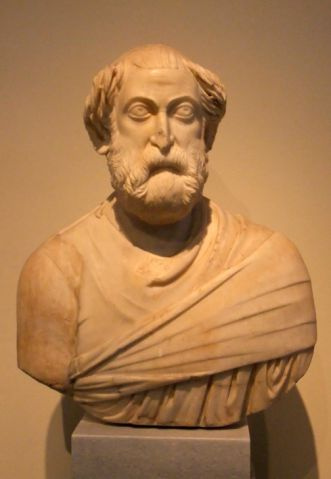
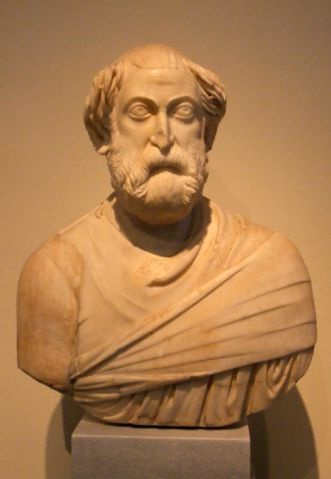
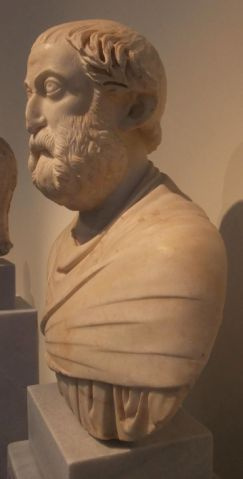
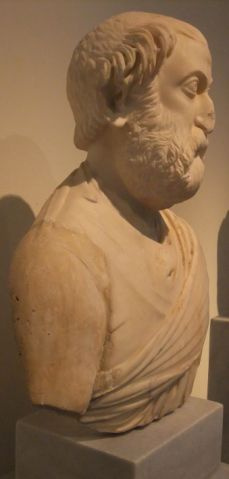
Bust of bearded man wearing toga. Athens (Achaea). Late fourth to earlier fifth century
Record details
Photographs
Bibliography
- Datsoule-Stavride, A., Hysteroromaika Portraita 2ou - 4ou m(eta) Ch(ristou) Aiona sto Ethniko Archaiologiko Mouseio Athenon, Archaiologike Ephemeris 1981, 127-38, Athens 1983, pp. 137-8 no. 423
- Kollwitz, J., Oströmische Plastik der theodosianischen Zeit, Berlin 1941, p. 91 no. 18 pl. 41
- Romiopoulou, K., Ellenoromaika Glypta tou Ethnikou Archaiologikou Mouseiou, Athens 1997, p. 132 no. 144
Discussion
DESCRIPTION (Object)
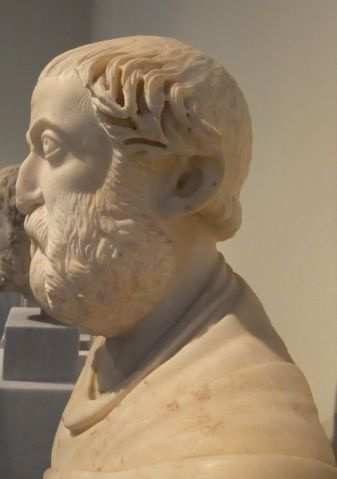
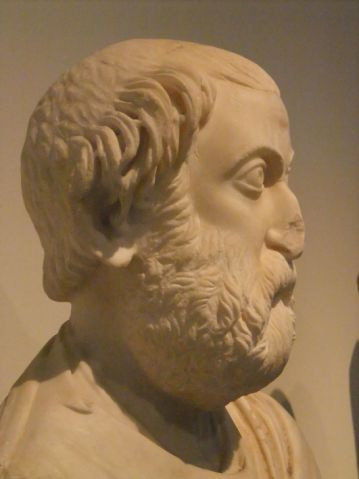
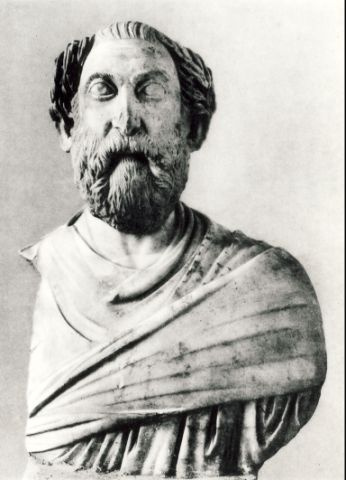
Bust of a bearded man wearing the late antique toga (see below, 'Description (Subject)'). Marble (Parian, according to Kollwitz 1941); H (overall) 56 cm, (head) 27.1 cm; W (head) 21.5 cm, (bust) 36 cm; D (head) 20.5 cm (all measurements from Datsoule-Stavride 1981, 137 n. 3). The right arm with the adjacent piece of shoulder is missing and today completed in plaster. Kollwitz 1941 pl. 41,1 displays the bust without this completion. The straight lines suggest a cutaway rather than a break. The foot of the bust is lost. The head is in an excellent state of preservation, only the tip of the nose and right nostril are slightly chipped.
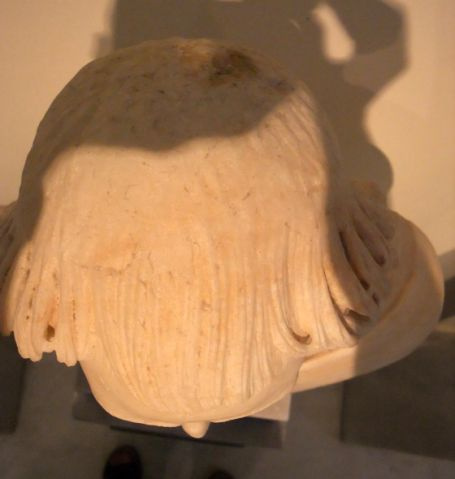
The lank hair is brushed foward into a 'wreath-hairstyle'. The wreath is voluminous over the temples, covering the upper part of the ears, whereas above the forehead the hair is too sparse to pile up; in the neck it forms a moderate coil. The hair falling into the forehead is brushed to the (proper) left side; the wreath at the left side is more voluminous than on the right. The scanty hair above the forehead is articulated by chisel-work; over the tempels deep long drill-lines separate the single strands which are subdivided again by chiselwork. The back of the head is just roughly finished. The beard is voluminous, lank around the mouth, screwed into curls at the jaws. This impression of different textures is achieved by chisel-work alone.
The eyes are wide-open, the raised eyebrows marked by parallel vertical chisel-strokes. The arch of the brows is repeated by the upper lid. The iris is circumscribed by an incised line, the shallow pupil crescent-shaped.
The mouth is covered by the thick moustache. The aquiline nose is straight and lean; at its root two horizontal lines are incised. The ears are large and protruding.
The cheek-bones are emphasized; the lower lid is set against the cheek by a marked ceasura, and deep folds run from the swelling nostrils downwards soon to be covered by the moustache. This creates the impression of few and short, but marked dark lines in an otherwise scarseley modelled surface. The forehead is slightly furrowed by two superficially incised horizontal lines.
PROVENANCE/ LOCATION
There is no published record of the provenance of the bust. Today it is in the National Archaeological Museum in Athens, inv. no. 423.
DESCRIPTION (Subject)
The bust portrays an elderly man, as indicated by the receding hair and the voluminous beard. The beard with its different textures, the hair with its asymmetric arrangement, the slender, aquiline nose and the large protruding ears delineate individual-looking features of the portrayed. The wide-open eyes and the swelling nostrils indicate attentive vigilance.
The portrayed wears the late antique toga with the balteus fanned out at the left shoulder. The right breast is covered by the upper tunic (colobium); at the right side of the neck the seam of a second tunic worn under the colobium is visible.
The voluminous beard associates our head with the long-bearded portrait-type of the 'Holy man' (LSA-1083). The 'wreath'-hairstyle, on the other hand, is displayed by high imperial office holders on monuments of the late 4th and 5th centuries, like the obelsik-base in Constantinople (390/2), city-gate sarcophagi, or honorific statues like the one for Oecumenius, governor (praeses) of Caria (LSA-150 (statue with head), LSA-151 (inscribed base)). A comparable combination of semantic contents is displayed by another portrait head in Athens (LSA-131).
The toga remains the dress of few high-ranking magistracies in the late-Roman state; moreover it is still the corporate dress of the ordo senatorius (Gehn 2012, 228-30). Only few magistracies were still entitled to recieve honorific statue-monuments in the 4th and 5th centuries. Epigraphic evidence in Athens and Greece testifies to the governor (proconsul) of Achaea (LSA-2, LSA-93, LSA-94, LSA-103, LSA-423, LSA-425 (just Athens)) and, by a lesser number of testimonies, to the praetorian prefect of Illyricum (LSA-1, LSA-55, LSA-137, LSA-138). It is a widely accepted hypothesis that the chlamydatus statues in Corinth represent proconsuls of Achaea (LSA-15, LSA-19, LSA-20, LSA-21, LSA-22, LSA-23, LSA-24, LSA-80). Moreover, it has been induced that the chlamys was the official dress the proconsul of Achaea was obliged to wear (Kollwitz 1941 [page]; Foss 1986 [page]) - this would exclude that office for the portrayed of our togate bust. Another explanation for the Corinthian evidence, still maintaining the hypothesis that the statues represent proconsuls of Achaea, is that the chlamydati represent a local tradition which does not exlude different representational patterns in other locales - the Corinthian evidence does not, in other words, necessarily exclude that the togate bust in Athens represents a governor of Achaea.
The official robe of the praetorian prefect, following literary and visual evidence, was the chlamys (Gehn 2012, 191-3.).
Senatorial rank in late antiquity was not necessarily connected with holding an office; Constantine's reform of the senate had elevated numerous local notables to senatorial rank who enjoyed a status of honorati of the highest rank but did not pursue a career in the imperial service (Chastagnol 1982, 172-3).
The togate bust doubtlessly represents a man of senatorial rank, possibly an office-holder or a former office holder, but possibly a local notable who did not hold imperial office.
DATE
Kollwitz 1941, 126 saw a loss of plastic values that dislodged the head from the art of the late 4th and beginning 5th centuries; with this style, wood-cut like in his view, religious fervour and fanatism were visualized in the portrait. By comparison with the consular diptych of Felix from 428 he came to a date around 430. With a similar psychological argument, Meischner 1991, 386 dated the portrait to 440/50; she compared it to the so-called 'Eutropius'-head from Ephesus in Vienna (LSA-690), a head which, in turn, again is only stylistically dated. Romiopoulou 1997 proposed a date of 350/60, without offering the reader any argument on that; she pointed out, however, the capability of the sculptor visible in the delineation of different textures of hair as well as in the capturing of individual features of the portrayed. She was followed in her dating by Kaltsas 2002.
The terminus post quem for our bust is provided by the typological features of the toga. The late antique toga appears on imperial statues from Aphrodisias datable to 388/92 (LSA-163,LSA-165). The statues display the balteus loosely draped over the breast. On the reliefs of the obelisk base (390/2) the toga shows a slight typological alteration, the balteus is now tautly wrapped around the breast and fanning out at the (proper) left shoulder. Our bust implies the development visible on the obelisk-base (Gehn 2012, 137-9).
Stylistically, we group our head together with the male portrait-bust from Thessaloniki (LSA-90) that was chosen as a prototype for the 'subtle style' of the ongoing 5th century by L'Orange 1961. Both heads emulate in the vivid characterisation of individual features combined with the staring rigidity of the eyes (Gehn 2012, 462-5 no. O 36).
The stylistic assessment of our head remains open to argument; we therefore integrate 'later' proposals into our outer dates. A terminus post quem of the 390s, however, is provided by the drapery of the late-antique toga displayed by our bust.
Discussion references
- Chastagnol, A., La carrière sénatoriale du Bas-Empire depuis Diocletien, Epigrafia e ordine senatorio, 1. Atti del Colloquio intenazionale AIEGL, Roma 14 - 20 maggio 1981, pp. 167-92, Roma 1982
- Kaltsas, N., Sculpture in the National Archaeological Museum, Athens, Athens 2002, p. 373 no. 798
- L'Orange, H. P., 'Der subtile Stil. Eine Kunstströmung aus der Zeit um 400 n. Chr.', Antike Kunst , 4 (1961) 68-75
- Meischner, J., 'Das Porträt der theodosianischen Epoche II (400 bis 460 n. Chr.),' , Jahrbuch des Deutschen Archäologischen Instituts, 106 (1991), 385-407
Cite: Last Statues of Antiquity, LSA-142 (Ulrich Gehn).