
LSA-1421
Base for statue of Decius Marius Venantius Basilius, consul and prefect of the City. Rome, Colosseum. 484.
Record details
Photographs
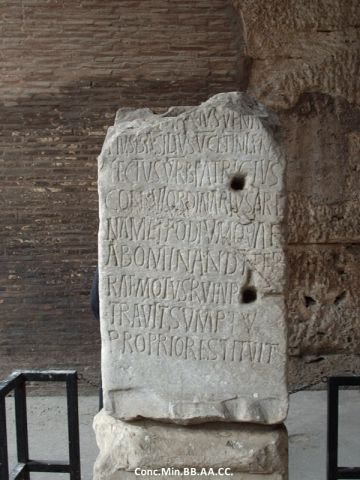
Inscription
[Decius] Marius Vena[n]/tius Basilius, v(ir) c(larissimus) et inl(ustris), pra[e]/fectus urb(i), patricius, / consul ordinarius, are/nam et podium quae /(6) abominandi ter/rae motus ruin(a) p[ros]/travit sumptu / proprio restituit.
Inscription translation
Decius Marius Venantius Basilius, of clarissimus and illustrious rank, prefect of the City, patrician, consul, restored with his own wealth the arena and podium which an abominable earthquake threw to the ground in ruin.
Bibliography
- Corpus Inscriptionum Latinarum; , VI, 1716c=32094c (+p. 4342)
- Orlandi, S., Roma. Anfiteatri e strutture annesse con una nuova edizione e commento delle iscrizioni del Colosseo. Epigrafia anfiteatrale dell’Occidente romano 6, Rome 2004, 51-56 n. 5
Discussion
INSCRIPTION
In nine lines. Letter height 5-7.5 cm.
[Decius] Marius Vena[n]/tius Basilius, v(ir) c(larissimus) et inl(ustris), pra[e]/fectus urb(i), patricius, / consul ordinarius, are/nam et podium quae /(6) abominandi ter/rae motus ruin(a) p[ros]/travit sumptu / proprio restituit.
Decius Marius Venantius Basilius, of clarissimus and illustrious rank, prefect of the City, patrician, consul, restored with his own wealth the arena and podium which an abominable earthquake threw to the ground in ruin.
The inscription records works carried out by Basilius in the Colosseum. Although it does not mention a statue explicitly, it was carved into a statue-base, and the genitive at the beginning of the inscription indicates the existence of one such honorific monument. In this case, the inscription would work like a caption, identifying the man represented on the statue, responsible for the works that made the Colosseum ready for use again.
DESCRIPTION (personal inspection)
Marble base, damaged at the top. 105 x 59.5 x 47.5 cm. There are no traces of moulding. The epigraphic field presents two round holes towards the right edge. There is an earlier dedication at the back, to the emperor Carinus (CIL VI, 1115). The base was turned upside down and re-used for our dedication.
PROVENANCE AND CURRENT LOCATION
Our inscription was found in the Colosseum. It is still there.
HONORAND, AWARDER AND DATE
Decius Marius Venantius Basilius was consul and prefect of the City in 484 (PLRE II, 218 Basilius 13; Orlandi 2004). The inscription does not mention an awarder, suggesting that the statue was set up by Basilius himself, in the place (or in addition to) of a normal building inscription.
Discussion references
- Martindale, J. R., The Prosopography of the Later Roman Empire. Vol. II A.D. 395-527, Cambridge 1980, p. 218 (Basilius 13)
Cite: Last Statues of Antiquity, LSA-1421 (Carlos Machado).