
LSA-143
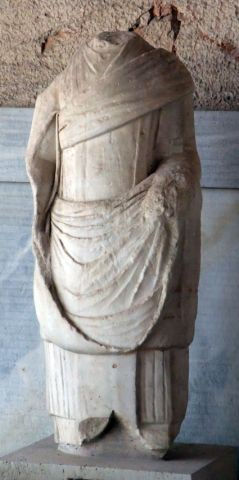
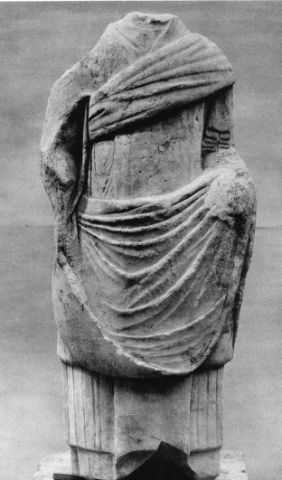
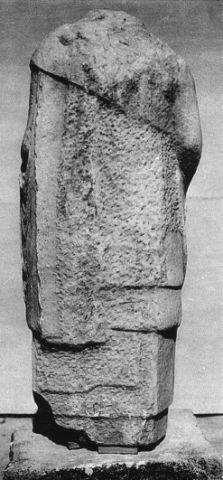
Headless statue of man wearing late-antique toga. Athens. Later fifth century
Record details
Photographs
Bibliography
- Gehn, U., Ehrenstatuen in der Spätantike. Chlamydati und Togati, Wiesbaden 2012, 465-9 cat. no. O 37
- Harrison, E. B., Portrait Sculpture: The Athenian Agora I, Princeton, N. J. 1953, pp. 79-80
- Kollwitz, J., Oströmische Plastik der theodosianischen Zeit, Berlin 1941, pp. 91-2, 112 no. 19
Discussion
DESCRIPTION (Object)
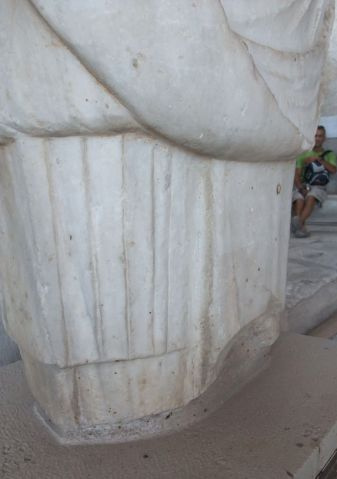
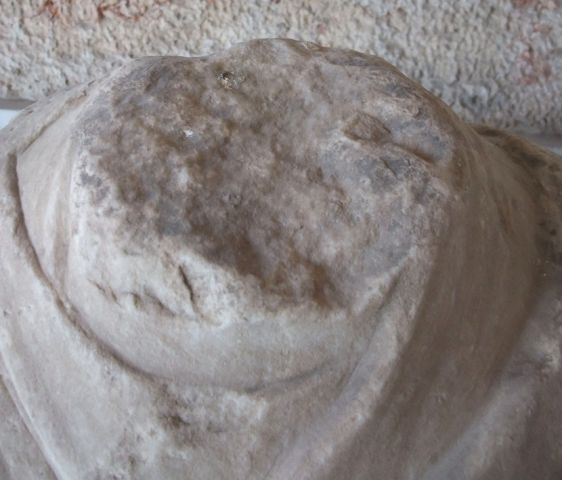
Torso of a togate statue, pentelic marble, H 133 cm, W 59.3 cm, D 36.3 cm. Head, both feet, right shoulder, part of the right forearm with adjacent garment, and left hand are missing. The neck is broken or worked back in a shallow concavity. The statue is notably 'rectangular' in form suggesting that it may have been carved from an architectural block The seam of the garment below the left hand is chipped; the surface slightly weathered. A large triangular piece of material is broken off at the lower rim of the front side.
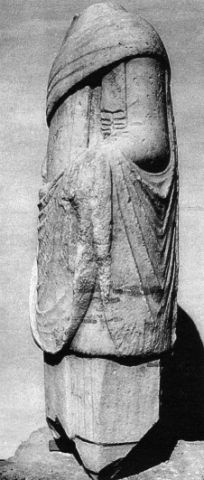
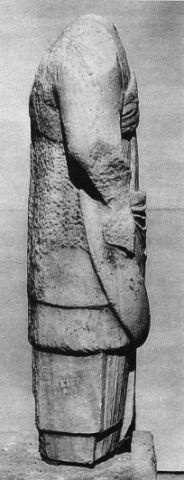
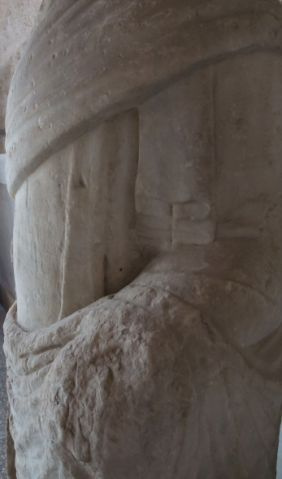
Only the front and left side of the statue are finished. The back is only roughly outlined, its surface finished with a point. At the right side the lower part of the statue, arm, shoulder and the 'sinus' unfolding to the front are finished; the flank behind the arm is left in the same rough state as the back. This suggests that it was set up in front of an angular wall where back and right side eluded the views.
The statue is of a bulky rectangularity; the folds are articulated in different qualities at different parts of the garment. They are rendered with some plastic volume and variability on the 'apron' that covers the lower body and on the balteus that crosses the breast. Under the 'apron', the folds of the colobium left and right of the lorum are shallowly incised vertical lines, whereas at the right side of the upper body between lorum, 'apron' and balteus they form a triangular pattern shallowly incised into the surface. The lorum is completely smooth; above the (proper) left upper arm the short sleeve of the colobium folds into a symmetrical ornament.
The build-up of the statue is made by simple geometrical forms, rectangles, parallelograms, or the trapez formed by the 'apron' in front of the lower body.
PROVENANCE/ LOCATION
The statue was excavated 1936 on the Agora, ca. seven m north of the northeast corner of the monumental North Court of the 'Palace of the Giants' (Harrison 1953, 79. In Harrison's terminology, the North Court is the 'Gymnasium'. On the 'Palace of the Giants' see Frantz 1988, 95-116, on the North Court pp. 99-102 (H. A. Thompson). Plan of the building Frantz 1988 pl. 54). It is today in Athens, Agora Museum inv. no. S 657, on display in front of the northern wall of the Stoa of Attalus.
DESCRIPTION (Subject)
The statue displays the late-antique toga costume, in an idiosyncratic manner, however, which is characterized by mannerisms and simplifications. As usual, the costume consists of a long and long-sleeved lower tunic (tunica manicata), a second, short-sleeved tunic (colobium) worn above the first one, the amictus (the toga proper) wrapped around the body, and of the lorum, a sash-like stripe worn between the toga proper and the colobium and hanging down in the middle of the body (Gehn 2012, 63-75); shoes are lost with the feet. The toga is wrapped around the body in the manner usual for the late-antique type, forming the balteus over the breast and the sinus-'apron' in front of the lower body, and with one of the two points of the toga draped over the left wrist (Gehn 2012, 43-4; 137-40). Late-antique toga statues are usually furnished with two attributes, a mappa worn in the right hand and a sceptre worn in the left (Gehn 2012, 141, 229-32). Wether our statue once carried these attributes is beyond saying, yet not excluded; repeatedly the mappa is held in the lowered right hand (our statue is chipped in that area), and the sceptre in the left hand is kept away from the body (LSA-198, LSA-698).
In some respects the drapery as displayed by our statue is deviant from what the viewer would expect from the other specimens of the type (Gehn 2012, 465-9 no. O 37). The balteus is loosely wrapped, whereas most togates of the type would have it tightly fastened and fanning out on the left shoulder. At the left side, where the point of the toga should hang down from the left wrist, the sculptor designed a second 'apron' in the back, visible when the statue is looked at from that side. This is the most evident of the mannerisms mentioned above; it is unique among our evidence, and it is not explicable from the way the late-antique toga was draped. Its purpose seems to be the creation of a formal correspondance between front and back when seen from the left side. Similarily the symmetric folds in front of the left upper arm serve a purely asthetic purpose when seen from the left. In the functional context of the costume, at this part of the body the short sleeve of the colobium is embraced and pressed together by the tightly wrapped balteus. The functional togetherness with the colobium is still comprehendible in the front view whereas in the view from the left side it is depicted as a purely ornamental element deprived of its functional purpose. The rounded edge running horizontally around the front side where the lower edge of the 'apron' is must be understood as a long pouch of the colobium drawn over the belt (interpreted in this sense already by Harrison 1953, 79). The colobium is drawn over a belt forming a pouch wich covers the belt in all cases of late-antique togate statues I am aware of; this is usually visible at the left side which is not covered by the amictus, and in the back (Gehn 2012, 140; 143-5). In no case, however, is the pouch so long and emphasized as in this case. The colobium is visible, as usual, at the lower body beneath the 'apron' to the left and right of the lorum, and at the upper body to the right of the lorum between balteus and apron', and on the right shoulder. It is marked with fold-patterns known from other depictions of the garment, but in a flattened and simplified manner (see above, 'Description (Object)'). The long-sleeved under-tunic (tunica manicata) is without any folds, neither at its seam nor at the arms; usually, the under-garment is articulated in both areas. Conspicuous is the lorum which lies as a broad smooth bend over the middle of the body; this again is an idiosyncratic manner of displaying that component of the costume. It contrasts a widespread convention to articulate the lorum as a sleeve-shaped cloth; it is not, however, throughoutly unparalleled (LSA-1039, togatus in Izmir from Ephesus). The components of the costume, doubled in the view from the left side (which obviously was displayed to the viewer, see above, 'Description (Object)')) are barely outsketched at the right side and in the back. This again deviates from the practice of most statues of this type, where the back is less elaborate, yet basically consistent with the front side. Additional seamlines visible at the right side and in the back do not betoken additional components of the garment.
DATE
The clumsy, stiff rectangularity and the schematic treatment of the folds led scholars to assign our statue a date late in the 5th century (Kollwitz 1941, 112; Harrison 1953, 80). Kollwitz quoted for an approximate date in the 2nd half of the 5th century the diptych of Boethius (Consul 487, Delbrueck 1929 no. 7) where he saw the same stiffness and ornamentalization of details. Harrison 1953, 80 adopted Kollwitz' date and comparisons, extending the case with further arguments. Seeing our statue associated with a building that was seen as a gymnasium at her time, she proposed a terminus ante quem of 529, the year when the schools of Athens were closed by Justinian; a rough terminus post quem, so she believed, was provided by the inscription IG II/III 13275 to Sextus Petronius Probus referring to a bronze statue (LSA-1). Harrison believed that this inscription was 'set up ca. A.D. 440' and 'suggests a certain degree of prosperity in Athens at this time. Our torso, at the other hand, reflects poverty and failing technique' (quotation Harrison 1953, 80).
Harrison's attempt to add non-stylistic evidence to support the dating of our statue is no longer tenable in the light of recent research. The exact function of the 'Palace of the Giants' remains unclear, but it is agreed that it was, if outstandingly large and sumptuous, a late-antique house. H. A. Thompson suggested that it was 'an official residence, maintained by the Imperial government and intended for the occasional accomodation either of the emperor himself or of high-ranking imperial offcials when on tour of duty' (Thompson in Frantz 1988, 111). According to Fowden 1990 it was the town house of the empress Eudocia, an Athenian by birth. The findspot of our torso, moreover, does suggest its belonging to the 'Palace of the Giants', which, however, is all but secured. The inscription referred to by Harrison for a terminus post quem of 440 is, in our view, from the late 4th century (LSA-1).
The dating of the torso still must depend on stylistic and typological considerations. In our view, its 'formulaic stiffness' (as Harrison put it) still pledges us to recognize in it 'probably the latest Athenian statue preserved from antiquity' (Harrison 1953, 80). From Athens, if only in the form of a bust, another late-antique togate is preserved (LSA-142). The bust displays the balteus, one of the main features of the late-antique toga costume, in the same manner as most of the statues known from Asia minor and from Rome. The portrait bust dates to the late 4th/ early 5th century; the stylistic difference to our statue is eye-catching.
The mannered and partly mislead representation of the costume by our torso can not be explained as an aesthetic choice contemporary with the bust LSA-142; the statue is considerably later. A date in the late 5th century for our torso still seems tenable to us, both art-historically and historically (detailed discussion Gehn 2012, 465-9 no. O 37).
Discussion references
- Delbrueck, R., Die Consulardiptychen und verwandte Denkmäler, Berlin & Leipzig 1929
- Fowden, G., The Athenian Agora and the Progress of Christianity, Journal of Roman Archaeology 3, 1990, 494–501
- Frantz, A., Late Antiquity A. D. 267 - 700: The Athenian Agora XXIV, Princeton 1988
Cite: Last Statues of Antiquity, LSA-143 (Ulrich Gehn).