
LSA-144
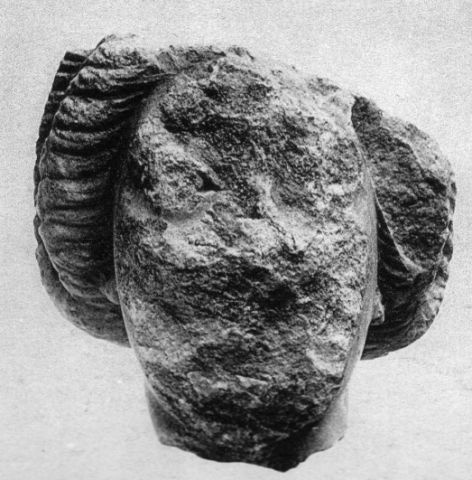
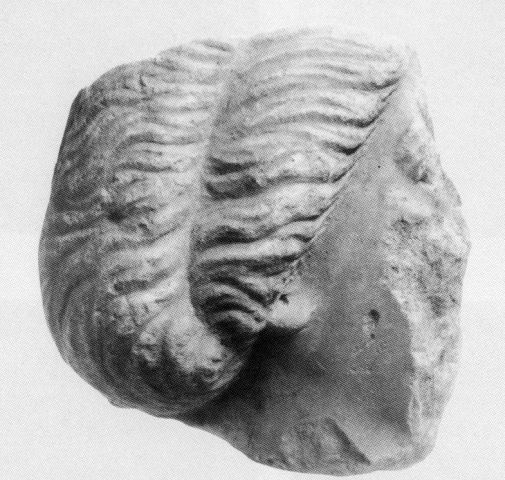
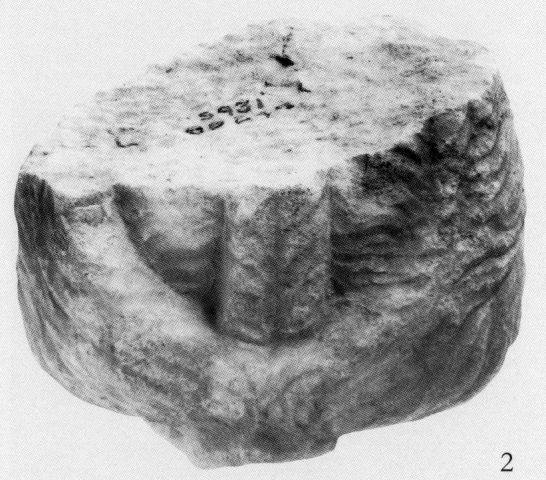
Fragmentary portrait head of woman. Athens. Mid to late fourth century
Record details
Photographs
Bibliography
- Harrison, E. B., Portrait Sculpture: The Athenian Agora I, Princeton, N. J. 1953, p. 71 no. 55 pl. 35
- Schade, K., Frauen in der Spätantike--Status und Repräsentation, Mainz 2003, 178 no. I 14 pl. 31, 1-3
Discussion
DESCRIPTION (Object)
Fragment of a portrait head of a woman, neck broken below the chin. Pentelic marble, H 19.5 cm, W 22 cm. The top of the head is broken or worked back in a diagonal slice sloping from the (proper) right to the left side. The whole face is battered off, leaving only the right eye and temple partly recognizable. The surface of the cheeks and a part of the jawline is preserved in the side views. The extant hair is intact except for a large chip at the left temple. A knob below the encircling braid in the centre of the backside is probably a support rather than a part of the coiffure (Harrison 1953, 71; Schade 2003, 178).
The hair is worked out on all sides; single strands are articulated by as wavy lines by a flat chisel, deeper incised around the face, very shallowly at the back, and at an intermediate grade at the sides.
The eyes, as far as recognizable, were wide open and overarched by raised eyebrows. A bulge below the right eye indicates a lacrimal sac.
The face is of a regular oval; there are drill holes in the earlobes. The carnate is smoothly polished. Schade 2003, 178 observes that the head was slightly turned to the right.
PROVENANCE/ LOCATION
The head was excavated 1937 in a modern wall east of the 'Valerian Wall' ('Post-Herulian Wall') in the Eleusinion area at the northern slope of the Acropolis (Harrison 1953, 71; Eleusinion: Travlos 1971, 198-203). It is today in Athens, Agora Museum, inv. no. S. 931.
DESCRIPTION (Subject)
The portrait depicts a woman with voluminous hair twisted into a circular puff around the face and drawn back from the face towards the ears and the back; the ears are covered save the earlobes. In the back, the hair has been combined into a bun wich superimposes the first layer of hair at the sides and on the skull. This arrangement follows, as already Harrison 1953, 71 pointed out, the fashion of the encircling braids, although the encircling mass of hair appears to be not braided on our head. At the backside, a narrow bipartited braid runs up the skull from the centre of the 'encircling bun' thus adding an element of the 'central-braid' hairstyle to the arrangement of the hair.
From the extant modellings around the right eye the portrayed will have been of mature age. The drill holes in the earlobes indicate that she was wearing jewellery.
Schade 2003, 102-3 argues that the encircling-braids hairstyle was was a visual representation of the female associated with virtues like piety and chastity; the voluminous hair, moreover, signals matronal dignity, and the elaborate arrangement points out the social statues of the portrayed. The jewellery worn by the portrayed underlines her elite status and economic potency as well as it stresses her female beauty and raises her representative appearance.
DATE
The 'encircling-braid' hairstyle is first testified to by coin portraits of Galeria Valeria from 308 (Schade 2003, 26 with n. 187); it was, with a wide range of variability, in fashion throughout the 4th century (Schade 2003, 96-7). Harrison 1953, 71 saw the 'slender proportions' and the 'stylized symmetry' of our head as an indicator for a date in the late 4th century. Schade 2003, 178 proposed a date in the 2nd third of the 4th century. Following both scholars, we adopt a date in the mid to late 4th century.
Discussion references
- Travlos, J., Bildlexikon zur Topographie des antiken Athen, Tübingen 1971
Cite: Last Statues of Antiquity, LSA-144 (Ulrich Gehn).