
LSA-1447
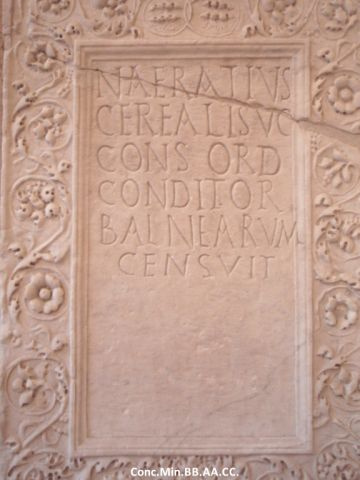
Base for statue (subject unstated), re-erected by Naeratius Cerealis, consul. Rome. 358.
Record details
Photographs
Inscription
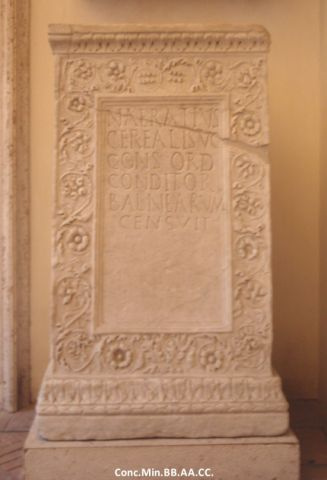
Naeratius / Cerealis, v(ir) c(larissimus), / cons(ul) ord(inarius), / conditor /(5) balnearum, / censuit.
Inscription translation
Naeratius Cerealis, of clarissimus rank, consul, founder of the baths, ordered (this).
Bibliography
- Corpus Inscriptionum Latinarum; , VI, 1744a=31916c (+p. 4749-50)
Discussion
INSCRIPTION
In six lines. Letter height 5.5-3 cm.
Naeratius / Cerealis, v(ir) c(larissimus), / cons(ul) ord(inarius), / conditor /(5) balnearum, / censuit.
'Naeratius Cerealis, of clarissimus rank, consul, founder of the baths, ordered (this).'
DESCRIPTION (personal inspection)
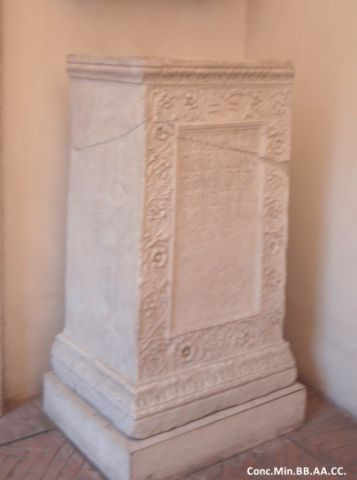
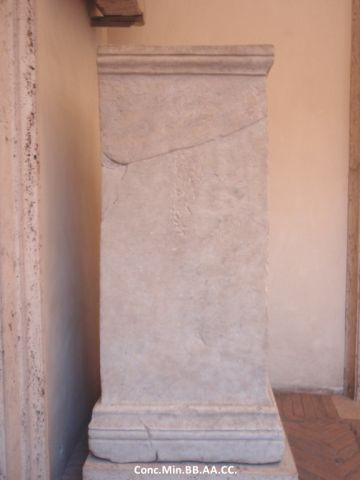
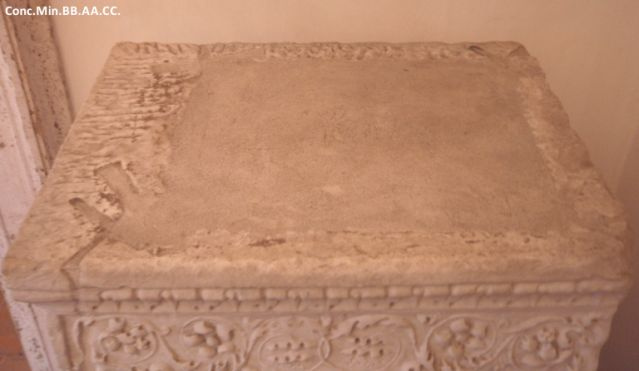
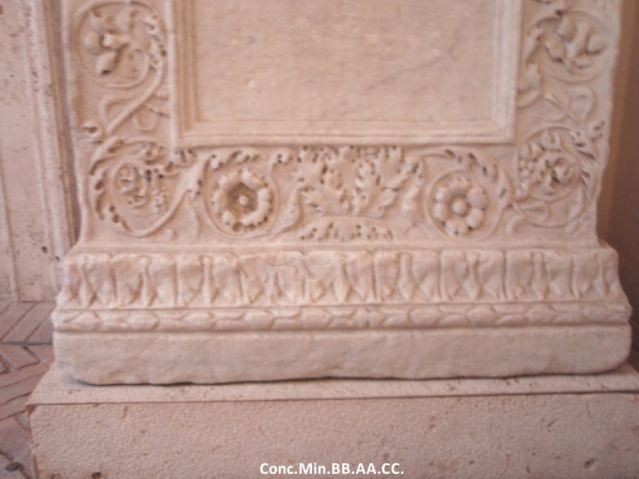
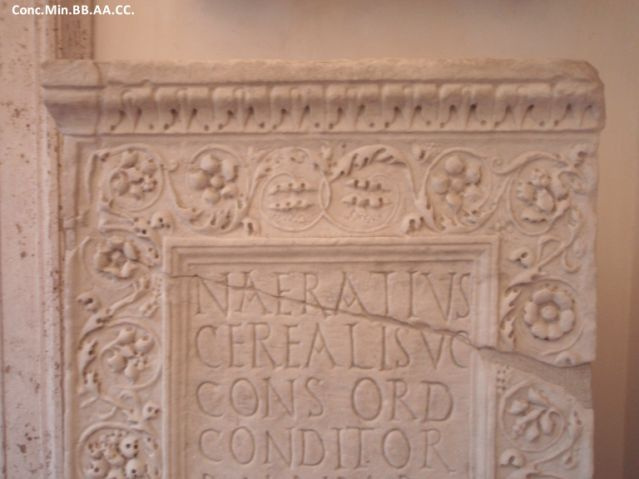
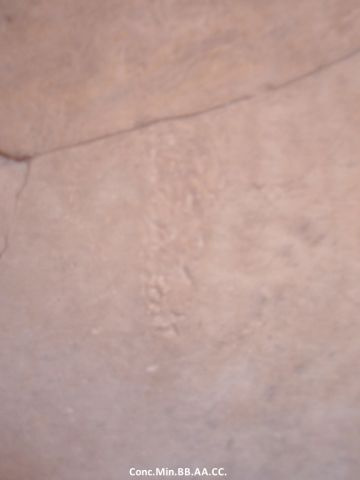
White marble base, 124.5 x 76 x 57 cm. The base was broken into three pieces and it was later reassembled with cement. It has mouldings on top and bottom on three sides. The front is framed by a band of leaves scrolls and flowers. The epigraphic field is smooth, with no clear sign of re-use. The inscription is regular but the fifth lines runs over the moulded frame (last letter only). The right and left sides are smooth. The left side has clear marks of work with point chisel on central-upper part, as if decoration had been erased (but this is unclear). The top is only partially preserved, covered in most part with cement.
PROVENANCE AND LOCATION
Our base was first recorded as in the Villa Celimontana, on the Caelian hill, towards the Aurelian walls. Its original location is probably the vicinity of the church of Santa Maria Maggiore, where other bases set up by the same Cerealis were found. The Liber Pontificalis (46.3) mentions a domus Palmati in the fifth century life of bishop Xystus III (Ed. Duchesne, p. 233), equipped with a bakery and baths. It probably referred to a domestic building with an adjoining thermal complex open to the public, donated to the church by Naeratius Palmatus, son of Cerealis. The house and the baths of Naeratius Cerealis were excavated in the 1870s, on the corner of the modern Via Farini and Via Cavour, together with another base celebrating Cerealis (Lanciani 2000, 374; Lanciani 1988, 45-46; see LSA-1455 for the base), confirming the provenance of this series of bases (see also Lanciani 1990, pl. 17).
The base is now in the Museo Nazionale Romano at Palazzo Altemps, in the ground floor courtyard.
HONORAND, AWARDER AND DATE
The dedication celebrates Naeratius Cerealis, founder of baths in the year of his consulship (358). Cerealis was a member of a powerful family, prefect of the city in 352-3 and consul in 358 (PLRE I, 197-199 Cerealis 2; Chastagnol 1962, 135-139). Cerealis had strong connections in the court, and his wealth was famous in Rome. The foundation of a lavishly decorated bathing complex in Rome, next to his house, was a remarkable demonstration of his prestige and wealth.
Cerealis was also responsible for the setting up of LSA-790, LSA-1446, LSA-1448, LSA-1449, LSA-1450, LSA-1451, LSA-1452, LSA-1453 and LSA-1454. Although not all of these were found in situ, they certainly came from the same baths founded by our awarder.
Discussion references
- Chastagnol, A., Les fastes de la Préfecture de Rome au Bas-Empire, Paris 1962
- Jones, A. H. M. et al., The Prosopography of the Later Roman Empire. Vol. I 260-395, Cambridge et al. 1971 (1975), pp. 197-199 (Cerealis 2)
- Lanciani, R., Forma Urbis Romae, Rome 1990, pl. 17
- Lanciani, R., Notes from Rome, London 1988
- Lanciani, R., Storia degli scavi di Roma e notizie intorno le collezioni romane di antichità, vol. 6 (1700-1878), Rome 2000
Cite: Last Statues of Antiquity, LSA-1447 (Carlos Machado).