
LSA-1461
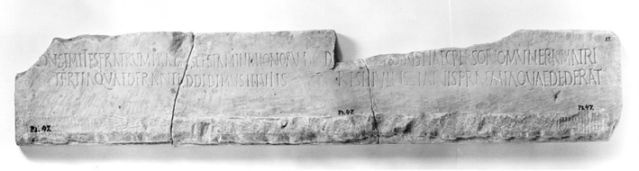
Fragmentary plaque from base for statue of Anicia Faltonia Proba, 'wife, daughter and mother of consuls'; erected by two of her sons. From Rome. 395.
Record details
Photographs
Inscription
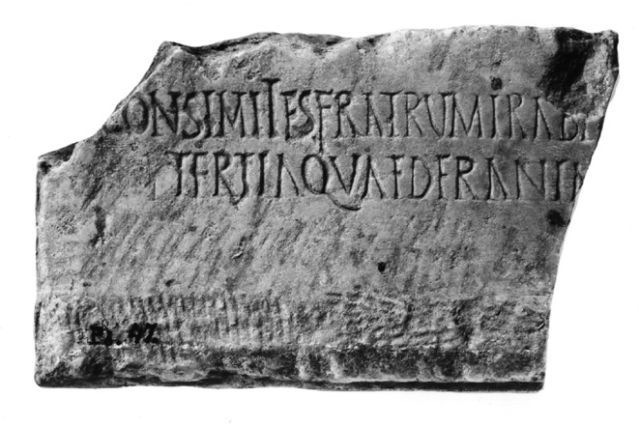
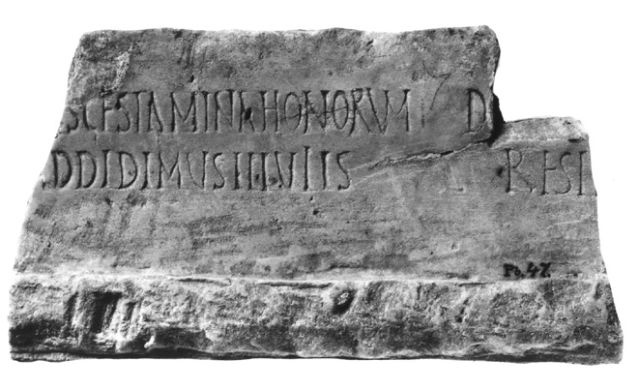
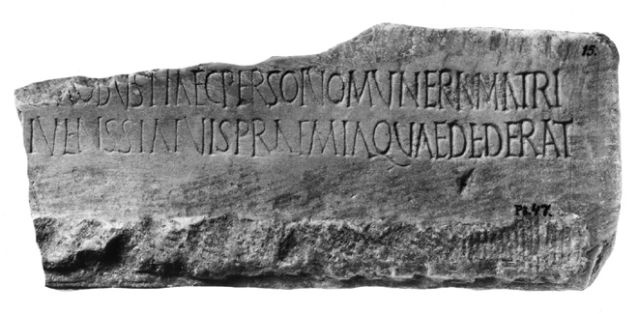
Consimiles fratrum trabeis gestamina honorum / tertia quae derant (sic for ‘gerant’) addidimus titulis, / dilectae Probus haec persolvo munera matri, / restituens statuis praemia quae dederat. // Aniciae Faltoniae / Probae, Amnios, Pincios /(5) Aniciosque decoranti, / consulis uxori, / consulis filiae, / consulum matri. / Anicius Probinus, v(ir) c(larissimus), /(10) consul ordinarius, / et Anicius Probus, v(ir) c(larissimus), / quaestor candidatus, / filii devincti / maternis meritis /(15) dedicarunt.
Inscription translation
Something similar to the consular robes of us brothers, the cloaks of honour, the third which they held, we present with this inscription; I, Probus, fulfil these duties towards my beloved mother, repaying with statues the gifts that she had given.
To Anicia Faltonia Proba, an adornment of the Amnii, the Pincii and the Anicii, wife of a consul, daughter of a consul, mother of consuls. Anicius Probinus, of clarissimus rank, consul, and Anicius Probus, of clarissimus rank, quaestor (quaestor candidatus), sons overwhelmed by their mothers merits, dedicated [this].
Bibliography
- Corpus Inscriptionum Latinarum; , VI, 1754 (+p. 4752)
Discussion
INSCRIPTION
In 15 lines.
Consimiles fratrum trabeis gestamina honorum / tertia quae derant (sic for ‘gerant’) addidimus titulis, / dilectae Probus haec persolvo munera matri, / restituens statuis praemia quae dederat. // Aniciae Faltoniae / Probae, Amnios, Pincios /(5) Aniciosque decoranti, / consulis uxori, / consulis filiae, / consulum matri. / Anicius Probinus, v(ir) c(larissimus), /(10) consul ordinarius, / et Anicius Probus, v(ir) c(larissimus), / quaestor candidatus, / filii devincti / maternis meritis /(15) dedicarunt.
'Something similar to the consular robes of us brothers, the cloaks of honour, the third which they held, we present with this inscription; I, Probus, fulfil these duties towards my beloved mother, repaying with statues the gifts that she had given.
To Anicia Faltonia Proba, an adornment of the Amnii, the Pincii and the Anicii, wife of a consul, daughter of a consul, mother of consuls. Anicius Probinus, of clarissimus rank, consul, and Anicius Probus, of clarissimus rank, quaestor (quaestor candidatus), sons overwhelmed by their mothers merits, dedicated [this].'
The first four lines are in verse, two elegiac distichs, with each line of inscription corresponding to a line of verse. These are clearly set apart from the dedicatory inscription, and inscribed side by side. The verses are different from the rest of the inscription not only in style and lay-out, but also in date, having been carved when Anicius Probus was made consul in 406 (see below).
DESCRIPTION
Front of marble base, 15 x 79.3 cm. Only the upper part survives. It is damaged on the left and in the middle.
PROVENANCE AND CURRENT LOCATION
The provenance of our base is uncertain. It was first recorded as part of the collection of Cardinal Cesi, near the basilica of S. Peter. A number of dedications to Probus and his wife Proba were part of the cardinal's collection, all of them dedicated by their children. The familial character of these dedications (see below) indicates that they must have come from a family domus or monument, possibly even from the family's mausoleum in that area (Machado 2011, 511-512).
The surviving part is now in Leiden, Ryksmuseum van Oudheden (inv. Pb 47).
HONORAND, AWARDER AND DATE
Anicia Faltonia Proba was wife of Sextus Petronius Probus (PLRE I, 736-740 Probus 5) and descendant of a distinguished family (PLRE I, 732-733 Proba 3). Our base was dedicated by her sons, Anicius Probus (PLRE II, 913-914 Probus 11) and Anicius Probinus (PLRE I, 734-735 Probinus 1), when the latter was consul in 395. The base was 're-dedicated' in 406, when Anicius Probus was made consul and the verse inscription was added to the monument. This dedication was part of a series of dedications carried out by members of the family in name of Probus and Proba on that year: LSA-1459, LSA-1460, LSA-1462 and LSA-1463.
Discussion references
- Jones, A. H. M. et al., The Prosopography of the Later Roman Empire. Vol. I 260-395, Cambridge et al. 1971 (1975), pp. 732-733 (Proba 3), 734-735 (Probinus 1) and 736-740 (Probus 5)
- Machado, C., "Roman Aristocrats and the Christianization of Rome", in P. Brown and R. Lizzi Testa (edd), Pagans and Christians in the Roman Empire: the Breaking of a Dialogue (Christianity and History, vol. 9), Berlin 2011, pp. 493-516
- Martindale, J. R., The Prosopography of the Later Roman Empire. Vol. II A.D. 395-527, Cambridge 1980, pp. 913-914 (Probus 11)
Cite: Last Statues of Antiquity, LSA-1461 (Carlos Machado and Ulrich Gehn).