
LSA-1478
Base for statue of unknown aristocratic honorand, patron and benefactor of the city of Saena. Rome. 394.
Record details
Photographs
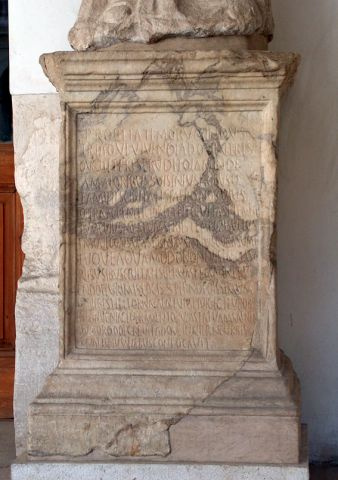
Inscription
------ / probitate morum, indus/triaque vivendi adque utris/que litteris erudito, iam inde / a maioribus suis inlustribusq(ue) /(5) familiis civitatis patrono, cuius / opera ac beneficio recepit civitas elemen/tum, cuius meatum series temporis vetus/tasque consumserat; nam, eius cura sump/tuque, aqua modo non diist (sic, for ‘deest’) necessa/riis usibus civitatis, berum (sic, for ‘verum’) etiam in eru/endo plurimis iocis (sic, for ‘locis’) splendidissimum /(12) urbi pr(a)estitit ornamentum. Huic igitur, ob / haec insignia genera meritorum, statuam Saenen/sium ordo decrevit, adque in aeterne urbis /(15) privatis eius aedebus (sic, for‘aedibus’) conlocavit. // (on the side) Dedic(ata) Id(ib)us Aug(ustis) dd(ominis) nn(ostris) / Arcadio III et Honorio II / Augg(ustis) conss(ulibus).
Inscription translation
...by the goodness of his ways, his hardworking life, and his erudition in both languages, (is) already, through his forefathers and his most shining lineages, patron of the city. By his deeds and benefaction, the city received the element whose path the passage of time and age had consumed; for through his toil and expense, water is not only no longer lacking for the necessary uses of the city, but also,by excavation in a number of places, (now) provides a shining ornament for the town. To him, therefore, for these outstanding examples of merit, the council (ordo) of Saena decreed a statue and set it up in his private house in the Eternal City. Dedicated on the Ides of August in the consulship of our lords Augusti Arcadius for the third time and Honorius for the second time. (Transl. U. Gehn)
Bibliography
- Corpus Inscriptionum Latinarum; , VI, 1793 (+p. 4763)
Discussion
INSCRIPTION
In 15 lines, with three extra lines for the dating inscription on the side. Letter height 4.5-2.5 cm.
------ / probitate morum, indus/triaque vivendi adque utris/que litteris erudito, iam inde / a maioribus suis inlustribusq(ue) /(5) familiis civitatis patrono, cuius / opera ac beneficio recepit civitas elemen/tum, cuius meatum series temporis vetus/tasque consumserat; nam, eius cura sump/tuque, aqua modo non diist (sic, for ‘deest’) necessa/riis usibus civitatis, berum (sic, for ‘verum’) etiam in eru/endo plurimis iocis (sic, for ‘locis’) splendidissimum /(12) urbi pr(a)estitit ornamentum. Huic igitur, ob / haec insignia genera meritorum, statuam Saenen/sium ordo decrevit, adque in aeterne urbis /(15) privatis eius aedebus (sic, for‘aedibus’) conlocavit. // (on the side) Dedic(ata) Id(ib)us Aug(ustis) dd(ominis) nn(ostris) / Arcadio III et Honorio II / Augg(ustis) conss(ulibus).
'...by the goodness of his ways, his hardworking life, and his erudition in both languages, (is) already, through his forefathers and his most shining lineages, patron of the city. By his deeds and benefaction, the city received the element whose path the passage of time and age had consumed; for through his toil and expense, water is not only no longer lacking for the necessary uses of the city, but also,by excavation in a number of places, (now) provides a shining ornament for the town. To him, therefore, for these outstanding examples of merit, the council (ordo) of Saena decreed a statue and set it up in his private house in the Eternal City. (on the side) Dedicated on the Ides of August in the consulship of our lords Augusti Arcadius for the third time and Honorius for the second time.' (Transl. U. Gehn)
Although the base is well preserved, the opening of the inscription does not survive. Alföldy (in CIL VI, p. 4763) suggests that it was carved into the plinth of the statue. The inscription presentes a few mistakes, which were not recorded in CIL VI, 1793. In ll. 4-5, the reference to the 'families', in the plural, probably includes both the paternal and maternal lines. The letters of the inscription were painted (CIL VI, p. 4763).
DESCRIPTION (CIL)
Marble base, 113 x 75 x 50 cm. The lower right corner is missing, and it was replaced. The base has mouldings on top and bottom. The epigraphic field measures 67 x 53. It is framed by moulding. Its surface is rough, suggesting the erasure of an earlier inscription.
PROVENANCE AND CURRENT LOCATION
The base was found in the basilica of S. Paolo fuori le mura. It was certainly out of context. As the dedication informs us, it was originally set up in the domus of the honorand. The base is now in the Villa Celimontana, in the gardens of Istituto della Società Geografica Italiana.
HONORAND, AWARDER AND DATE
The identity of the honorand is unknown. The opening dedication of our monument was in a different piece, possibly the plinth of a statue (see above). The statue was set up by the ordo of the people of Saena, probably modern-day Siena (and not Senigallia, as suggested in CIL VI, p. 4763). The statue was dedicated on the 13th of August 394 (inscription).
Cite: Last Statues of Antiquity, LSA-1478 (Carlos Machado).