
LSA-149
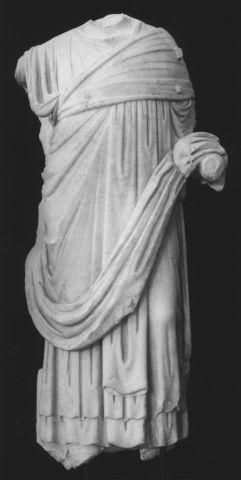
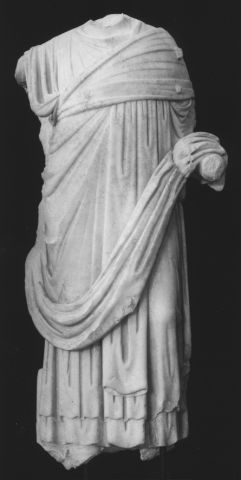
Headless togate statue. Aphrodisias (Caria). Fifth century
Record details
Photographs
Discussion
DESCRIPTION (Object)
Life-size statue. H: 123, W: 50, D: 48 cm. Medium to fine-grained white marble.
The statue is preserved from the shins to the base of the neck. Missing are: the head, the right arm from the biceps down, the left wrist and hand, the ankles, the feet, most of the statue support in the form of scrolls, and the plinth.
The statue was made in one piece from the plinth to the head. There are two struts in the area of the left chest and shoulder for the attachment of an attribute (presumably a sceptre). A further strut on the left side at the height of the left thigh originally attached drapery to the body.
The front of the statue is highly polished, and the carefully executed folds are schematic in pattern. The back surface has not been fully finished, although the dress details are fully represented. The right side is less finished than the left side, suggesting that it was less visible to the viewer.
PROVENANCE
Found in the Bouleuterion in 1964. It was excavated in East Chamber 6, the south easternmost chamber, beneath the seating of the Bouleuterion.
DESCRIPTION (Subject)
The statue wears a late antique toga, over a short-sleeved tunic (colobium) which reaches to the mid-shins, and which in its turn covers a long-sleeved under-tunic. The hem of the long-sleeved tunic is visible beneath the hem of the colobium. Another garment, the lorum, appears as a vertical band between the legs at the front of the statue and in a vertical loop behind the left shoulder. The upper bands of senatorial footwear are still visible beneath the hem of the toga. The sinus of the toga hangs along the right side of the body until the knee and is then draped over the left arm.
The figure probably stood with its weight over the right leg. A bundle of upright scrolls, the upper edge of which is preserved, once supported the statue at the right leg. The right arm, no longer preserved, was raised, and would certainly have held a mappa in the hand. The left arm projects forward. Struts on the chest show that a sceptre was held in the left hand.
CONTEXT
The find location suggests that the statue was deliberately stored. It was perhaps originally displayed nearby in the North Agora.
DATE
The statue closely resembles in dress and style two other late fifth century statues from Aphrodisias, Pytheas (LSA-147 and LSA-148) and Flavius Palmatus (LSA-198 and LSA-199)
Cite: Last Statues of Antiquity, LSA-149 (J. Lenaghan).