
LSA-15
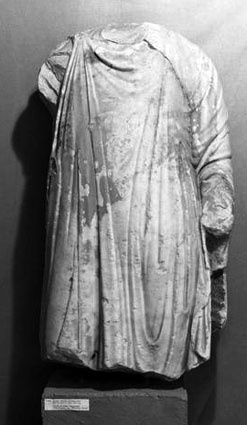
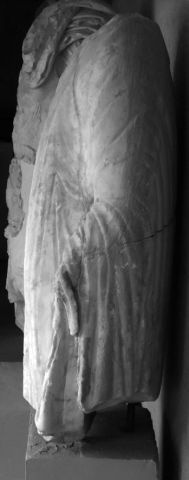
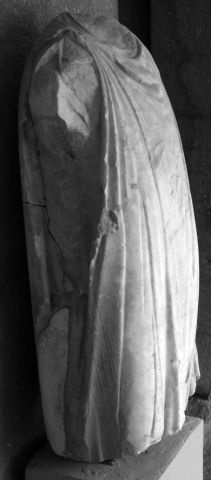
Torso of male statue, wearing chlamys. Corinth (Achaea). Late fourth to early fifth century
Record details
Photographs
Bibliography
- Brown, A., Last Men Standing: Chlamydatus Portraits and Public Life in Late Corinth, Hesperia 81, 141-76, 2012, 148 figs. 8. 9
- Gehn, U., Ehrenstatuen in der Spätantike. Chlamydati und Togati, Wiesbaden 2012, 470-3 cat. no. O 39
- Sturgeon, M. C., Sculpture: The Assemblage from the Theatre: Corinth IX, 3, Princeton 2004, 163 - 165 no. 54 pl. 55 e, f
Discussion
PROVENANCE
Found 11 May 1908, in the upper SW cavea of the theatre. First published by Johnson 1924.
CURRENT LOCATION
Corinth Museum Cloister inv. no. S-903.
DESCRIPTION (Object)
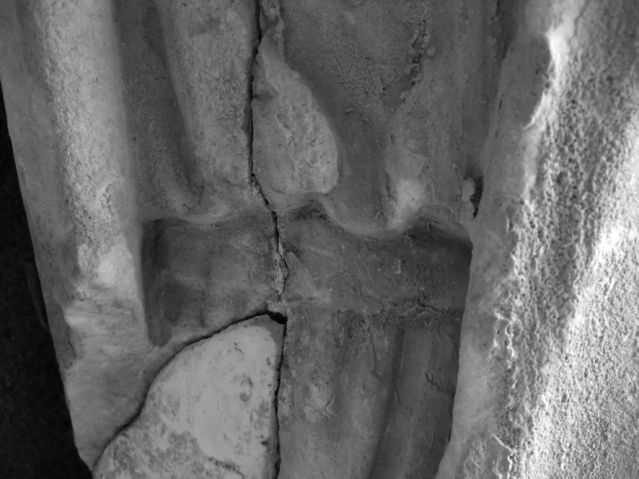
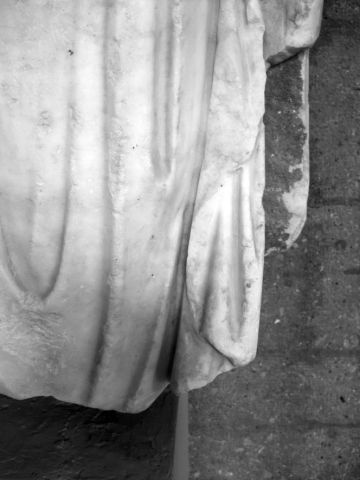
Male torso, just over life-size. White marble, fine to medium grained (Sturgeon 2004). Made up of four conjoining pieces. Head, left forearm, right arm, and lower body below knees missing. All sides including the back are finished. Pick marks show that the statue was later trimmed for reuse as a building block. The surface is chipped and worn, with heavy encrustation on all sides.
DESCRIPTION (Subject)
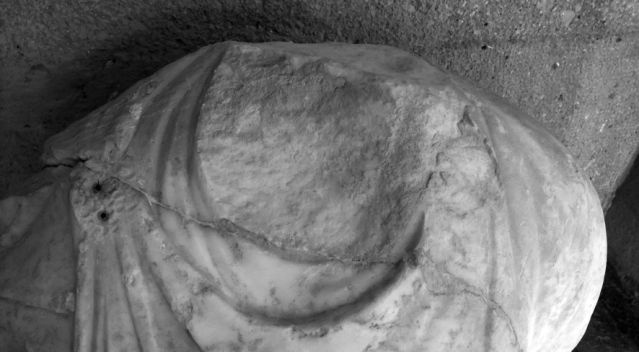
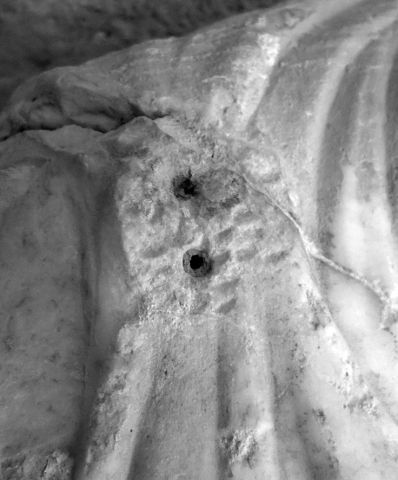
Dressed in a chlamys pinned on the right shoulder with a separately worked (metal ?) crossbow fibula, now lost (visible are the round base for this, prepared with a flat chisel, and two small dowel holes). The tunic worn under the chlamys is visible at neck and on right side; a wide belt (cingulum) is visible, where not covered by the tunic, on the right side. No attributes are preserved.
The weight is on the left leg; the right leg is to the side and forward. The left arm is wrapped in the chlamys and slightly bent; the right arm probably once projected forward from the torso, supported there by a marble strut (for this gesture cf. 'Patricius Novara' Delbrueck N 64).
DATE
Sturgeon 2003 dated the statue to the mid-4th century on the assumption that the theatre was destroyed and went out of use by earthquakes in 365 and/ or 375 (Sturgeon 2003, pp. 164, 166).
Stylistically this is the most finished, and therefore probably the earliest, of the extant chlamydati from Corinth. The closest parallels in style and costume are the late 4th and early 5th century statues from Aphrodisias (LSA-150, LSA-169, LSA-170, LSA-171).
FURTHER DISCUSSION
The cloak of the statue (the chlamys) was the characteristic dress of late imperial officials. This, like the other chlamydati from Corinth, is therefore probably the statue of a proconsul of Achaea, whose seat was in the city (Kollwitz 1941, 89; Foss 1990, 213; Brown 2010, 26; Gehn 2012, 216-18). However a member of a higher rank in the late Roman administration (pretorian prefect, vicar) cannot be ruled out.
Discussion references
- de Grazia, C. E., American School of Classical Studies at Athens, "Excavations of the American School of Classical Studies at Corinth:
The Roman Portrait Sculpture," Ph.D. Dissertation
, Columbia University, 1973, 284-6, no. 89, pl. 95 - Delbrueck, R., Die Consulardiptychen und verwandte Denkmäler, Berlin & Leipzig 1929, N 64
- Foss, C., Stephanus, Proconsul of Asia and Related Statues, History and Archaeology of Byzantine Asia Minor
, (Reprint ed. p. III) Aldershot 1990, pp. 196-219, 213 - Johnson, F. P., Sculpture, 1896-1923: Corinth IX, 1, Cambridge, Mass. 1931, 150 no. 325
- Johnson, F. P. Byzantine Sculpture at Corinth, American Journal of Archaeology 28, 1924, 253-265, 253 no. 1, fig. 1
- Kollwitz, J., Oströmische Plastik der theodosianischen Zeit, Berlin 1941, 89 no. 13, pl. 19, 2
Cite: Last Statues of Antiquity, LSA-15 (Amelia Brown/ Ulrich Gehn).