
LSA-150
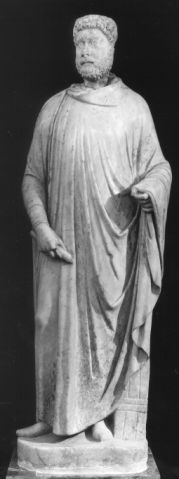
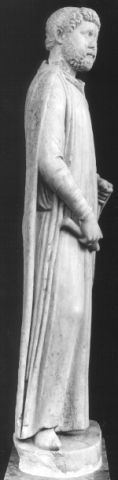
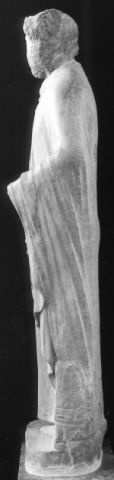
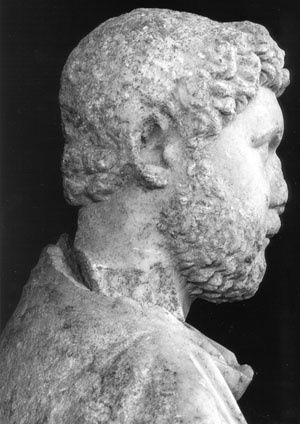
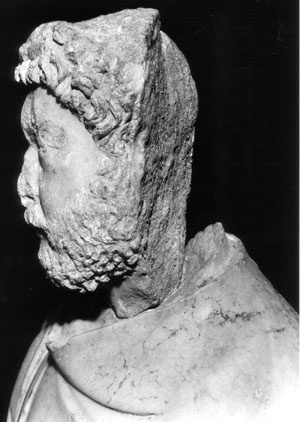
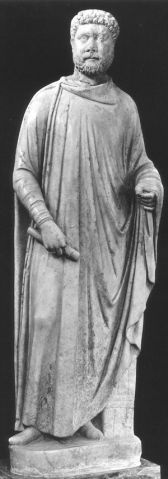
Statue of Oecumenius, governor. Aphrodisias (Caria). Late fourth-early fifth century.
Record details
Photographs
Bibliography
- Smith, R.R.R. 'The statue monument of Oecumenius. A new portrait of a late antique governor from Aphrodisias', The Journal of Roman Studies, 92, London 2002, 134-56
Discussion
DESCRIPTION (Object)
Life-size statue, preserved in two main fragments: (1) head, and (2) statue body on oval plinth with bundle of scrolls. H: 191, W: 65 cm. Medium-grained white marble.
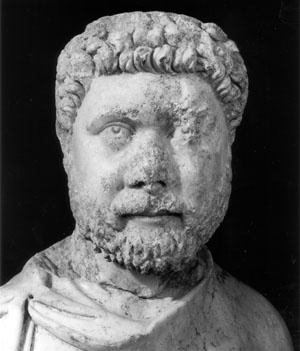
The back left quadrant of the head, from the nape to the left ear, is missing. Many locks of hair, especially in the second tier above the brow, are chipped, as is the brow, the left eye, and end of the nose. The statue body lacks only the tip of the left thumb, the right index finger, the end of the scroll held in the right hand, and a separately worked fibula (for which a small dowel hole is preserved) at the right shoulder. The front surface preserves its original high polish.
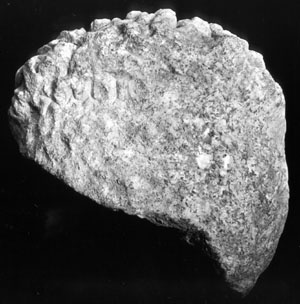
The statue was made in one piece from the plinth to the head. The back of the statue was flatly worked and finished only with a claw chisel. The longer portions of the beard and the hair around the face were deeply drilled. The hair on the top of the head and behind the ears has been only roughly rendered as combed forward, with a flat chisel. The pupils are rendered as deeply drilled U-shapes which thicken at the base of the U. Three letters, XMΓ, were inscribed on the top of the head, behind the hair over the brow.
PROVENANCE
The body was excavated in 1965 in front of its base in the north aisle of the north stoa of the North Agora, just west of the Bouleuterion. The head was excavated in the large house to the west of the Bouleuterion. It had been built into the fill that closed off a niche in room 11 at the southeast corner of the complex.
DESCRIPTION (Subject)
The figure wears a long cloak, a chlamys, that reaches almost to the plinth and which was fastened at the right shoulder by a no longer preserved fibula. The chlamys is worn over a sleeved tunic which is belted at the waist. The belt itself is not visible but the blousing of material over it can be seen on the right side where the two edges of the chlamys come together but do not overlap. On the feet are soft, seamless leather boots, and on the fourth finger of the right hand is a simple ring.
The figure stands with weight over the left leg. A bundle of vertical scrolls supports the statue along the outside of the left leg. The lowered left arm bends at a 90 degree angle and is enveloped by the chlamys, whose folds are held by the left hand. The right arm is lowered and set forward in front of the body; the right hand holds a scroll.
The hair is combed flatly forward and rises in two tiers of deeply drilled curls around the face. The moustache is short, and the beard is full and becomes thicker below the jaw line. The subject has a distinctive, full, plump-cheeked physiognomy.
DATE
The statue was found fallen directly in front of its base (LSA-151), honouring the governor Oecumenius, in the north stoa of the North Agora. The secure date of the monument, in the late fourth or early fifth century, depends on a combination of the inscribed text and the portrait style. A more precise date depends on uncertain prosopographic considerations (see below and on LSA-151).
PORTRAIT TYPE
The portrait is known in another life-size marble head from Salamis (LSA-869), the capital of Cyprus, where he may also have been governor. The position of governor of Cyprus was a more senior post (consularis) than that of governor of Caria (praeses); the Cypriote honour would then post-date the Aphrodisian one.
FURTHER NOTES
This base and statue have allowed scholars to make the connection between the chlamydatus costume and governors as opposed to local magistrates. The inscription on the head of the statue stands for Christon Maria genna or Christ was born to Mary. A similar inscription appears on a head, now in Brussels, from the Hadrianic Baths at Aphrodisias (LSA-176). The Christian connection to which these concealed inscriptions refer is unclear.
Discussion references
- Ševčenko, I., "A late antique epigram and the so-called Elder Magistrate from Aphrodisias" Synthronon: Art et archéologie de la fin de l'antiquité et du m oyen age, recueil d'études, Bibliothèque des Cahiers Archéologiques 2 (1968), 29-41
Cite: Last Statues of Antiquity, LSA-150 (J. Lenaghan).