
LSA-1505
Base recording the restoration of a statue of the goddess Diana, by the senator Auxentius. Rome. Late third-late fourth century.
Record details
Photographs
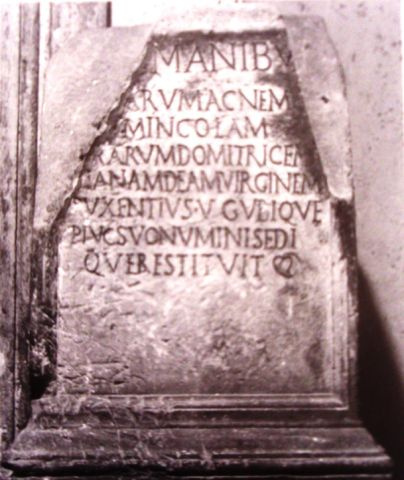
Inscription
[Umbr]arum ac nemo/[r]um incolam, / [f]erarum domitricem, / [D]ianam deam virginem/ Auxentius v(ir) c(larissimus) ubique/ piuc [sic, pro pius] suo numini sedi/que restituit.
Inscription translation
Auxentius, of clarissimus rank, universally pious, restored to her proper sanctity and position the maiden goddess Diana, the dweller in shady groves, the subduer of wild beasts. (translation adapted from Courtney)
Bibliography
- Corpus Inscriptionum Latinarum; , VI, 124=30700
- Courtney, E., Musa Lapidaria: a selection of Latin verse inscriptions, Atlanta 1995, no. 140
- Gregori, G. L. (ed.), La collezione epigrafica dell'Antiquarium comunale del Celio, Rome 2001
Discussion
Inscription:
In 7 lines.
[Umbr]arum ac nemo/[r]um incolam, / [f]erarum domitricem, / [D]ianam deam virginem/ Auxentius v(ir) c(larissimus) ubique/ piuc [sic, pro pius] suo numini sedi/que restituit.
'Auxentius, of clarissimus rank, universally pious, restored to her proper sanctity and position the maiden goddess Diana, the dweller in shady groves, the subduer of wild beasts.' (translation adapted from Courtney)
The inscription, in verse, has two glyconics enclosing a pherecratic, the same metrical units used in Catullus' hymn to Diana (Carm. 34) (Courtney, p. 346). We can read on top of the original inscription: [Dis] Manibu[s], but it is clearly a modern addition (see also CIL).
DESCRIPTION (from Gregori
White marble base, damaged on the top corners. The epigraphic field is framed by moulding. It is rough, suggesting re-use. The base has decoration on the sides.
HONORAND, AWARDER AND DATE
The inscription records a dedication to the goddess Diana by a vir clarissimus named Auxentius. The style of the lettering suggests a late date; it has been suggested that this Auxentius should be identified as the Auxentius who was governor of Cilicia in the late fourth century, later involved in building works in Rome (PLRE I, 142 Auxentius 5), but there is no definitive evidence for that.
Discussion references
- Jones, A. H. M. et al., The Prosopography of the Later Roman Empire. Vol. I 260-395, Cambridge et al. 1971 (1975), p. 142 (Auxentius 5)
Cite: Last Statues of Antiquity, LSA-1505 (Carlos Machado).