
LSA-151
Base for statue of Oecumenius, governor. Aphrodisias (Caria). Later fourth to earlier fifth century.
Record details
Photographs
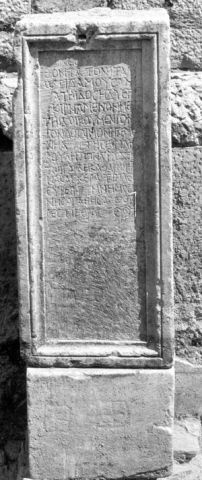
Inscription
τὸν σὲ νόμων πλή/θοντα, τὸν Ἰταλι/ώτιδα Μοῦσαν v./ v. Ἀτθίδος ἡδυεπεῖ /(5) v. κιρνάμενον μέλιτι / τῆιδ' Οἰκουμένιον / τὸν ἀοίδιμον ἡγεμο/νῆα v. στῆσε φίλη / βουλὴ τῶν Ἀφροδισιέω(ν)·/ (10) τῶι γὰρ δὴ καθαρῶι φρέ/να καὶ χέρα, τί πλέον / εὑρεῖν v. μνημοσύ/νης ἀγαθῆς ἄλλο πά/ρεστι γέρας; leaf
Inscription translation
You who are full of (knowledge of) laws, who have blended the Italian Muse with the sweet-voiced honey of the Attic, Oecumenius, the famous governor, the friendly council of the Aphrodisians has set you up here; for what greater reward than that of being well remembered can the man find who is pure in mind and in hand?
(Trans. C. Roueché)
Bibliography
- Roueché, C., Aphrodisias in Late Antiquity (Journal of Roman Studies Monograph 5), London 1989, no. 31
Discussion
INSCRIPTION
Verse inscription of three elegiac distichs laid out in 14 lines:
τὸν σὲ νόμων πλή/θοντα, τὸν Ἰταλι/ώτιδα Μοῦσαν v./
v. Ἀτθίδος ἡδυεπεῖ /(5) v. κιρνάμενον μέλιτι /
τῆιδ' Οἰκουμένιον / τὸν ἀοίδιμον ἡγεμο/νῆα v.
στῆσε φίλη / βουλὴ τῶν Ἀφροδισιέω(ν)·/
(10) τῶι γὰρ δὴ καθαρῶι φρέ/να καὶ χέρα, τί πλέον / εὑρεῖν v.
μνημοσύ/νης ἀγαθῆς ἄλλο πά/ρεστι γέρας; leaf
'You who are full of (knowledge of) laws, who have blended the Italian Muse with the sweet-voiced honey of the Attic, Oecumenius, the famous governor, the friendly council of the Aphrodisians has set you up here; for what greater reward than that of being well remembered can the man find who is pure in mind and in hand?' (Trans: C. Roueché)
Letter height 3.2 - 4.2 cm.
DESCRIPTION
Inscribed rectangular shaft mounted on a rectangular block; both shaft and block are re-used elements. Shaft H: 104.5, W: 49, D: 48.5 cm. Block H: 42, W: 56, D: 55 cm. White marble.
The two well-preserved elements create a vertical pillar with no projecting upper or lower mouldings. The inscribed shaft was worked on all sides. The front, right, and left sides have framing moulding around a central panel. At the front, below the inscription, the surface features claw chisel marks. The back is more roughly finished and lacks the framing moulding. The top surface has a lewis hole and a band of anathyrosis on the front edge. The block-like plinth has a smoothed front surface into which graffiti (two squares composed of four quadrants) have been etched. The sides of the plinth have anathyrosis, indicating that in the block’s original setting they were once the top and bottom areas.
The shaft has cuttings on the upper front, back, and proper left sides, probably for attaching the statue. The back and proper left side have further cuttings lower down, the function of which is not clear.
PROVENANCE AND CURRENT LOCATION
Excavated in 1965 in the north stoa of the North Agora, west of the Bouleuterion (where it still stands today). The statue (LSA-150) was found fallen in front of the base. The monument was flanked only a few metres to the west by a near contemporary statue monument for a governor named Alexander (LSA-153).
HONORAND, AWARDER AND DATE
Roueché dates the inscription to the late fourth or early fifth century AD. The use of the word hegemon for governor denotes a praeses and dates the inscription before the late fifth century when the governor of Caria was raised to the rank of consularis.
A governor of Crete in 382-83 is also named Oecumenius (PLRE I 115, Oecumenius Dositheus Asclepiodotus 2). Since the governorship of Crete was a more senior position than governor of Caria, we would have to imagine either that Oecumenius was in Caria before Crete, which may be chronologically difficult given the text and style of the Aphrodisian monument, or that the Aphrodisian monument commemorates a son of the Cretan governor. It is also possible that the two Oecumenii are not related.
Discussion references
- Jones, A. H. M. et al., The Prosopography of the Later Roman Empire. Vol. I 260-395, Cambridge et al. 1971 (1975), I 115, Oecumenius Dositheus Asclepiodotus 2
- Ševčenko, I., "A late antique epigram and the so-called Elder Magistrate from Aphrodisias" Synthronon: Art et archéologie de la fin de l'antiquité et du m oyen age, recueil d'études, Bibliothèque des Cahiers Archéologiques 2 (1968), 29-41
- Smith, R.R.R., "The statue monument of Oecumenius. A new portrait of a late antique governor from Aphrodisias", JRS 92 (2002), 134-56
Cite: Last Statues of Antiquity, LSA-151 (J. Lenaghan).