
LSA-1516
Base for statue of Ioannes, wrestler from Smyrna. Rome. 383-392
Record details
Photographs
Inscription
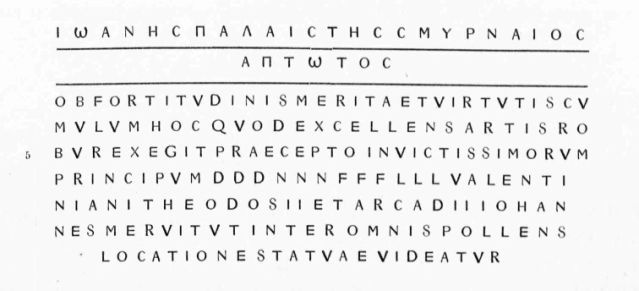
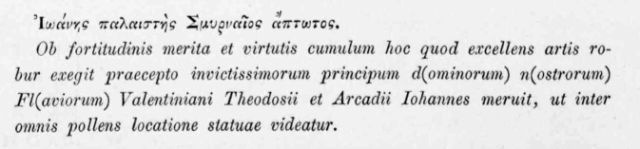
Ἰωάνης παλαιστὴς Σμυρναῖος / ἄπτωτος. / Ob fortitudinis merita et virtutis cu/mulum hoc quod excellens artis ro/bur exegit praecepto invictissimorum /(6) principum ddd(ominorum) nnn(ostrorum) FFFlll(aviorum) Valenti/niani Theodosii et Arcadii Iohan/nes meruit, ut inter omnis pollens / locatione statuae videatur
Inscription translation
Iohannes, unthrown Smyrnean wrestler. By the merits of his strength and the accumulation of his virtue Iohannes deserved this what the outstanding strength of art produced by order of our Lords, the Flavii Valentinian, Theodosius, and Arcadius, so that by the location of the statue one could see that he exceeded all.
Bibliography
- Corpus Inscriptionum Graecarum; , XIV, 1106
- Corpus Inscriptionum Latinarum; , VI, 10153
- Moretti, L., Inscriptiones Graecae Urbis Romae, Rome 1968-1990, I, 245
Discussion
INSCRIPTION
In nine lines, the first two in Greek, the others in Latin:
Ἰωάνης παλαιστὴς Σμυρναῖος / ἄπτωτος. / Ob fortitudinis merita et virtutis cu-/mulum hoc quod excellens artis ro-/bur exegit praecepto invictissimorum /(6) principum ddd(ominorum) nnn(ostrorum) FFFlll(aviorum) Valenti-/niani Theodosii et Arcadii Iohan-/nes meruit, ut inter omnis pollens / locatione statuae videatur.
'Iohannes, unthrown Smyrnean wrestler. By the merits of his strength and the accumulation of his virtue Iohannes deserved this what the outstanding strength of art produced by order of our Lords, the Flavii Valentinian, Theodosius, and Arcadius, so that by the location of the statue one could see that he exceeded all.'
Letter height not recorded.
DESCRIPTION
The block was described as a base of shining marble by the 17th century scholar Marquard Gude (Gudius) (Moretti 1968, 214). No measurements have been published, and there is no published image of the base.
PROVENANCE AND MOST RECENTLY RECORDED LOCATION
The inscription was found in the garden of San Pietro in Vincoli, that is the area of the ancient baths of Trajan on the Esquiline hill, in 1660 or 1661 (Moretti 1968, 214). The Greek athletes at Rome were organized in a union or club (synodos); Antoninus Pius granted them headquarters in the baths of Trajan (Inscriptiones Graecae XIV 1055; on the location see Steinby 1993, 330, Curia Athletarum; Richardson 1992, 102 Curia Athletarum; Caldelli 1992, 75-6). Inscriptions from the area testify to statues set up for athletes (Inscriptiones Graecae XIV 1102-5, 1107-10; Moretti 1968, 237-41, 243-4; Latin inscription for Filumenus LSA-1491) as well as to imperial statues set up by the athletes’ congregation (Inscriptiones Graecae XIV 1054, 1055, 1058 = Moretti 1968 nos. 235, 236, 242). These formed the nobilitating context of Iohannes’ statue (ut inter omnis pollens locatione statuae videatur, lines 8-9).
Not long after it was excavated, the inscription was brought to the house of Cardinal Flavio Chigi where it was recorded in 1668. According to Moretti 1968, 214 it is now lost (‘periisse videtur’).
HONORAND, AWARDER AND DATE
Iohannes, the honorand was a wrestler who remained unthrown ( ἄπτωτος, line 2) in his career. He was a native of Smyrna (line 1).
The inscription was set up by order of the emperors Valentinian II (Augustus 375-92), Theodosius I (Augustus 379-95) and Arcadius (Augustus 383-408) (lines 5-7; see below, 'Further Discussion'). The date range is given by the common reign of the emperors, 383-92.
FURTHER DISCUSSION
The erection of a statue in the headquarters of the Greek athletes’ congregation continues a tradition going back to the 2nd century (Caldelli 1992, 77-8; see also above, ‘Provenance and Current Location’). While the statues of the 2nd century were awarded by the athletes’ congregation, our statue in the late 4th century refers to imperial decree (probably an approval rather than on initiative of the emperors themselves). A further, similar inscription to another athlete was ordained by the same emperors (LSA-1491).
Discussion references
- Caldelli, M. L., 'Curia athletarum, iera xystike synodos e organizzazione delle terme a Roma', Zeitschrift für Papyrologie und Epigraphik, 93, Bonn, 1992, 75-87
- Chioffi, L., "Curia Athletarum", in E. M. Steinby (ed), Lexicon Topographicum Urbis Romae I, Roma 1993, p. 330
- Richardson, L. jr., A New Topographical Dictionary of Ancient Rome, Baltimore 1992
Cite: Last Statues of Antiquity, LSA-1516 (Ulrich Gehn).