
LSA-1519
Small fragment of plaque from base for statue of unknown emperor; perhaps erected by a rationalis. Rome, Forum. Probably 280-337.
Record details
Photographs
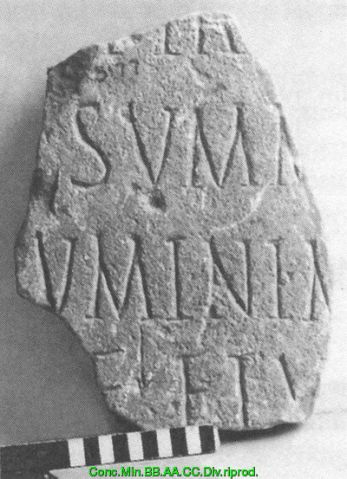
Inscription
------ / [---]++A[---] / [rat(ionalis?)] sumṃ(ae) [privat(ae?)], / [n]umini m[aiestati]/[qu]ẹ eiu[s dicatus].
Inscription translation
... officer in charge of the imperial fisc (?), devoted to his divine spirit and majesty.
Bibliography
- Corpus Inscriptionum Latinarum; , VI, 40760
Discussion
INSCRIPTION
In three partially surviving lines. Letter height 6-5.5. cm.
------ / [---]++A[---] / [rat(ionalis?)] sumṃ(ae) [privat(ae?)], / [n]umini m[aiestati]/[qu]ẹ eiu[s dicatus].
'... officer in charge of the imperial fisc (?), devoted to his divine spirit and majesty.'
DESCRIPTION (CIL)
Lower part of marble slab, 31 x 23 x 3 cm.
PROVENANCE AND CURRENT LOCATION
The fragment was found in the Roman Forum, but its precise findspot is not known. It is in the Lapidario Forense, inv. 5177.
HONORAND, AWARDER AND DATE
The inscription records a dedication to an unknown emperor, as shown by the last two surviving lines. The identity of the awarder, however, is more difficult to define. It is probable that his office was recorded on l.2, and in this case the identification as a rationalis summae privatae would be almost certain. In this case, the dedication must be dated to the end of the third or the beginning of the fourth century, when other known dedications by these officials are recorded in Rome.
Cite: Last Statues of Antiquity, LSA-1519 (Carlos Machado).