
LSA-152
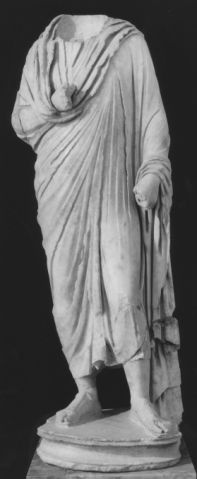
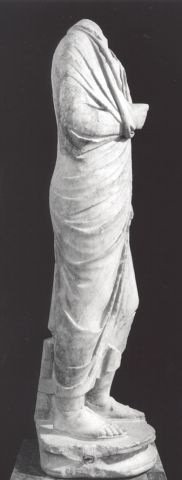
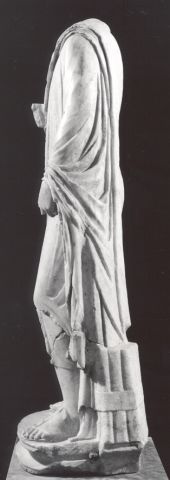
Statue wearing himation, re-used for governor Alexandros. Aphrodisias (Caria). Fourth century.
Record details
Photographs
Bibliography
- Smith, R.R.R. 'Late antique portraits in a public context: Honorific statuary at Aphrodisias in Caria, AD 300-600' , Journal of Roman Studies, 89 (1999), 155-89, 165-67, fig. 5
- Smith, R.R.R., S. Dillon, C.H. Hallett, J. Lenaghan, and J. Van Voorhis, Aphrodisias II: Roman Portrait Sculpture at Aphrodisias, Mainz 2006, no. 49
Discussion
DESCRIPTION
Headless life-size statue. H: 160, W: 54, D: 42.5 cm. Large-grained white marble.
The life-size statue is recomposed of four main fragments and several minor fragments of drapery. Missing are: head, added separately; fingers on both hands; end of scroll in left hand; and part of vertical drapery fold between legs.
The thumb and index finger of the left hand and the projecting part of the scroll held in the left hand were repaired; they were worked separately and attached by dowels. The neck was hollowed out as a socket for the fourth-century re-use, and it has a deep square dowel at the centre for the attachment of the new head. The square dowel tapers to a point inside. A similar technique was used in the statue re-used for a mid-fourth century emperor (LSA-196).
Clamps, located at the sides of the plinth, anchored the statue to its base. They correspond to cuttings on the doric capital set on top of the base (LSA-153). On the proper right side, part of the clamp embedded into the scotia is preserved. The torus profiles directly above and below this clamp were broken, probably when the statue was removed from its original base for re-use. The breaks have been tidied up with a claw chisel.
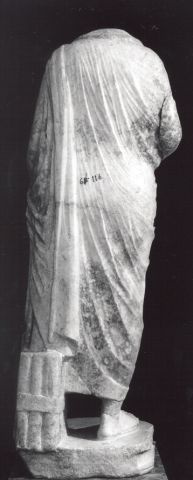
The front of the statue was higly polished. The drapery design on the back of the statue is fully articulated but more flatly and plainly finished with a rasp. The moulded profile of the plinth does not continue across the back.
PROVENANCE
The main parts of the statue were found in the north stoa of the North Agora immediately to the west of a large niche or exedra in its back wall to the west of the Bouleuterion. The fragment of the himation covering the lower left leg was found in 1998 in the same area. The monument lay to the west of the statue of the governor Oecumenius (LSA 150).
DESCRIPTION (Subject)
The figure wears a chiton, himation, and Greek sandals, and held a scroll in its left hand. It stands with its weight on the right leg. A set of bound scrolls serves as a support behind the left lower leg. The right hand is held in the arm-sling of the himation at the centre of the body, and the left arm rests alongside the body.
DATE
The original statue can be securely dated, on th basis of its style and clothing, to the later second or third century AD, and at life-size it is small for that period. The date of the second use (head, repairs, and re-working on plinth) depends on the inscribed base (LSA-153), which should probably be placed in the mid to late fourth century.
Cite: Last Statues of Antiquity, LSA-152 (J. Lenaghan).