
LSA-1523
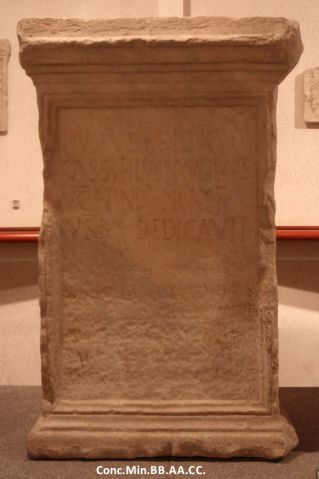
Base for statue (subject unstated), re-erected by Fabius Felix Passifilus Paulinus, prefect of the City. Rome. 450-476
Record details
Photographs
Inscription
Fabius Felix / Passifilus Paulinus, / v(ir) c(larissimus) et inl(ustris), praef(ectus) / urb(i), dedicavit.
Inscription translation
Fabius Felix Passifilus Paulinus, of clarissimus and illustrious rank, prefect of the City, dedicated [this].
Bibliography
- Corpus Inscriptionum Latinarum; , VI, 41391b
Discussion
INSCRIPTION
In three lines. Letter height 4.5-5 cm.
Fabius Felix / Passifilus Paulinus, / v(ir) c(larissimus) et inl(ustris), praef(ectus) / urb(i), dedicavit.
'Fabius Felix Passifilus Paulinus, of clarissimus and illustrious rank, prefect of the City, dedicated [this].'
DESCRIPTION (personal inspection)
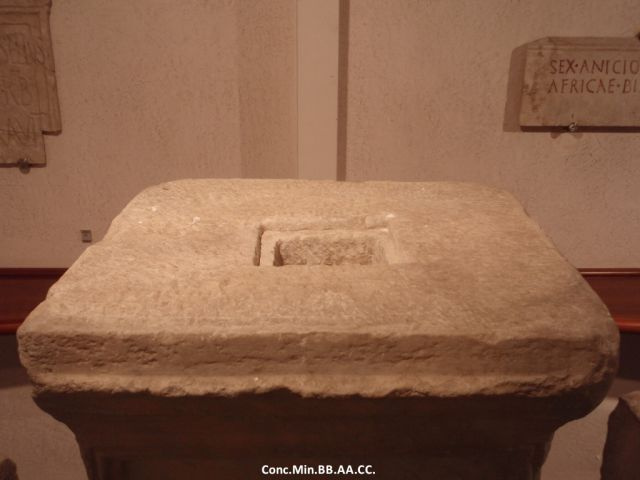
Marble base, 112.5 x 73 x 61 cm. The base has mouldings on top and bottom. The epigraphic field is framed by moulding, damaged at parts. Its surface is rough and it has traces of erased letters, from an earlier inscription.
PROVENANCE AND LOCATION
The base was discovered in the vicinity of the church of S. Pietro in Vincoli, on the Oppian hill in the same area as three very similar bases dedicated by the same man (LSA-1088, LSA-1283, LSA-1338). It is thought that this was the site of the main offices of the urban prefect (Chastagnol 1960, 243-251). The base is now in the Museo Nazionale Romano, at the baths of Diocletian.
HONORAND, AWARDER, AND DATE
The subject of the statue is not specified in the inscription, it can be assumed to have been a statue displayed for its historical and aesthetic value. Other dedications of the same type were carried out by the same urban prefect (see 'Provenance and Location'), all of which can be associated with the late antique concern with the embellishment of the city (Lepelley 1994).
As we have seen, Fabius Felix Passifilus Paulinus was responsible for a number of dedications during his urban prefecture. This cannot be precisely dated, but certainly fell in the latter half of the 5th century, or even later (PLRE II, 848 Paulinus 13). His name appears on an inscribed marble slab belonging to a late 5th century restoration of the seating of the Colosseum (Orlandi 2004, 499-500). Paulinus as urban prefect is mentioned on an inscribed bronze plaque that opens with the salutation 'Salvis d(ominis) n(ostris)' (CIL XV, 7111), which led Orlandi to suggest 476 (the last year in which there were two emperors in the Roman world) as the probable terminus ante quem for his prefecture. A later date however remains possible, since Orlandi correctly points out that the Ostrogothic king Theoderic also appears in inscriptions as dominus noster.
Discussion references
- Chastagnol, A., La préfecture urbaine a Rome sous le Bas-Empire, Paris 1960
- Lepelley, C., "Le musée des statues divines. La volonté de sauvegarder le patrimoine artistique paien à l'époque théodosienne", Révue Archéologique 42, 1994, pp. 5-15
- Martindale, J. R., The Prosopography of the Later Roman Empire. Vol. II A.D. 395-527, Cambridge 1980, p. 848 (Paulinus 13)
- Orlandi, S., Roma. Anfiteatri e strutture annesse con una nuova edizione e commento delle iscrizioni del Colosseo. Epigrafia anfiteatrale dell’Occidente romano 6, Rome 2004
Cite: Last Statues of Antiquity, LSA-1523 (Carlos Machado).