
LSA-153
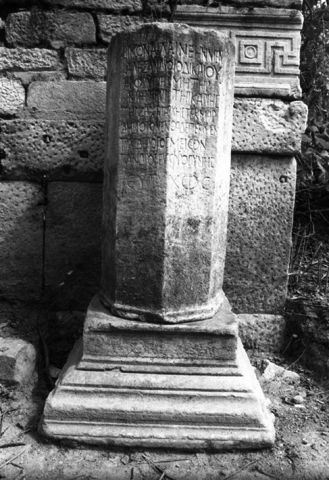
Statue base for Alexandros, governor. Aphrodisias (Caria). Fourth century.
Record details
Photographs
Inscription
Ἀγαθῇ τύχῄ / εἰκόνα λαϊνέην μὲν / Ἀλεξάνδροιο δικαίου / ἡ Φρυγίης μήτηρ /(5) μητέρι τῆι Καρίης /
τῆς ζαθέης ἀρχής τέκμαρ / ἄμβροτον ἐνθάδ' ἔπεμψεν /
πᾶς δὲ λόγος μείων /τ' ἀνδρὸς εὐφροσύνης. /
(10) εὐτυχῶς.
Inscription translation
A stone image of the just Alexander the mother of Phrygia sent here to the mother of Caria, (as) an undying mark of his god-like rule; but all words fall short of the man's good cheer. With good fortune!
(trans. C. Roueché)
Bibliography
- Roueché, C., Aphrodisias in Late Antiquity (Journal of Roman Studies Monograph 5), London 1989, no. 32
Discussion
INSCRIPTION
Verse inscription of two elegiac distichs laid out in eight lines, with an introductory and a concluding formula; in total ten lines:
Ἀγαθῇ τύχῄ /
εἰκόνα λαϊνέην μὲν / Ἀλεξάνδροιο δικαίου /
ἡ Φρυγίης μήτηρ /(5) μητέρι τῆι Καρίης /
τῆς ζαθέης ἀρχής τέκμαρ / ἄμβροτον ἐνθάδ' ἔπεμψεν /
πᾶς δὲ λόγος μείων /τ' ἀνδρὸς εὐφροσύνης. /
(10) εὐτυχῶς.
'A stone image of the just Alexander the mother of Phrygia sent here to the mother of Caria, (as) an undying mark of his god-like rule; but all words fall short of the man's good cheer. With good fortune!' (Trans: C. Roueché)
Letter height 3.5 - 8 cm.
DESCRIPTION
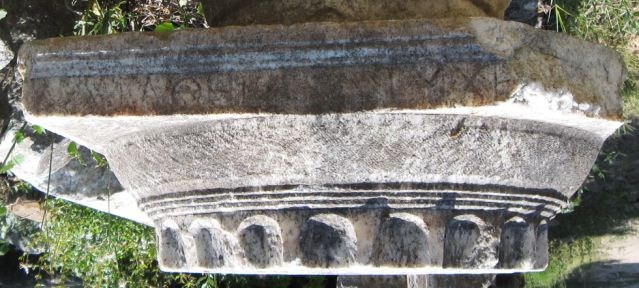
Tri-partite statue base, made up of three disparate re-used blocks. 1) Octagonal shaft with a partially erased 10 line inscription of the second century AD, H: 104.5, W: 49, D: 48.5 cm. 2) Lower moulded plinth. 3) Doric column base onto which Agathē Tychē is inscribed. White marble.
1) The lower plinth is elaborately moulded on three sides; the back is plain. In the complexity of its profile it is comparable to the upper plinths of statue bases of the late second or early third century.
2) The octagonal shaft has a lower moulding on all sides. An inscription runs across its two front faces. Of the sides which are currently against the wall, two have a rougher claw-chisel surface and two bear a partially removed inscription. The removed inscription is not directly opposite the inscription for Alexander.
This inscription (second century) is still legible and records a dedication given by two brothers and a third man to the city.
'Zenon son of Euthymos (?Eudamos), natural son of Zenon son of Agathas the son of Euthymos (?Eudamos) with his brother Iulius (?) having had this made (?) in company with Claudius Adrastos son of Hierax, dedicated it, together with all the decorative features round it, to the fatherland.' (Trans: IAph2007.3.4.i)
The top of the octagonal shaft has a band of anathyrosis surrounding a roughly picked area with a central round cutting. This was for the attachment of the original element set above it. Within the round cutting is a smaller deeper hole that might correspond to its second use.
3) The Doric base has cuttings in its upper surface that correspond exactly to those on the sides of the plinth of the statue, LSA-151.
PROVENANCE
The lower moulded plinth and the octagonal shaft were excavated in 1965 still standing in the north stoa of the North Agora. The base stood immediately to the west of a large niche in the back wall of the stoa, to the west of the Bouleuterion.
HONORAND
Alexander is honoured by the 'mother', or metropolis, of Phrygia, that is, probably by Laodicea. The praise of his justice (Ἀλεξάνδροιο δικαίου, line 3) and his good rule (τῆς ζαθέης ἀρχής, line 6) make sure that he was a high ranking imperial office holder; most probably he was a governor of Phrygia. He was honoured at Aphrodisas because Aphrodisias was his hometown.
DATE
The script suggests a date in the fourth century, and the content is comparable to fourth to fifth century epigrams. The only further indication of a date lies perhaps in the seeming emphasis on 'mothers', metropoleis. Phrygia and Caria had been one province with one metropolis until the early fourth century (c. AD 303, see Roueché 1981) at which point it was divided, each with its own metropolis. This inscription may deliberately emphasize the separate status.
Discussion references
- Reynolds, J., C. Roueché, and G. Bodard , Inscriptions of Aphrodisias , (2007), available <http://insaph.kcl.ac.uk/iaph2007, 3.4.i
- Roueché, C., Rome, Asia and Aphrodisias in the Third Century, The Journal of Roman Studies, Vol. 71 (1981), 110-111
Cite: Last Statues of Antiquity, LSA-153 (J. Lenaghan).