
LSA-1536
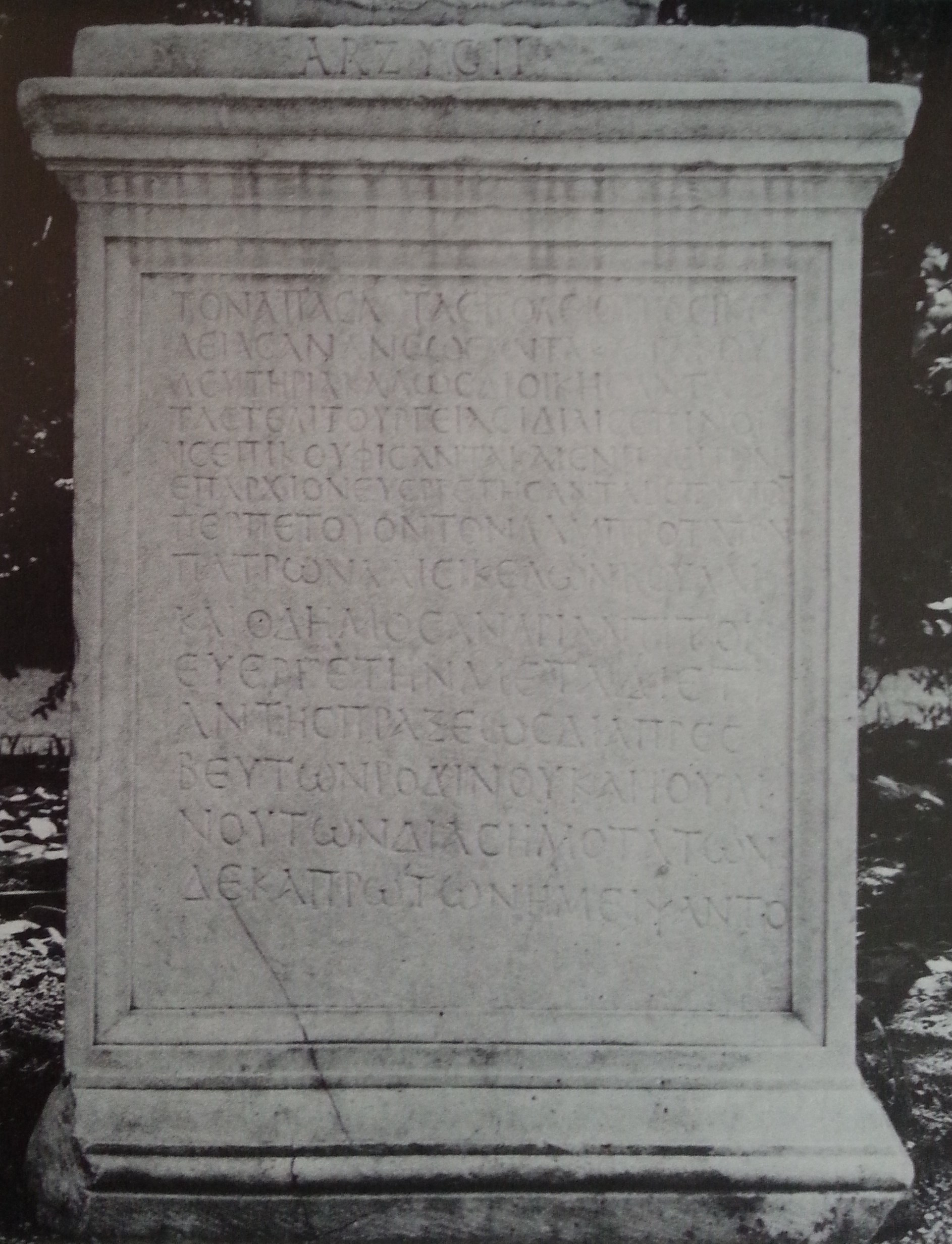
Base for statue of Betitius Perpetuus signo Arzygius. Rome. 312-324.
Record details
Photographs
Inscription
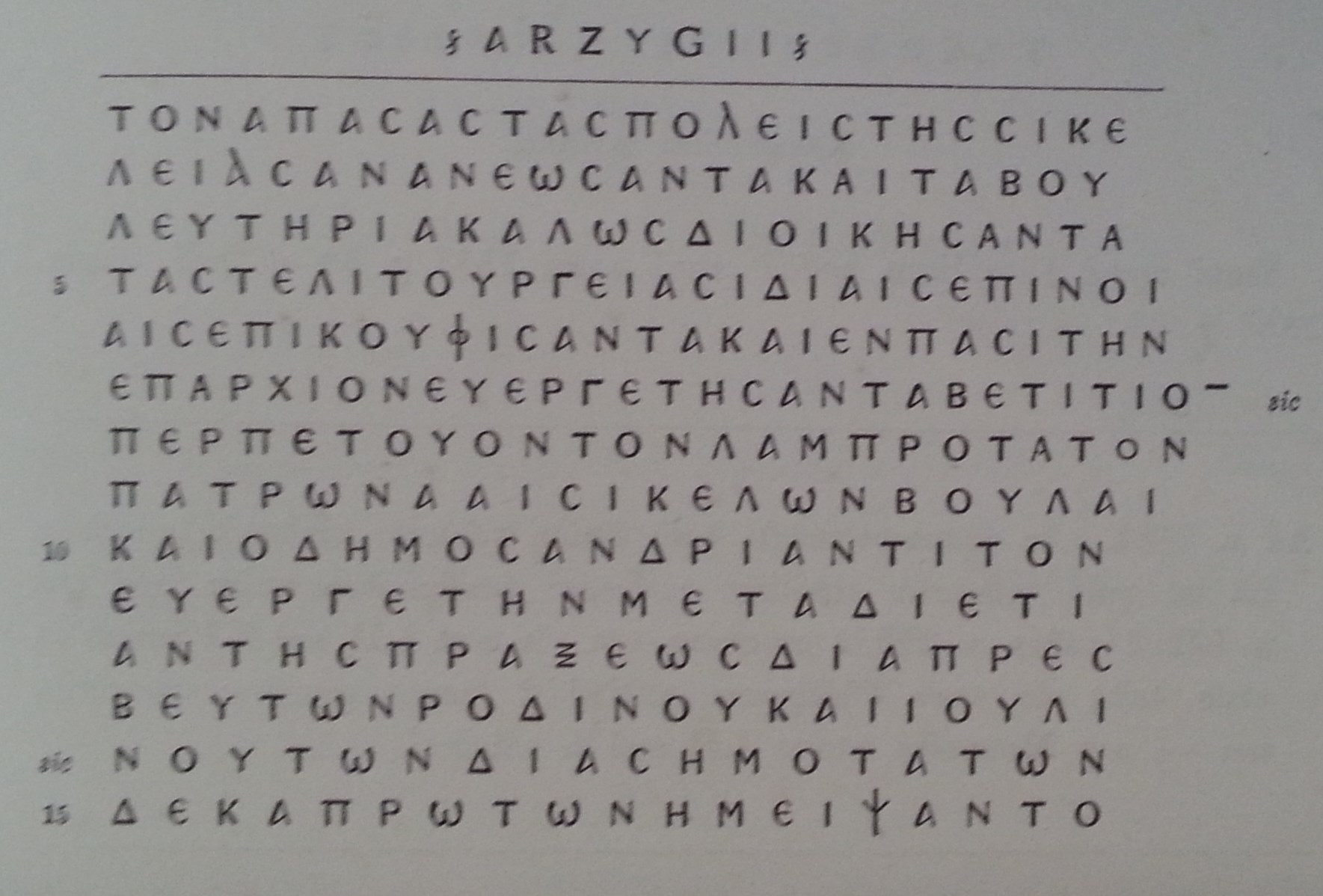
Αrzygii. / τὸν ἁπάσαϛ τὰϛ πόλειϛ τηϛ Σικε/λίαϛ ἀνανεώσαντα καὶ τὰ βου/λευτήρια καλῶϛ διοικήσαντα/ (5) τάϛ τε λιτουργείαϛ ἰδίαιϛ ἐπινοί/αιϛ ἐπικουφίσαντα καὶ ἐν πᾶσι την/ ἐπάρχιον (sic) εὐεργετήσαντα Βετίτιον/ Περπέτουον τὸν λαμπρότατον/ πάτρωνα αἱ Σικελῶν Βουλαὶ/ (10) καὶ ὁ δῆμοϛ ανδριάντι τὸν/ εὐεργέτην μετὰ διέτι/αν τῇϛ πράξεωϛ διὰ πρεσ/βευτῶν ῾Ροδίνου καὶ Ιουλι[α]/νοῦ τῶν διασημοτάτων/ (15) δεκαπρώτων ημείψαντο.
Inscription translation
[Statue] of Arzygius. To him who renewed all cities of Sicily, and who kept the councils well, who relieved the civic duties with his own insight and did benefactions in the entire province, Betitius Perpetuus, of clarissimus rank, their patron; the councils of the Sicilians and the people rewarded with a statue their benefactor, after two years of his deeds, through the legates Rodinus and Iulianus, both of perfectissimus rank, decemprimi.
Bibliography
- Corpus Inscriptionum Latinarum; , IG XIV, 1078a
- Corpus Inscriptionum Latinarum; , VI, 31961
- Moretti, L., Inscriptiones Graecae Urbis Romae, Rome 1968-1990, no. 60
Discussion
INSCRIPTION
In 15 lines. Line 1, in Latin, is carved upon the plinth above the upper moulding; the 14 lines of Greek are carved on the shaft:
Αrzygii. / τὸν ἁπάσαϛ τὰϛ πόλειϛ τῆϛ Σικε/λίαϛ ἀνανεώσαντα καὶ τὰ βου/λευτήρια καλῶϛ διοικήσαντα/ (5) τάϛ τε λιτουργείαϛ ἰδίαιϛ ἐπινοί/αιϛ ἐπικουφίσαντα καὶ ἐν πᾶσι την/ ἐπάρχιον (sic) εὐεργετήσαντα Βετίτιον/ Περπέτουον τὸν λαμπρότατον/ πάτρωνα αἱ Σικελῶν Βουλαὶ/ (10) καὶ ὁ δῆμοϛ ανδριάντι τὸν/ εὐεργέτην μετὰ διέτι/αν τῇϛ πράξεωϛ διὰ πρεσ/βευτῶν ῾Ροδίνου καὶ Ιουλι[α]/νοῦ τῶν διασημοτάτων/ (15) δεκαπρώτων ημείψαντο.
'[Statue] of Arzygius. To him who renewed all cities of Sicily, and who kept the councils well, who relieved the civic duties with his own insight and did benefactions in the entire province, Betitius Perpetuus, of clarissimus rank, their patron; the councils of the Sicilians and the people rewarded with a statue their benefactor, after two years of his deeds, through the legates Rodinus and Iulianus, both of perfectissimus rank, decemprimi.'
Letter height 3 – 3.5 cm.
DESCRIPTION (from Guerrini and Gasparri 1993, and the published images)
Rectangular white marble base moulded at top and bottom; H 128, W 75, D 47 cm. The epigraphic field on the shaft has a moulded frame. The lateral faces are finished, the back face is only roughly finished. On the top face there are two holes, filled with bronze, for the fixing of a statue.
PROVENANCE AND CURRENT LOCATION
The inscription was found in Rome, in the area of the church of Sant‘ Andrea al Quirinale, in 1888.
This inscription, set up by clients to their patron, and with no reference to any authority of the urbs Roma, was almost certainly originally set up in the family house (domus) of the senator (on the domus see LTUR II, 154 (Guidobaldi)).
The inscription is now standing in the gardens of the Palazzo del Quirinale (without published inv. no.).
HONORAND, AWARDER AND DATE
Betitius Perpetuus signo Arzygius, the honorand, was, as our inscription states, patron of Sicily (PLRE I, 689 Betitius Perpetuus signo Arzygius 2). This relationship resulted from his office as governor (corrector) of the province, under Constantine (probably in 312/24); in this function he set up a statue to Constantine in Marsala (LSA-2059). The office is not made explicit in our inscription; however, the honorand is praised for financial and political support: he relieved civic duties (litourgeias, line 5); he administered the councils well (lines 2-3); he renewed all the cities (lines 1-2); and did benefactions in the entire province (line 5-6). He did his good deeds for a period of two years (meta dietian tes praxeos, lines 11-12), a typical period for a provincial governorship.
The outer dates for our inscription are suggested by the inscription Betitius Perpetuus set up for Constantine (LSA-2059). The terminus post quem for his time in office is the conquest of Italy by Constantine in 312; a probable terminus ante quem is the imperial title of invictus used in that inscription, which was by and large replaced in official inscriptions by victor after Constantine defeated Licinius in 324.
The inscription was set up by the provincials of Sicily, styled 'the councils of the Sicilians, and the people' (ai Sikelon boulai kai o demos, lines 9-10). The task was performed by two legates, Rodinus and Iulianus. They both had equestrian (perfectissimus, Greek diasemotatos) rank and were taken from the highest ranks of provincial notables (decemprimi, Gr. dekaprotoi, line 15).
FURTHER DISCUSSION
Betitius Perpetuus signo Arzygius was possibly the grandfather of Betitius Perpetuus Arzygius the governor (consularis) of Tuscia and Umbria in the mid-later 4th century (PLRE I, 689 Betitius Perpetuus Arzygius 3) who was awarded a statue by the provincials of Tuscia and Umbria, possibly also in the family house in Rome (LSA-1406).
Discussion references
- Guerrini, L. and C. Gasparri (eds.), Il Palazzo del Quirinale. Catalogo delle Sculture, Roma 1993, 242-3 no. 109 pl. 53
- Guidobaldi, F. 'Domus: Betitius Perpetuus Arzygius', Lexicon Topigraphicum Urbis Romae. II. D-G, Rome 1995, 154
- Jones, A. H. M. et al., The Prosopography of the Later Roman Empire. Vol. I 260-395, Cambridge et al. 1971 (1975)
Cite: Last Statues of Antiquity, LSA-1536 (Discussion added 2/15 (Ulrich Gehn)).