
LSA-154
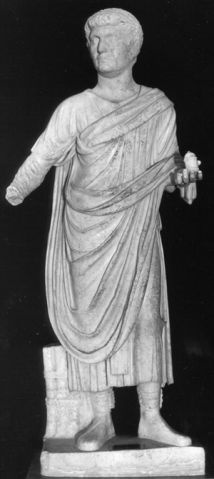
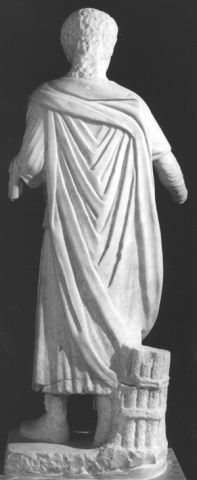
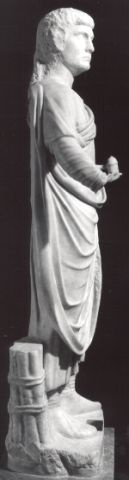
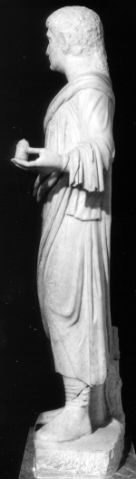
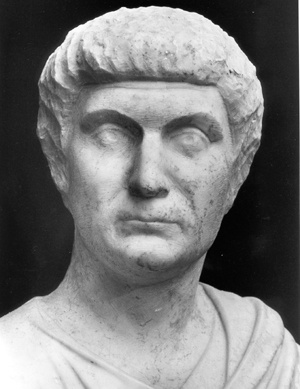
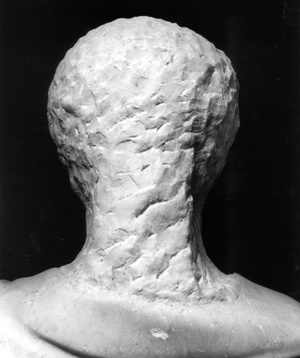
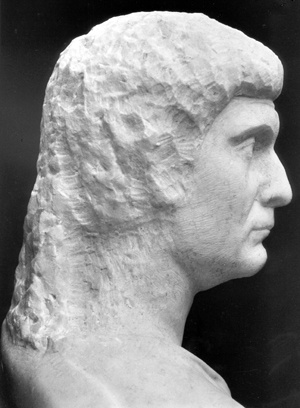
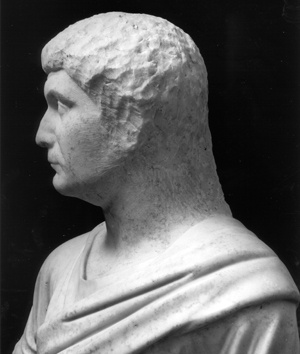
Portrait statue of man of holding inkpot, with unfinished head. Aphrodisias (Caria). Late fourth century.
Record details
Photographs
Bibliography
- Inan, J. & E. Alföldi-Rosenbaum, Römische und frühbyzantinische Porträ̈tplastik aus der Türkei : neue Funde, Mainz 1979, 224-6, no. 195, pl. 138.3 and 147.1-2
- van Voorhis, J., Aphrodisias V. The Sculptor’s Workshop, Mainz forthcoming
Discussion
DESCRIPTION (Object)
Life-size statue with unfinished head. H: 157.5, W: 66.0, D: 34.5 cm. Head H: 21 cm. Plinth: H: 8, W: 57, D: 34 cm. Fine-grained white marble.
Recomposed from six joining fragments: 1) plinth with feet and book rolls, broken diagonally from middle of scrolls to left ankle, 2) head and body, 3) left hand, broken at wrist, 4) left thumb and inkpot, 5) left index finger, and 6) tip of third left finger. Missing the right hand and the end of the toga hanging over the left arm. The bottom of the plinth is broken. The surface has root marks, and an iron stain in middle of neckline of tunic.
The statue was carved in one piece from a single block of marble. Both of the extended arms were worked from the same block of marble, and neither were supported by struts. The body of the statue has a high polish on both the front and the back (which is flat and more schematic). The arms and the fine finish both attest significant interest and competence on the part of the sculptor. The portrait head, however, has not been finished. The face and neck display the marks of a coarse rasp, and the hair and ears have been roughly shaped with point and flat chisels.
The drapery folds are deeply drilled, and the details of the body, especially the shoes, are carefully carved. The location of the pupils has been indicated by shallow circular indentations. No lower eyelid has been defined.
PROVENANCE
All of the fragments were found in the Sculptors’ Workshop at Aphrodisias. This is located along the north side of the courtyard to the northeast of the Bouleuterion.
DESCRIPTION (Subject)
The under life-size portrait statue represents a mature, clean-shaven man wearing a toga and holding an inkpot in his outstretched left hand. Whereas the body is fully finished, the features of the portrait head have been worked to an intermediate stage with a coarse rasp and the hairstyle is only roughly sketched.
The right leg serves as the weight leg, and the left leg is bent, with the left foot turned out. The left arm bends and the right extends away from the body. A basket of scrolls on the outside of the lower right leg serves as a support. The left hand holds an inkpot which takes the form of small, moulded cylinder covered by a domed lid with a small knob. The missing right hand may once have held another attribute, possibly a scroll or a pen. The head turns to its right.
The figure wears three distinct garments: a long-sleeved tunic, a short-sleeved tunic, and a toga. The tunics hang to the middle of the calf and are belted; the portion which blouses over the belt is visible at the proper left hip. The lower edge of the toga falls below the lower right knee. The sinus crosses at the waist, and the balteus rises from under the right armpit to the left shoulder. This corresponds neither to the toga contabulata nor the late antique toga.
The boots (calcei patricii) are thin-soled and made of soft leather. Straps cross over the foot, wrap around the ankles, and tie in front. Laces hang down on either side of the knot.
The unfinished head is supported by a neck pillar and is large in proportion to the body. The subject was a clean-shaven, middle-aged man with fleshy cheeks and prominent naso-labial lines. The chin is strong and jutting. The unsmiling mouth is thin-lipped, and the upper lip protrudes slightly. The nose, the nostrils of which have not yet been drilled, has a distinctive bump. The eyes set deep beneath sharp, arching eyebrows and a broad forehead. Had the piece been finished, the head size would have been reduced and the abruptness of the features would have been softened.
The contour of the hair shows that the figure would have worn a short, cap-like style with bangs cut straight across the brow. The hair would have to have been cut fairly close to the head.
DATE
The shallow depth of the statue as well as the use of fine-grained marble are typical of late antique portraits at Aphrodisias. The form of the toga resembles that used for Valentinian II and Arcadius (LSA-163 and LSA-165) which date to 388-392. The short hairstyle would also fit a fourth century date.
The context provides a solid chronological framework. A hoard of twelve coins dating from the reigns of Constantius II through Theodosius II was recovered just south of the room where this statue was found. The hoard seems to have belonged to the operational level and suggests that the workshop functioned between the mid-fourth and the early fifth century.
HONORAND
The costume indicates that the statue represents a figure of senatorial status. The inclusion of the inkpot as an attribute is unusual and known in no other extant statuary. It suggests education and erudition which, given the dress here, probably indicated suitability for office.
The portrait was intended to be a distinct individual. This and the virtuouso carving suggest a commissioned opus which was abandoned at a late moment.
Discussion references
- Goette, H.R., Studien zu römischen Togadarstellungen, Mainz 1990, 62, no. D 11
- Smith, R.R.R. 'Late antique portraits in a public context: Honorific statuary at Aphrodisias in Caria, AD 300-600' , Journal of Roman Studies, 89 (1999), 155-89, pl. 1.2
Cite: Last Statues of Antiquity, LSA-154 (J. Lenaghan).