
LSA-1540
Fragmentary plaque from base for statue, probably of empress Helena, mother of Constantine I. Rome. 330.
Record details
Photographs
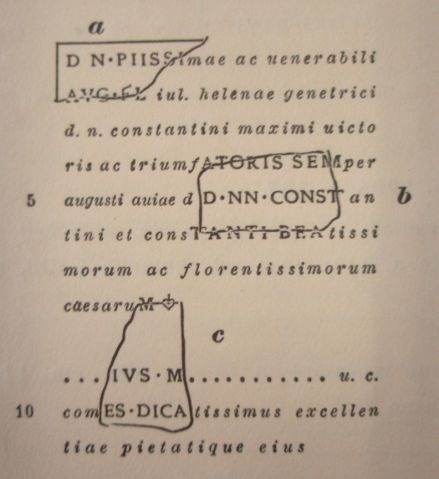
Inscription
D(ominae) n(ostrae), piissi[mae ac venerabili] / Aug(ustae), Fl(aviae) [Iul(iae) Helenae, genetrici] / [d(omini) n(ostri) Constantini maximi, victo]/[ris ac triumf]atoris, sem[per] /(5) [Augusti, aviae d]d(ominorum) nn(ostrorum) Const[an]/[tini et Cons]tanti, bea[tissi]/[morum ac florentissimorum] / [Caesaru]m. /(8) [Iul]ius M[aximilianus, v(ir) c(larissimus)], / [com]es, dica[tissimus excellen]/[tiae pietatique eius].
Inscription translation
To our lady, the most pious and venerable Augusta, Flavia Iulia Helena, mother of our lord Constantine the greatest, victorious and triumphant, forever Augustus, grandmother of our lords Constantine (II) and Constans, most blessed and most eminent Caesars. Iulius Maximilianus, of clarissimus rank, count, most dedicated to her excellence and piety.
Bibliography
- Corpus Inscriptionum Latinarum; , VI, 36950 (+p. 4354)
Discussion
INSCRIPTION:
The inscription is fragmentary, and the original number of lines is unknown; parts of eight different lines survive. The fragments that were found record only:
Frag. a (the initial parts of the first two lines): D(omin-) n(ostr-) piissi[m- ---] / Ạụg̣(ust-) F̣ḷ(avi-) [---].
Frag. b (parts of three lines): [---]fatoris sem[---] / [---]d(ominorum) nn(ostrorum)Const[---] / [---]ṭạṇṭị ḅẹạ[---].
Frag. c (parts of three lines): [---]ṃ / [---]ius M[---] / [---]es dica[---].
The opening of the inscription with the adjective piissimus/a, soon after d. n. shows that this is a dedication to a member of the imperial family. This is also suggested by the place of discovery of these fragments, the vicinity of the Sessorian Palace and the church of S. Croce in Gerusalemme, associated by texts and inscriptions to the empress Helena, mother of Constantine and grandmother of the Caesars, mentioned in frag. (b). Based on this hypothesis, a reconstruction may be suggested to our text, with the help of another base dedicated to Helena, in the same area, by Iulius Maximilianus, comes (LSA-835). The reconstruction suggested in CIL seems to be based on this rationale, and it reads thus:
D(ominae) n(ostrae), piissi[mae ac venerabili] / Aug(ustae), Fl(aviae) [Iul(iae) Helenae, genetrici] / [d(omini) n(ostri) Constantini maximi, victo]/[ris ac triumf]atoris, sem[per] /(5) [Augusti, aviae d]d(ominorum) nn(ostrorum) Const[an]/[tini et Cons]tanti, bea[tissi]/[morum ac florentissimorum] / [Caesaru]m. /(9) [Iul]ius M[aximilianus, v(ir) c(larissimus)], / [com]es, dica[tissimus excellen]/[tiae pietatique eius].
'To our lady, the most pious and venerable Augusta, Flavia Iulia Helena, mother of our lord Constantine the greatest, victorious and triumphant, forever Augustus, grandmother of our lords Constantine (II) and Constans, most blessed and most eminent Caesars. Iulius Maximilianus, of clarissimus rank, count, most dedicated to her excellence and piety.'
Note, however, that the suggestion for line eight is quite unlikely, as it places the end of the line at the centre of the epigraphic field (see image). The suggestion for line 11 is highly hypothetical, although in this case perfectly plausible.
DESCRIPTION:
Three fragments of a marble slab, of which only two survive. These were part of a same monument, occupying different parts that do not fit together.
PROVENANCE AND LOCATION:
Found during works of demolition of an ancient wall ('un antico muro di cinta': probably late antique) on via Eleniana (Gatti 1902, 5554). It must have been originally dedicated in the area of the Sessorian Palace, a complex associated with Helena, and where another base dedicated to her by this same awarder was discovered (see Guidobaldi 1995, 304-308). Mostly lost; frag. (a) in Antiquario del celio; frag. (b) in Palazzo delle Esposizioni, cassa 197 (CIL VI, p. 4354).
HONORAND, AWARDER AND DATE:
Iulius Maximilianus, of clarissimus rank and count, is the addressee of Cod Theod 15.2.1, dated to 330. He received it as consularis aquarum (PLRE I, 575 Maximilianus 2). He was also responsible for the dedication of LSA-835). The empress Helena, to whom the statue was dedicated, was made Augusta in 325, and probably died in 330 (PLRE I, 410-411 Helena 3).
Discussion references
- Gatti, G., "Roma. Regione V", Notizie degli Scavi di Antichità, 1902, 554
- Guidobaldi, F., "Sessorium", in E. M. Steinby (ed.), Lexicon Topographicum Urbis Romae, vol. IV, Rome 1999, 304-308
- Jones, A. H. M. et al., The Prosopography of the Later Roman Empire. Vol. I 260-395, Cambridge et al. 1971 (1975), pp. 410-411 (Helena 3)
Cite: Last Statues of Antiquity, LSA-1540 (Carlos Machado).