
LSA-1541
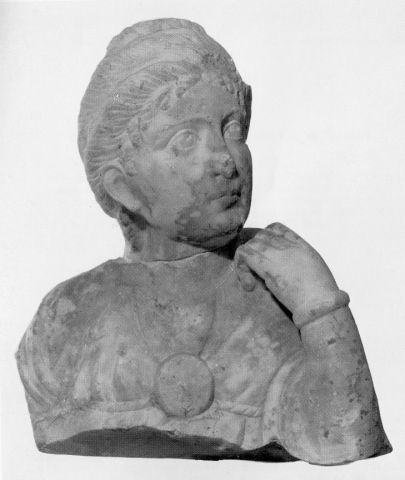
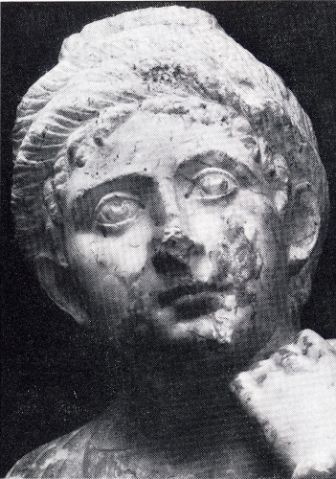
Fragment of portrait statue of girl (in 'Fausta' type). Art Market. Late third to early fourth century.
Record details
Photographs
Bibliography
- Bergmann, M., Studien zum römischen Porträt des 3. Jahrhunderts n. Chr., Bonn 1977, 198 (Tetrarchic to Constantinian)
- Sothebys London, Catalogue of Egyptian, Western Asiatic, Greek, Etruscan, and Roman Antiquities. Also Islamic Pottery and Metalwork. Monday 1st Cecember 1969, London 1969, 74, no. 157
Discussion
DESCRIPTION (Object)
Fragment of bust or statue. H: 44.5 cm. Marble.
The object is broken at the right upper arm and below the breasts. It preserves the chest, head, and left arm. The head has broken at the base of the neck but appears to join the chest break upon break.
The hair is indicated with a flat chisel. The pupils are large crescents, and the irises are large and engraved with a flat chisel.
PROVENANCE
Unknown.
DESCRIPTION (Subject)
The bust or statue portrays a girl. She turns to her right and reaches with her right arm to her chin. She wears a sleeved inner garment; it ends in a roll at the wrist. Over this seems to be a second garment which is belted below the breasts. Possibly a third garment is draped in the crook of the right arm. A large circular medallion hangs on a cord between the breasts.
The hair is pulled off the face and arranged at the sides in two tiers of hair that are pulled back and upward. Short locks escape this arrangement and fall directly onto the brow. A braid is pulled from the back of the head to the top of the head.
The face has a tall brow, large eyes, a long nose, full cheeks, and a small rounded chin. The mouth is short from side to side with a pronounced dip at the centre of the upper lip and a pouting lower lip.
DATE AND HONORAND
The technique in which the portrait is carved and the clothing which it wears suggest a date at the end of the third century or later. Moreover, the portrait seems to follow the same model as LSA-573 and LSA-1300. Delbreuck identified LSA-573 as Fausta for which there is no strong evidence. Bergmann considers all three portraits to represent different girls of the same historic period, the late Tetrarchy or early Constantinian era . Fittschen has noted, with regard to LSA-573 that it follows the same model as a Severan portrait now in the Toledo Museum of Art in Ohio.
To this author and to De Kersauson, the coincidence of three essentially similar portraits of girls in the late Tetrarchic or early Constantinian period suggests that one honorand is intended. Probability would favour an imperial identity.
Discussion references
- de Kersauson, K., Les portraits romains II; de l’année de la guerre civile (68-69 après J-C) à la fin de l’Empire , Paris 1996, 524-5
Cite: Last Statues of Antiquity, LSA-1541 (J. Lenaghan).