
LSA-1544
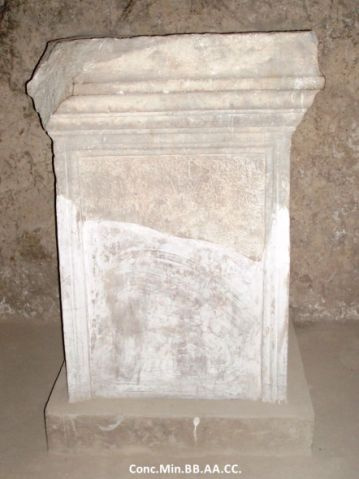
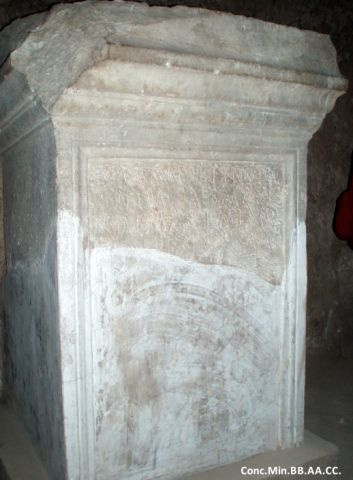
Re-used fragmentary base for statue of Maximian, emperor. Rome, from castrum of the equites singulares. 286-305.
Record details
Photographs
Inscription
Magno et invicto, / d(omino) n(ostro), imp(eratori) Caes(ari) M(arco) Aur(elio) / Val(erio) Maximiano, / ṣẹṃpẹṛ invicto, /(5) Aug(usto). / [---]ụs, v(ir) p(erfectissimus), / ------?
Inscription translation
To the great and unconquered, our lord emperor Caesar Marcus Aurelius Valerius Maximianus, forever unconquered, Augustus ... (…)us, of perfectissimus rank …
Bibliography
- Corpus Inscriptionum Latinarum; , VI, 40720
Discussion
INSCRIPTION
In six surviving lines. Letter height 4.5-3 cm.
Magno et invicto, / d(omino) n(ostro), imp(eratori) Caes(ari) M(arco) Aur(elio) / Val(erio) Maximiano, / ṣẹṃpẹṛ invicto, /(5) Aug(usto). / [---]ụs, v(ir) p(erfectissimus), / ------?
'To the great and unconquered, our lord emperor Caesar Marcus Aurelius Valerius Maximianus, forever unconquered, Augustus ... (…)us, of perfectissimus rank …'
DESCRIPTION (personal inspection)
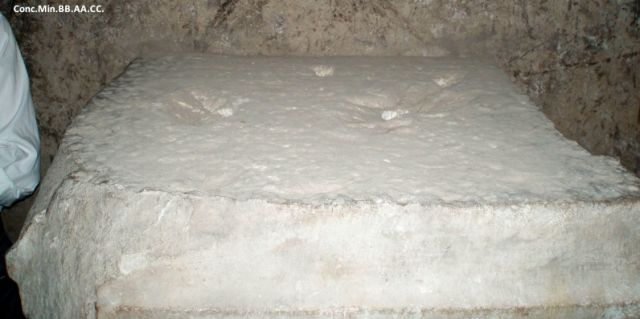
Marble base, 72 x 90 x 86 cm (CIL). The lower part is lost. The base had three lives, as indicated by the traces of earlier inscriptions. It has moulding on the top. The epigraphic field is framed by moulding. It is very rough, and traces of the earlier inscriptions can still be seen. The base has two holes on the top.
PROVENANCE AND CURRENT LOCATION
Our base was found in the area of the camp of the equites singulares, during excavations underneath the basilica of S. Giovanni in Laterano. It was found with LSA-1543. It is still there.
The equites singulares were disbanded by the emperor Constantine after his victory over Maxentius. Their camp was soon afterwards demolished and the Lateran basilica was built on top of it, by the same emperor. Our base was probably broken and used as infill at the foundations of the Constantinian building.
HONORAND, AWARDER AND DATE
The inscription records a dedication to the emperor Maximian, who was Augustus between 286 and 305.
Although the identity of the awarder does not fully survive,he was almost certainly an official of the equites singulares.
Cite: Last Statues of Antiquity, LSA-1544 (Carlos Machado).