
LSA-1545
Small fragment of base for statue of emperor, probably of Diocletian or Maximian. Rome. 289-295.
Record details
Photographs
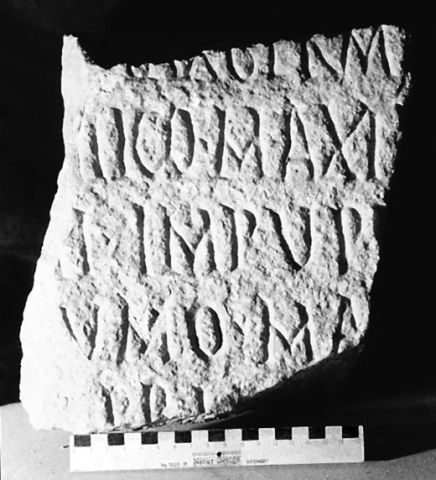
Inscription
------ / [---] ṃạx̣(imo), G̣ẹṛṃ[anico maximo], / [Sarma]ṭico maxiṃ[o ---] / [---] X̣I, imp(eratori) V, p(atri) p̣(atriae), [---] / [---]umo ma[---] / [---] pṛịṇ[cipi ---] / ------?
Inscription translation
To... the greatest, greatest victor over the Germanic peoples, greatest victor over the Sarmatians,... for the eleventh time, imperator for the fifth time, father of the fatherland… emperor…
Bibliography
- Corpus Inscriptionum Latinarum; , VI, 36997=40723
Discussion
INSCRIPTION:
Five surviving lines. Letter height 3,5-4.
------ / [---] ṃạx̣(imo), G̣ẹṛṃ[anico maximo], / [Sarma]ṭico maxiṃ[o ---] / [---] X̣I, imp(eratori) V, p(atri) p̣(atriae), [---] / [---]umo ma[---] / [---] pṛịṇ[cipi ---] / ------?
'To... the greatest, greatest victor over the Germanic peoples, greatest victor over the Sarmatians,... for the eleventh time, imperator for the fifth time, father of the fatherland… emperor…'
The style of the letters suggest a late third-early fourth century date.
The inscription records a dedication to an emperor, who was victor over the Germanic peoples and the Sarmatians, at the same time as he held some unknown title (but probably the tribunician power) for the eleventh time and the power of imperium for the fifth time. The reference to victories over the Sarmathians and the Germanic peoples could refer to Commodus, but this is unlikely due to the style of the letters. The two most likely possibilities are Diocletian and Maximian, but the number of times each one of them held the tribunician power and was acclaimed as imperator does not match (Kienast 1990, 268 and 275). Alföldy (CIL VI, 40723) suggests Maximian, thinking that the epigrapher might have made a mistake when inscribing the number of his acclamations (writing V, instead of X). In any case, whether referring to Diocletian or Maximian, the epigrapher must have made a mistake in the numbering of the titles. Alföldy's tentative reconstruction for this inscription is:
[Imp(eratori) Caes(ari) M(arco) Aurelio Valerio] / [Maximiano, p(io), f(elici), invicto Aug(usto)], / [pont(ifici)] ṃạx̣(imo), G̣ẹṛṃ[anico maximo], / [Sarma]ṭico maxiṃ[o, co(n)s(uli) IIII, trib(unicia)] / [pot(estate)] X̣I, imp(eratori) V, p(atri) p̣(atriae), [proco(n)s(uli)], / [opt]umo ma[xumoque]/ pṛịṇ[cipi], / ------.
'To the emperor Caesar Marcus Aurelius Valerius Maximianus, pious, fortunate, unconquered Augustus, highest pontiff, greatest victor over the Germanic peoples, greatest victor over the Sarmathians, consul for the fourth time, holding the tribunician power for the eleventh time, imperator for the fifth time, father of the fatherland, proconsul, emperor ...'
PROVENANCE AND LOCATION:
The precise provenance of this base is uncertain. It was first recorded as seen in the cella of the temple of Venus and Rome, between the Forum and the Colosseum, but certainly in a re-used context. It was in the Lapidarium of the Forum, inv. 5149 in 1993 (CIL).
DESCRIPTION:
Small fragment of white marble base, 27 x 23 x 11.5cm, broken on all sides. The surface shows clear signs of erasure of an earlier inscription.
HONORAND, AWARDER AND DATE:
The inscription records a dedication of a statue to an emperor, possibly Diocletian or Maximian (see discussion above). In this case, it must have been dedicated between 294 (when Diocletian held the tribunician power for the eleventh time) and 295 (when Maximian did it). In any case, 295 is a secure terminus ante quem, as the Augusti received the title of Persicus maximus on that year (Kienast, 1990, 268 and 275).
Discussion references
- Kienast, D., Römische Kaisertabelle : Grundzüge einer römischen Kaiserchronologie, Darmstadt, 1996
Cite: Last Statues of Antiquity, LSA-1545 (Carlos Machado).