
LSA-1546
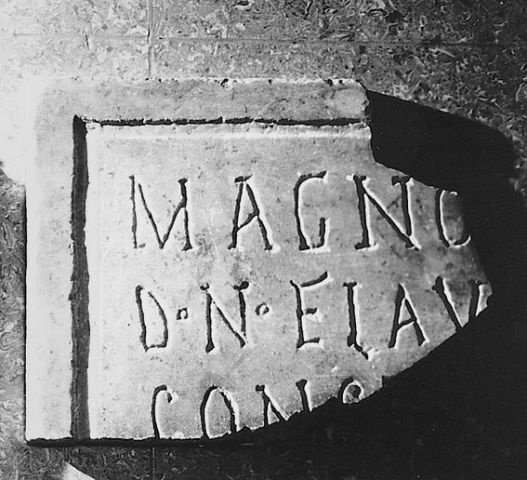
Small fragment of plaque with dedication to Constantius I, emperor, probably from base for statue (with LSA-1547). Rome. 305-306.
Record details
Photographs
Inscription
Magno [et invicto] / d(omino) n(ostro) Flav[io Valerio]/ Cons[tantio, pio], / [felici, Aug(usto), pontif(ici)] / [max(imo) ---] / ------.
Inscription translation
To our lord, the great and unconquered Flavius Valerius Constantius, pious, fortunate, Augustus, highest priest (pontifex maximus)…
Bibliography
- Corpus Inscriptionum Latinarum; , VI, 40723a
- Kränzl, F. and E. Weber, Die römerzeitlichen Inschriften aus Rom und Italien in Österreich, Vienna 1997, no. 3
Discussion
INSCRIPTION:
In 5 lines. Letter height 6.5-6 cm.
Magno [et invicto] / d(omino) n(ostro) Flav[io Valerio] / Cons[tantio, pio], / [felici, Aug(usto), pontif(ici)] / [max(imo) ---] / ------.
'To our lord, the great and unconquered Flavius Valerius Constantius, pious, fortunate, Augustus, highest priest (pontifex maximus)…'
Fragmentary inscription of dedication to the emperor Constantius I.
PROVENANCE AND LOCATION:
The provenance of this fragment is unknown. It is now in Innsbruck (Austria), at the University Museum (CIl; Weber and Kränzl 11987, n. 3).
DESCRIPTION:
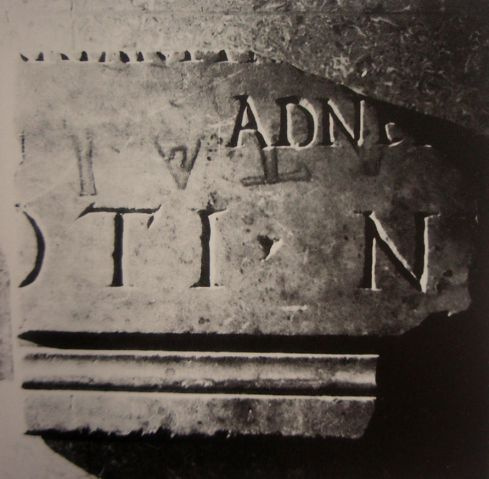
Marble plaque, framed with moulding. Only the upper right corner survives. There is an earlier inscription at the back, part of a larger monument originally dedicated to members of the Severan dinasty (CIL VI, 40620a; Kränzl and Weber 1987, no. 3). Another part of the earlier inscription can be seen at the back of LSA-1547, dedicated to Galerius. The original Severan monument was probably dismantled and the inscribed marble plaque was cut and prepared for re-use. The dedications to Constantius I and to Galerius were independent monuments, since the surviving fragments of both monuments correspond to the upper right hand corner of a marble plaque. Their common original use, however, as well as the exact similar wording of the inscription reinforces the idea that they were placed together, either as a par or as part of a larger statue group honouring the second tetrarchy (including Maximinus Daia and Flavius Severus).
HONORAND, AWARDER AND DATE:
The inscription refers to Constantius I as Augustus, and must therefore be dated to 305-306. The identity of the awarder does not survive.
Cite: Last Statues of Antiquity, LSA-1546 (Carlos Machado).