
LSA-155
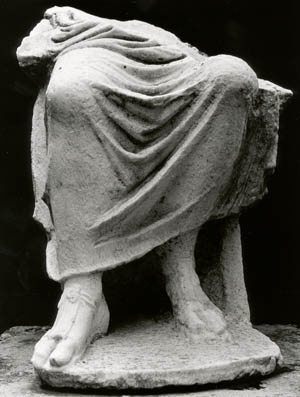
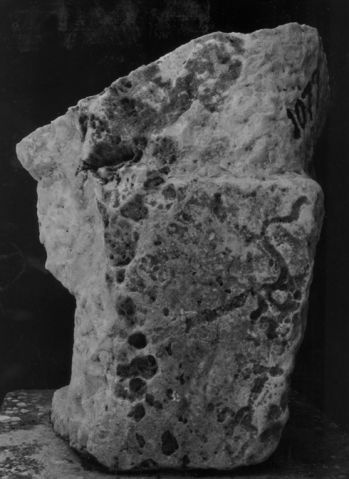
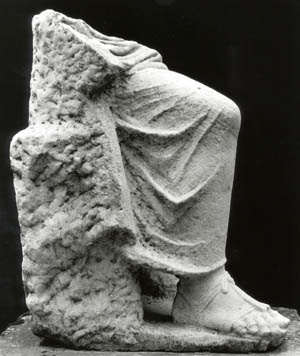
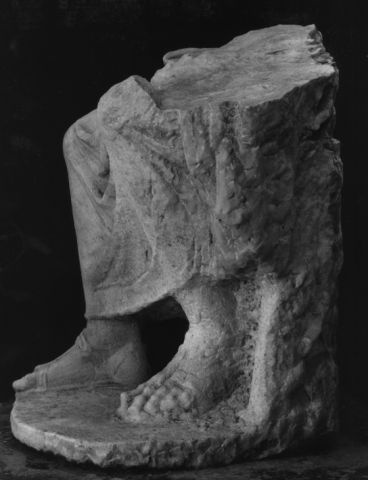
Lower part of seated male statue wearing himation. Aphrodisias (Caria). Fourth century.
Record details
Photographs
Bibliography
- Rockwell, P. 'Unfinished statuary associated with a sculptor’s studio', Aphrodisias Papers 2: the theatre, a sculptor’s workshop, philosophers, and coin-types (JRA Suppl. Series 2), Ann Arbor 1991, figs. 8, 17-18.
- van Voorhis, J., Aphrodisias V. The Sculptor’s Workshop, Mainz forthcoming
Discussion
DESCRIPTION (Object)
Lower body of life-size statue. H: 73.5, W: 57.5, D: 56.0 cm. Medium to large-grained white marble.
The upper part of the statue is missing. A break runs diagonally from the right hip to the left thigh. The roll of drapery pulled across the figure’s lap and hangs on either side of the chair is badly chipped on the left side and completely broken on the right. The folds of drapery are chipped and worn.
The statue was never finished and displays signs of secondary carving. The sides are more coarsely worked than the front, and the back of the statue remains in quarry state. The right foot is more fully finished than the left which is smaller and not fully worked out of the background. The sandal of the left foot is incorrectly represented. On the right lower leg of the figure, a narrow strip of rasp-finished surface runs vertically down the shin. This area finished with the rasp is at higher level than the more roughly worked stone adjacent to it and therefore must reflect an earlier stage of work.
PROVENANCE
It was found in the Sculptors’ Workshop at Aphrodisias in 1969. The Workshop was located along the north side of the courtyard to the northeast of the Bouleuterion.
DESCRIPTION (Subject)
The life-size statue preserves the lower part of a seated male figure seated on a backless chair, draped in a himation and wearing Greek sandals. It rests on a thin plinth with an irregular curving front edge. The right foot is placed forward; its toes extend beyond the edge of the thin plinth. The left foot is set back, close to the seat, and the left knee is raised higher than the right. The bottom edge of the himation crosses the body above the ankles, and a roll of material drapes loosely across the figure’s lap. The representation of the drapery is simplified and schematic in its arrangement. In contrast, the details of the sandals are fully indicated, and the toes are carefully articulated, with sharp, knobby joints.
It appears that the statue was never finished during its first carving phase. It was perhaps abandoned on account of a technical problem or possibly the commission was cancelled. At a later time secondary work was undertaken on the statue which may simply have been for practice since it too was never finished.
DATE
The date of the first carving phase cannot be determined and must depend on stylistic analysis. The treatment of the toes of the feet recall the treatment of another work from the same workshop, a fine statue of a Satyr holding the baby Dionysos. That statue probably belongs to the late third or fourth century. It is noteworthy that this feral feature is appropriate for a satyr but seems out of place in a civic portrait.
The secondary carving of the seated figure must come after the initial carving and before the Workshop went out of use. The coins found in the area indicate that Workshop continued until the early fifth century. Thus, one should imagine the second carving to belong to the later fourth or early fifth century.
HONORAND
Statues of seated men wearing the traditional Greek himation are common throughout the Greek East in the imperial period. The types of chairs on which they sat and the lack or presence of a chiton could give them a variety of connotations. These important details are missing in this instance.
Two late-antique examples are preserved from Aphrodisias. Both were located in the south Agora. One is bare-chested and was set probably in a second use on a base for the governor of AD 284 (Aphrodisias II no. 52). The other wears a chiton and had a separately worked head of the late fifth century LSA-172.
Cite: Last Statues of Antiquity, LSA-155 (J. Lenaghan).