
LSA-1553
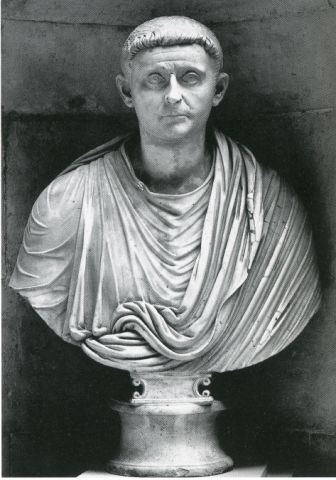
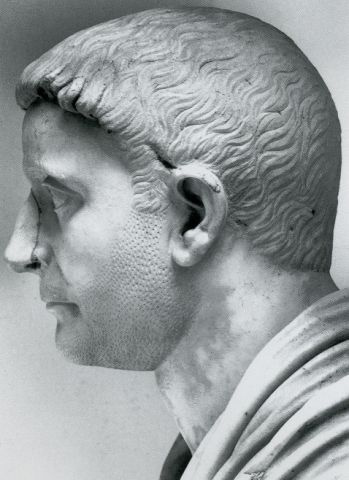
Togate bust of man, recut from earlier portrait. From West? Fourth century.
Record details
Photographs
Bibliography
- Borg, B., H. von Hesberg, and A. Linfert, Die antiken Skulpturen in Castle Howard (Monumenta artis Romanae. Antike Skulpturen in englischen Schlössern. Monumenta artis Romanae ; 31, Wiesbaden 2005, 119-120, no. 64, pls. 65 and 66.2
Discussion
DESCRIPTION (Object)
Over life-size bust. H: 88.3, H (chin to crown): 23.2 cm. Fine-grained, somewhat grey marble.
The head, bust, tabula and foot are made in one piece. They have either been cut down from a a first century statue (Goette) or were originally an early Antonine bust (Borg).
The nose is restored, and probably the iris has been gone over. Many folds have marble and plaster repairs.
The hair around the brow is in places undercut with a drill and in places separated by drill work. The rest of the hair and eyebrows are rendered with engraved lines made with a flat chisel. The beard and moustache have been engraved into the surface with a fine point chisel. The pupils of the eyes are defined by two contiguous drill points set in the centre of the eye. The irises are semi-circular lines of the flat chisel which do not touch the lower lid.
PROVENANCE
Although no provenance is recorded for this object, most of the Castle Howard collection was acquired in Rome in the 18th century.
DESCRIPTION (Subject)
The portrait bust consists of a thick cylindrical foot, a broad tabula, a large area of chest which extends to the waist and includes the upper arms, and a proportionately small head. It depicts a man dressed in a tunic and toga and turned to his right.
The cylindrical foot has upper and lower moulding but the scotia or central indentation is minimal. Thus, it is thick. The tabula is framed by mouldings which terminate on the sides in scrolls that have been fretted with a drill.
The large chest area shows a tunic with a round neckline and flat but copious folds. Over this, on the left and lower parts of the chest, is the toga. It wraps in numerous fine folds over the left arm, and features an umbo just to the proper right of centre at the bottom and a balteus which rises from right waist to the left side of the neck. The folds of the balteus are slightly broader and more irregular.
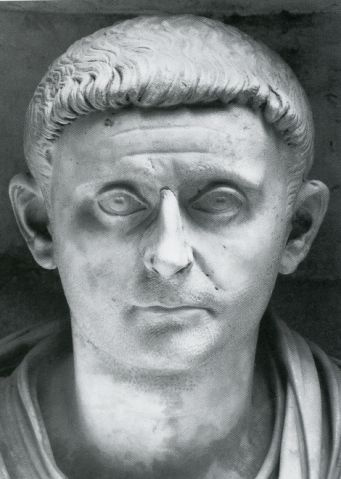
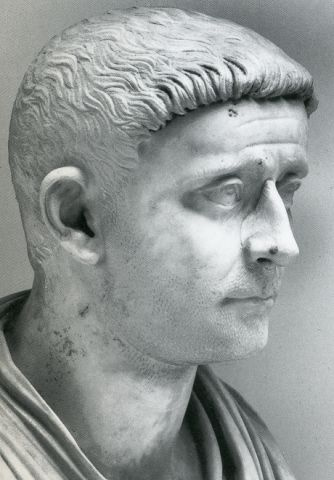
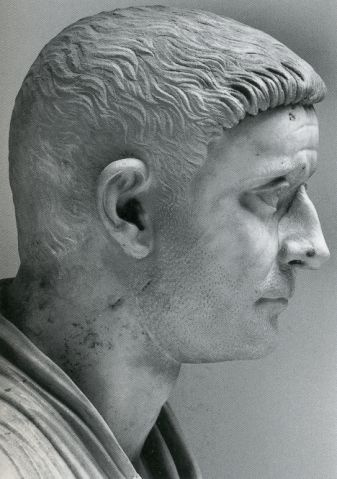
The man wears a short hairstyle in which the hair is combed forward in medium-length curving strands which generally maintain a uniform volume of c. 2 cm. On the right side the locks at the temple are flat and combed forward, but around the rest of the brow and the left temple there is undercutting so that the hair seems to turn under itself. Over the right eye the locks turn inward until over the middle of the right eye. Between the right eye and the left eye, the locks turn to the right, and above the outer corner of the left eye, the fringe becomes irregular. In front of the ears the hair are sideburns of trimmed short locks which are completely separate from the stubble beard below them
The head has a broad modelled brow which features two emphatic creases and slopes at the temples. The eyes are close-set, small, and with pointed inner canthi. The naso-labial folds are deep, and the mouth is thin-lipped. The chin is small and receding. A stubble beard and moustache cover the upper lip, cheeks, chin, and area under the cheeks.
DATE
The current portrait head shows a stippled beard that continues onto the neck and a combed forward hairstyle. In addition, the eyeballs are marked. These details of fashion and technique suggest a date in the fourth century.
HONORAND
The physiognomy of the portrayed is not known in any other representation. He is therefore not an imperial figure. The choice of the togate costume, however, suggests a man of rank and one with connections to the traditional Roman world; for example, a man of clarissimus rank from Italy.
TECHNICAL DISCUSSION AND RELEVANCE
This portrait has four distinct signs of re-cutting. (1) The hair has been cut back. There are traces of longer hair around both ears as well as a drilled out area in front of the upper edge of the left ear. (2) The eyes have been schematically marked. (3) The beard and moustache have been regularly stippled into the face. (4) The head appears too small for the bust.
Two hypotheses have been put forward. Goette suggested that this portrait was originally a togate statue of the Emperor Claudius (AD 41-54). The facial structure (the broad brow that slopes, the prominent ears, and deep naso-labial folds) as well as the general shape of the hair have an undeniable resemblance to the portraits of Claudius. The large ample toga is also potentially first century. The hypothesis has two serious weaknesses. First, the drapery over the left arm comes inward toward the centre of the bust and thus reacts to a bust form. In statues this drapery falls more vertically. Two, the bust is made in one piece with the cylindrical foot which is difficult to imagine practically. It would certainly have been easier to carve a foot from another element.
Borg has therefore suggested that the monument has been re-worked from a large early Antonine bust. The size of the bust cannot pre-date the Hadrianic period. The traces of drilling in the hair and traces of longer hair around the ears would suit this period when drill work was being experimented with and when combed forward hairstyles of curling locks were popular. The figure might originally even have had a beard. Borg plausibly compares certain facial details to those of Antoninus Pius (AD 138-161).
There has been no comprehensive study concerning the adaptation of statues into busts. Borg, correctly critical of Goette’s hypothesis, points out that there is little to no secure evidence for this in antiquity. If this were indeed the case, this would seem a notable technical particularity of ancient carvers and reflect perhaps on the static and aesthetic concerns surrounding the use of busts. Interestingly neither Goette nor Borg discuss or illustrate the structure and workmanship of the back of the bust.
Discussion references
- Goette, H.R., Studien zu römischen Togadarstellungen, Mainz 1990, 70ff, pl. 59.1-2
Cite: Last Statues of Antiquity, LSA-1553 (J. Lenaghan).