
LSA-1555
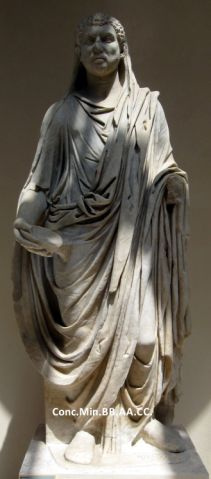
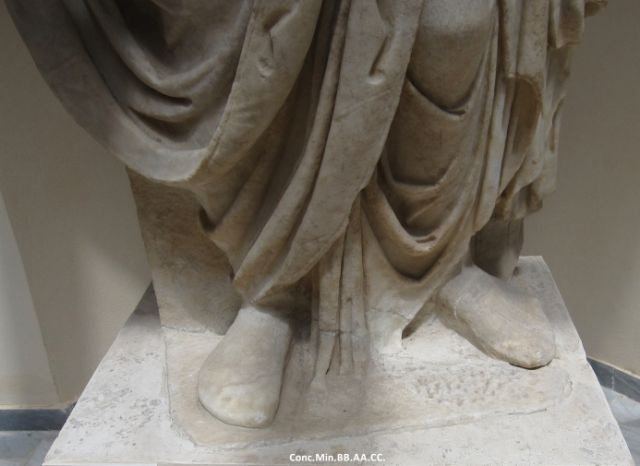
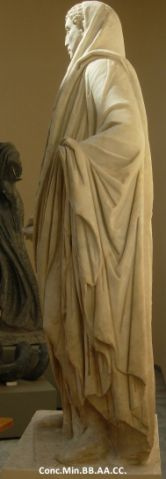
Togate portrait statue of man with inscribed stubble beard, re-used(?). From Ostia. Late third to early fourth century.
Record details
Photographs
Bibliography
- Calza, R. 'Una statua imperiale del IV secolo nel Museo Ostiense', Bullettino della commissione archeologica comunale di Roma 72, Rome 1948, 83-94, pls. 1-2
- de Chirico, R. 'VI. Ostia. --Sculture provenienti dall'edificio degli Augustali', Notizie degli scavi di antichità, Rome 1941, 222-9, figs. 3-5
Discussion
DESCRIPTION (Object)
Over life-size statue. H: 200, H (of neck and head): 38, H (face) 29 cm. Yellowish Italian marble
Well-preserved. The left side of the nose, the right thumb, and the left arm from the middle of the forearm down have broken off. There are chips in the right eyebrow and drapery. The plinth has been set into a modern base at an angle that detracts from the right turn of the head.
The statue is made in one piece from the head to the plinth. The right hand and patera are connected to the upper thigh by a strut. A statue support is located along the outside of the right leg. It has no representational detail.
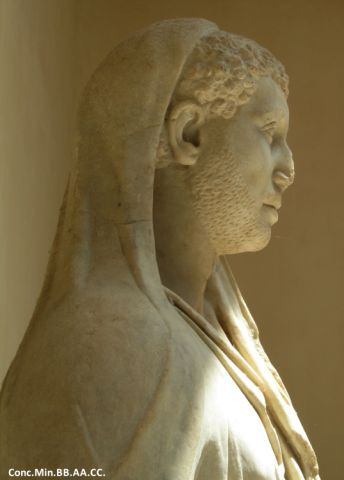
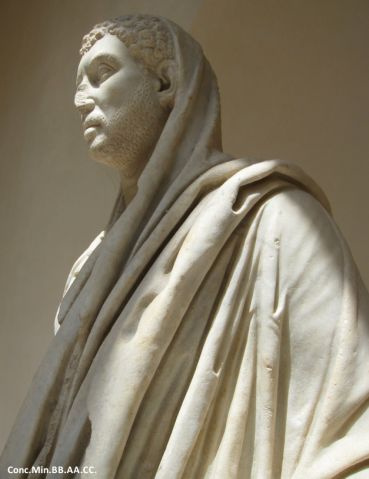
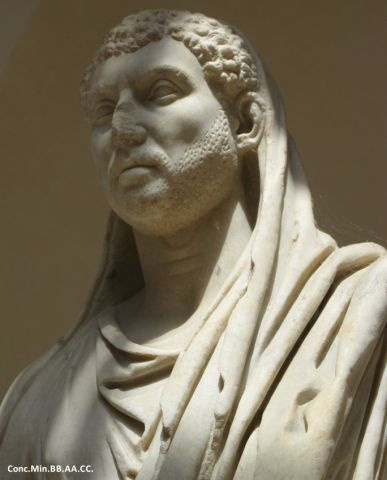
The hair is curly but rendered with almost no drill work. The eyes are unmarked; Calza sees a small pupil marking which I could not find on personal inspection; irregular marks do appear in Figure 4 of the original 1941 publication. The beard has been chiselled into the cheeks and upper lip, seemingly at a second moment from the manufacture of the statue. It makes a broad even band down the sides of the cheeks, and the moustache cuts into the lines of the philtrum and obscures the definition of the upper lip. The eyebrows also have been gone over with a chisel, perhaps to give them a slightly higher arch. On the inside of the left foot on the plinth is a rough picked area. This may be part of the original statue since it is difficult to imagine any object in this location which might have been removed.
PROVENANCE
Found with a group of ten sculptures in the College of the Seviri Augustales. This complex was enhanced with a series of rooms around a new, two-storeyed central apsed room. The new mosaic floors, crustae wall decoration, and building technique suggest the renovation occurred in the late third or early fourth century. ***?cite de Chirico***The sculptures were found neatly stacked in a corner of the courtyard. They included a re-used but headless statue of a Sevir Augustalis; two headless statues in cloaks; a female statue possibly of the early fourth century (LSA-1556); a Hadrianic portrait statue of a woman; a re-cut third century male head for insertion; two male portrait heads for insertion of the first century; a fragmentary statue of Diana; and a reclining nymph. Although these statues may hypothetically have been assembled here from far afield for burning, (1) one of the headless statues is a Sevir, (2) two of the statues (this and LSA-1556) date to the same period as the renovation, and (3) there are three male portrait statues with sockets for heads and three male portrait heads for insertion. This suggests a unity within the group.
DESCRIPTION (Subject)
The statue shows a mature man wearing a toga and in the act of sacrifice. He has short curly hair that recedes at the corners of the brow and a stubble beard.
The statue stands with its weight over the right leg. Both arms extend along the sides of the body. In the right hand is a patera. The left arm is bent at a 90 degree angle and supports the end of the toga. The head, the back of which is covered by the toga, is turned slightly toward the right.
The man wears a voluminous version of a high imperial toga pulled over the back of his head. The toga features a broad sinus that extends below the knees, a small umbo on the right side of the waist, a regular balteus, and the standard lacinia. Under the toga he wears a short-sleeved tunic which also features large heavy folds. On his feet are soft leather shoes.
The head shows a broad-faced man with thick curly hair, prominent cheekbones over slightly hollowed cheeks, and a small full-lipped mouth. Two furrows rise from the inner corners of the eyebrows and disrupt an otherwise smooth brow. The eyebrows are thick and arched. A beard and moustache have been etched into the surface of the face.
DATE
The carving technique and costume of the statue belong to the high imperial period. The fact that the statue has been cut from one block of marble without any piecing also suggests a second century date. The hairstyle of the original portrait statue is full and curly but rendered without drill work. This seems most likely to belong in the Hadrianic era; it can be placed certainly between the end of the first century and the middle of the second century. However, this hairstyle and lack of eye markings are not contemporary with the stubble beard that has been pecked into the cheeks and upper lip. Thus, the statue seems to have been re-used.
In support of this hypothesis is the find context. The building was refurbished in the late third or early fourth century, and two other statues, both re-used, were also found there (see above).
The structure of the statue (that is, general shape, pose, and arrangement of drapery) recalls another late third century statue from the environs of Rome which re-uses a second century togate body (LSA-852) in combination with a late third century head.
IDENTIFICATION
Calza identified this statue as Maxentius (306-312) because of its size, its context, a historic connection of Maxentius and Ostia, and its physiognomy. All of these arguments, but perhaps the lattermost, are potentially valid. Yet, none of the other statuary found in the College is imperial, and the statue does not wear senatorial calcei, which one would expect even in a re-used statue. It is probably safer to assume that this re-cut togatus represented an important private individual.
Discussion references
- Goette, H.R., Studien zu römischen Togadarstellungen, Mainz 1990, 133, no. 58 (statue: Hadrianic to early Antonine)
Cite: Last Statues of Antiquity, LSA-1555 (J. Lenaghan).