
LSA-1556
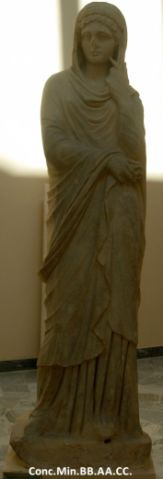
Portrait statue of woman in pudicitia pose. From Ostia. Late second or earlier fourth century.
Record details
Photographs
Bibliography
- de Chirico, R. 'VI. Ostia. --Sculture provenienti dall'edificio degli Augustali', Notizie degli scavi di antichità, Rome 1941, 234-7, figs. 10-12
Discussion
DESCRIPTION (Object)
Life-size statue. H: 175, H (head): 22 cm. White Italian marble.
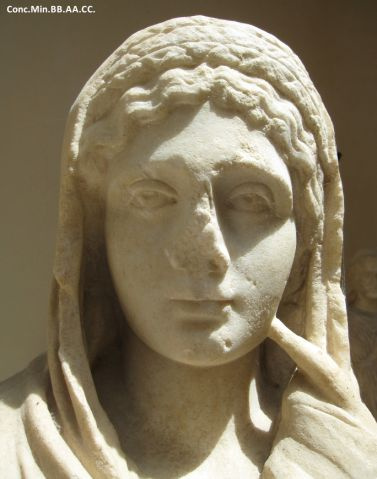
Well-preserved. The right side of the nose, the edges of the drapery in the veil, the outer part of the right eyelid, and the front part of the right foot have broken off. Various other minor chips and abrasions can be found throughout.
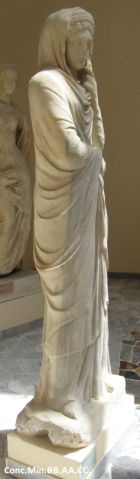
The statue is made in one piece from the head to the plinth. The back of the statue is flat with representational detail in low relief. There is a cutting under the left foot on the top surface of the plinth, and a cutting on the right side of the plinth. These were presumably used to attach the statue to its base.
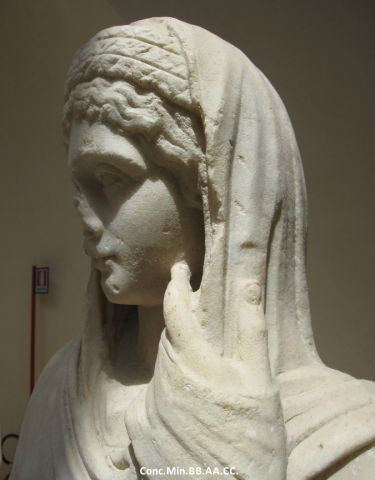
The criss-crossing locks in the encircling braids have been rendered with a flat chisel. A drill has been used to separate the wavy locks over the brow. The pupils are drilled out in a large crescent-shape, and the inner canthi are also defined by drill points. The iris is a finely engraved semi-circular line which touches the bottom lid. The upper line of the eyelid is precisely and deeply defined by a flat chisel. Deep drill channels also separate the neck from the inside of the veil.
PROVENANCE
Found with a group of ten other sculptures in the College of the Seviri Augustales. This complex was located on the south side of the Decumanus to the west of the Theatre. It was enhanced with a series of rooms around a new, two-storeyed central apsed room. The new mosaic floors, crustae wall decoration, and building technique suggest the renovation occurred in the late third or early fourth century. The sculptures were found neatly stacked in a corner of the courtyard. They included a re-used togate statue of a bearded man (LSA-1555); a re-used but headless statue of a Sevir Augustalis (LSA-1642); two headless statues in cloaks; a Hadrianic portrait statue of a woman; a re-cut third century male head for insertion; two male portrait heads for re-insertion of the first century; a fragmentary statue of Diana; and a reclining nymph. Although these statues may hypothetically have been assembled here from far afield for burning, (1) one of the headless statues is a Sevir, (2) two of the statues (this and LSA-1555) date to the same period as the renovation, and (3) there are three male portrait statues with sockets for heads and three male portrait heads for insertion. This suggests a unity within the group.
DESCRIPTION (Subject)
The portrait statue depicts a woman with a fashion hairstyle composed of encircling braids and a non-specific physiognomy. She stands in the ‘Pudicitia’ pose which was popular in funerary statuary.
Here, the weight rests upon the left leg. The right arm is bent across the body at a 90 degree angle; the upper arm remains alongside the body and the forearm crosses the body horizontally. The right hand rests near the left hip. The left arm is bent over itself; the upper arm remains next to the body and the forearm moves from the left waist in the direction of the left side of the chin. The left hand is wrapped within the palla and holds the edge of the palla near the left side of the face. The index figure actually touches the face. The head tilts downwards and turns to its right. The shape of the body is particularly rectangular; the lines from the shoulders to the feet are almost vertical.
The articles of clothing worn are the tunica, palla, and closed shoes. The palla covers the head and its bottom hem reaches below the right knee and to the left knee. The tunica appears only around the lower legs and around the front neckline.
The hair over the brow is parted in the centre and brushed in gentle waves toward the sides of the head, possibly covering the ears. The remainder of the hair is caught in three braids that wind around the head.
The face is a soft oval. The brow is tall and smooth with no break at the bridge of the nose. It seems to hang over the entire face. The eyes are small, have heavy upper lids, and large pupils. The mouth is small, and there is a deep indentation beneath the lower lip and above the chin which causes the lower to roll out. The chin is small and rounded.
DATE
The portrait statue is difficult to place chronologically. It was initially published as late second century (de Chirico, 1941) and then subsequently as late antique (Calza BdA 1942). Neither the hairstyle nor the technical details are conclusive.
The flat encircling braids might be an early second century ‘basket’ or ‘turban’ coiffure. Such a date, however, would be incongruous with the eye markings. Hairstyles with encircling braids do return to fashion in the fourth century; for example, LSA-768, LSA-964, LSA-1194, and LSA-1299. LSA-592 shows that the fashion continues into the late fourth century.
The small-scale of the statue, its lack of depth, and inorganic handling of the body recall late antique statuary, especially the similarly-sized togatus from Ostia (LSA-1082). The lack of modelling and plasticity in the face also suggest a late antique rather than a second century date.
Cite: Last Statues of Antiquity, LSA-1556 (J. Lenaghan).