
LSA-1557
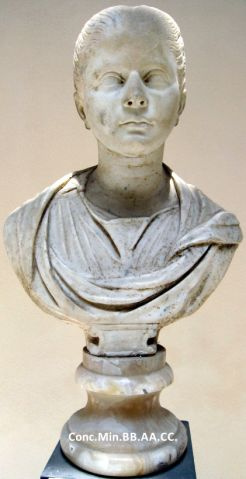
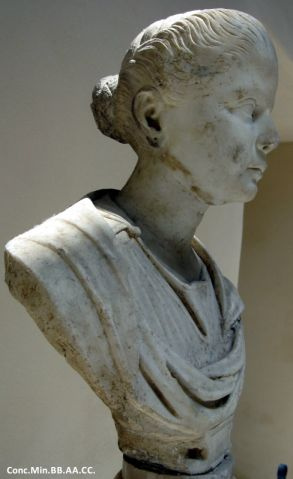
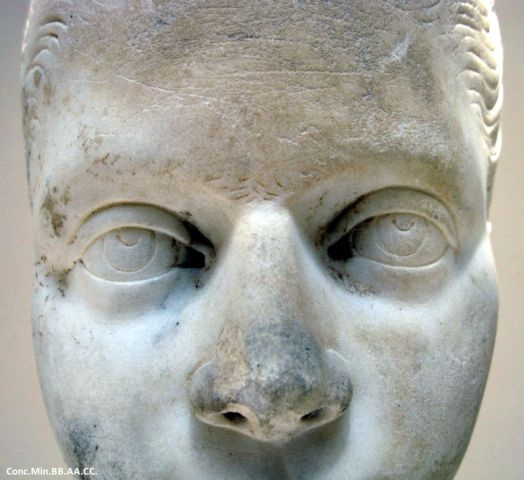
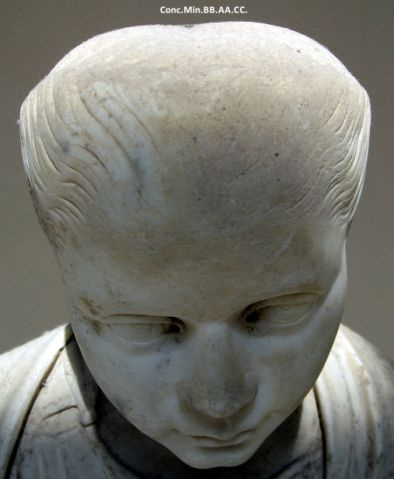
Portrait bust of girl, possibly reworked. From Ostia. Fourth century(?)
Record details
Photographs
Bibliography
- Calza, R. (ed.), Scavi di Ostia. v.9. I Ritratti, pt. 2. Ritratti romani dal 160 circe metà del III secolo d.C. , Rome 1977, 26-7, no. 29, pls. 21-2
Discussion
DESCRIPTION (Object)
Life-size bust. H: 44 cm. H (of head): 22 cm. White Italian marble.
The bust is worked in one piece of marble from the bottom of the tabula to the top of the head. The tabula currently rests on a moulded alabaster foot, which is seemingly alien to the original bust (see Calza who describes the foot as missing).
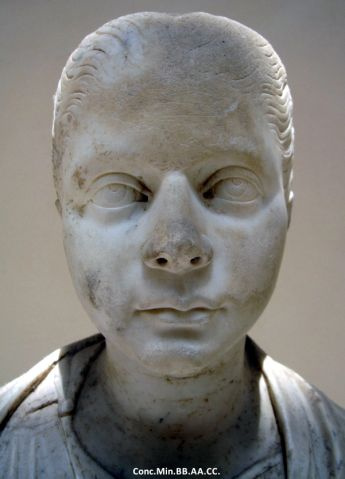
The preservation is excellent. There are scratches on the brow; the eyebrows are worn; the tip of the nose is abraded; and the separately worked, probably metal, earrings are missing. The back is covered with root marks.
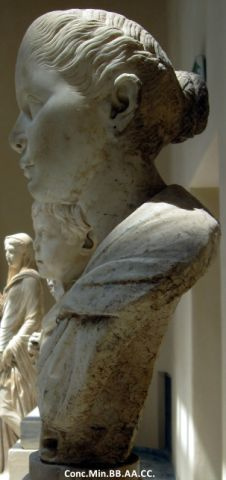
The back of the head is completely worked, and the back of the bust is hollowed out on either side of a central spine. The area behind the scrolls of the tabula has not been removed. The lateral edges of the bust do not curve backward.
There is some emphatic and schematic drillwork in the drapery of the bust. Two descending deep drill channels make a V-shape in the undergarment. Three deep drill channels in the outer garment essentially create a circle around the perimeter of the work. Deep drill work is also visible at the nostrils and in the canthi, and hole has been drilled in each earlobe for the attachment of an earring. The scrolls of the nameplate (tabula) are not drilled.
Fine engraved lines made by a flat chisel have been used throughout the portrait. They define the inner frame of the tabula; the sewn edges of the inner garment; ‘Venus’ lines on the neck; the hair on the bridge of the nose; and the hair of the head.
Some of this flat chisel work may belong to a second moment of carving. Two concentric semi-circles define the pupil and iris in each eye. Another curving line marks separates the canthi from the eyeballs. Furthermore, there is a flat chisel line between the neck and the jaw bone on each side of the face. The flaring part of the nostrils has also been outlined with a fine flat chisel line. Some of the hair around the brow also seems to have been added. This is especially true on the right side of the head where the engraved locks are not all continuous. Moreover, the hair at the centre of the brow is oddly rendered. The brow rises, and there is marble enough for a three-dimensional rendering of the hair; yet the hair is only sparsely and flatly incised.
PROVENANCE
Found in a room behind the Temple of Hercules to the northwest on 3 September 1938.
DESCRIPTION (Subject)
The portrait busts shows a girl dressed in two garments who turns gently to her right. She has fine hair pulled into a bun and a distinctive physiognomy with large eyes.
The drapery is rendered in a decorative almost inorganic manner. The outer garment is of a heavier material and is wrapped around the shoulders. The inner garment has an engraved hem at its upper edge, and one button is visible on the right shoulder.
The hair is sharply engraved around the brow. It is pulled back around the ears in a band of gently curving locks which tucks under itself. The hair is gathered above the nape in a bun of tightly wrapped braids.
The face is distinctive. The eyes and mouth are disproportionately large. They are both mannered in rendering. The eyes have large and long inner canthi, and upper lids which overlap the lower lids; because the detailing is engraved, this has an inorganic aspect. The mouth is broad, and the upper lip has a pointed central overhang. The lower lip pouts above a projecting rounded chin.
Behind the chin, the skin hangs loosely, and on the neck are engraved Venus lines. Both these details seem unusual in a girl who would appear to be under the age of 14. Even earrings on the image of a child seem unusual.
DATE
The date is controversial. Von Heintze has argued for a early fourth century date whereas Calza has placed it in the late second century. The problem lies in the fact that the bust is full of inconsistencies in hairstyle and technique. This is mainly because so much detail has been engraved with a flat chisel rather than rendered in relief. It is possible [see Description (Object) above] that the bust was refreshed at a second moment.
The shape and technical structure of the bust give it a terminus post quem of at least c. 130. The flat and schematic arrangement of the drapery suggests that the terminus post quem can probably be shifted to the later second or early third century. This dating accords generally with the hairstyles of the important young women of that era; the bun recalls that of Lucilla, and the flat linear of the hair around the brow as well as the neat tuck around the ears can be seen on portraits of Crispina and Plautilla.
Yet, this bust may have been refreshed after its creation. The emphatic marking of the eyes not made by the drill; the outlining of the nostrils; the line separating the face from the neck; and the unusual shape of the hair over the brow are not details typical of second to third century Roman portraiture. Furthermore, the hair around the brow is comparable both in style and in technique to the that worn by the so-called portrait of Fausta (LSA-573) in Paris. The mouth (especially the distinctive upper lip) and eyebrow also do repeat in that Fausta portrait. It is difficult to judge whether this is simple coincidence, a case of ‘Zeitgesicht’, or a version of the same individual (see below). But in any case in terms of dating it is perhaps easiest to assume that both Calza and von Heintze are partially correct.
HONORAND AND CONTEXT
The find location in Ostia, presumably on the east side of the via del Tempio di Ercole, locate it between the Baths of Mithras, the Temple of Hercules, and the House of Cupid and Pysche. This leaves all possibilities open. However, the subject (young girl) and the genre (bust) make a private context seem likely; the separately added earrings, vulnerable to theft, seem to affirm this. Most probably this was the image of a beloved daughter, portrayed in the manner of an Imperial princess and set in a late-antique house.
Discussion references
- Heintze, H. von 'Römische Bildniskunst' in, Das römische Weltreich. Propyläen Kunstgeschichte II , Berlin 1967, 263-4, no. 332a
- von Heintze, H. ‘Ein spätantikes Mädchenportät in Bonn. Zur stilitischen Entwicklung des Frauenbildnisses im 4. und 5. Jahrhundert’, Jahrbuch für Antike und Christentum 14, Münster 1971, 65, no. 2, pls. 5a and 6a (first third of fourth century, Fausta)
Cite: Last Statues of Antiquity, LSA-1557 (J. Lenaghan).