
LSA-1558
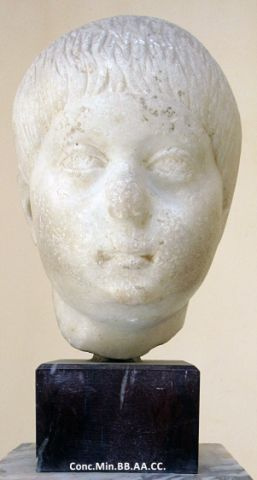
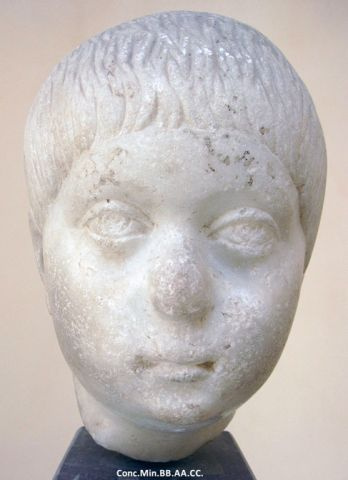
Portrait of boy, re-cut. From Ostia. Fourth century.
Record details
Photographs
Discussion
DESCRIPTION (Object)
Over life-size head. White Luni marble.
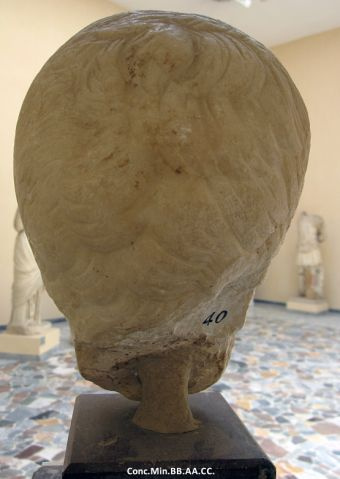
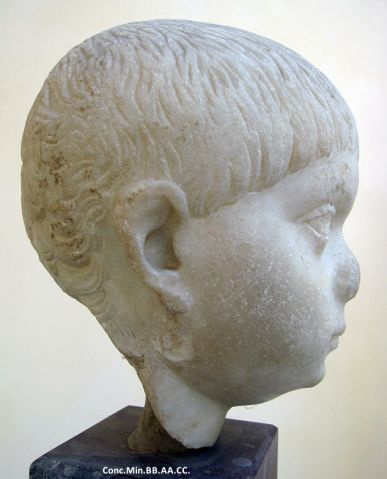
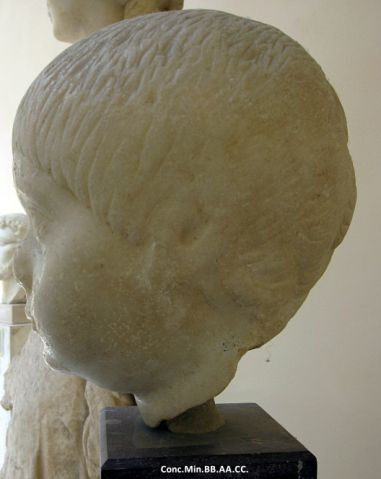
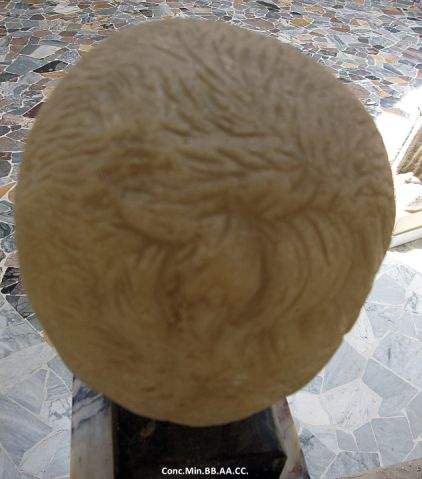
The head has broken irregularly around the neck. The break begins in the middle of the neck and moves upward into the cranium at the back of the hair. More is missing on the back right side of the he head than on the left. The tip of the nose and the rim of the right ear are broken. Only a ghost of the left ear is extant. The reason for this, however, seems to be the working down of an originally larger head.
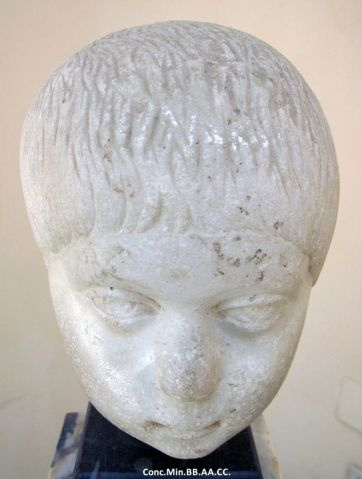
The head has been re-carved from an earlier portrait. The back of the head preserves the original Julio-Claudian portrait. The front of the head has been taken back significantly and at an irregular angle. The still visible depression of the inner ear on the left side is higher than eye level, whereas on the right side the original ear is maintained in the correct relationship to the eye. It is, however, too large for the current portrait. The hair at the front, top, and sides of the head has been deeply engraved. The engraving varies from long bending lines to smaller, simple rectolinear cuts of the flat chisel. Both the pupil and the iris have been cut into the surface of the eye with a flat chisel. On the right eye both iris and pupil are semi-circular. On the left eye, the pupil appears to be circular. The lines defining the upper eyelid of the right eye and the lower lid of the left eye seem to have been added with a flat chisel. The lips are separated by a drill channel which ends in large points on both sides of the mouth.
PROVENANCE
From the Forum Baths in 1922?
DESCRIPTION (Subject)
The head turns to its right. It depicts a soft-faced child with short straight hair.
The brow is low with lightly indicated arching eyebrows over large eyes. The bulge of the eyeball continues significantly below the lower lid. The bridge of the nose is broad and indented; the end of the nose is large and fleshy (and there are barely traces of the nostrils). The mouth is small but the deep drilling in the corners makes it seem down-turned. The chin is set back, short, and slightly pointed.
The hair is combed straight forward on to the brow. It is rendered in medium-length locks that merge into the brow.
DATE
The head has been re-cut from an early first century portrait. It furthermore depicts a child, probably under the age of five. These two facts make it difficult to date. Nonetheless three considerations permit for a hypothetical mid-fourth century date. (1) It was found at the Forum Baths which were refurbished twice in the fourth century and whence also comes a Constantinian (or Valentinian imperial portrait), LSA-1294 . (2) The eye markings are unlikely to have been done in the third century when more regular drilling was in vogue. (3) The hairstyle, though of course childish, is relatively long and sticks to the brow. This is unlike the child portraits of the third century.
Cite: Last Statues of Antiquity, LSA-1558 (J. Lenaghan).