
LSA-1559
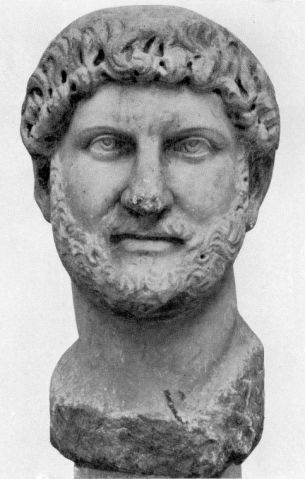
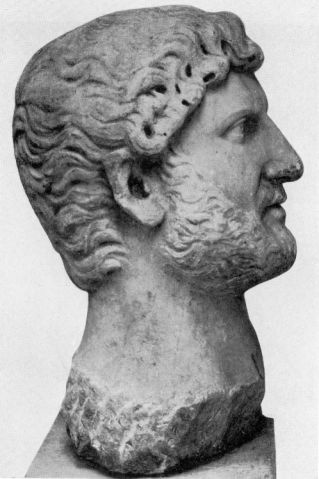
Over life-size portrait head for insertion of Hadrian. From Ostia. Third or fourth century?
Record details
Photographs
Bibliography
- Calza, R. (ed.), Scavi di Ostia. v.5. I Ritratti, pt. 1. Ritratti greci e romani fino at 160 circa d.C., Rome 1964, 76, no. 122, pl. 71
Discussion
DESCRIPTION (Object)
Over life-size head for insertion. H: 46 cm. Italian marble.
The tip of the nose is chipped. Otherwise completely preserved. The back has not been completely worked out.
The head was made for insertion into a statue.The square cut of the area at the base of the neck suggests that the statue was cuirassed. The drill has been used sporadically in the hair around the brow. Two drill holes also appear on the left side of the face in the beard. This side of the face was turned away from the viewer. The lips are separated by a thick drill line. The pupils and irises are marked by two concentric semi-circles made with a flat chisel. This is the same technique for marking eyes as is seen on LSA-1557.
PROVENANCE
Found in the canal at Castel Fusano in 1961. Castel Fusano is a few kilometres southeast of the site of Ostia.
DESCRIPTION (Subject)
The head represents the Emperor Hadrian (117-138). Although the pattern of the hair locks does not follow any one of Hadrian's types precisely, the combination of the physiognomy and the general form of hair and beard make the portrait immediately recognizable.
DATE
Eye markings begin to appear in Roman portrait sculpture c. AD 130. The eye markings on this head are incongruous with the date of the honorand. Moreover, the drill work in the fringe does not follow the locks of hair, and the drilling of the mouth is too emphatic. Thus, the portrait has been made in a period after the late third century for the esteemed emperor of the past, or an earlier portrait of the emperor has been refreshed after the late third century, or the portrait has simply been re-used for another honorand in after the late third century. Another portrait head of Hadrian (LSA-2118<k)as well as a statue of Marcus Aurelius (?)(LSA-1133<k) provide other examples of the same problem.
Cite: Last Statues of Antiquity, LSA-1559 (J. Lenaghan).