
LSA-1560
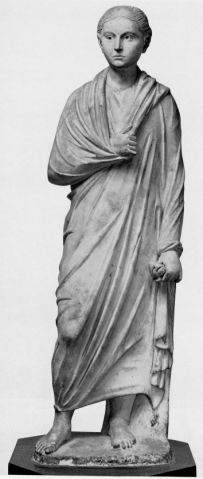
Male himation statue with portrait of girl. From lower Egypt. Fourth century?
Record details
Photographs
Bibliography
- Graindor, P., Bustes et statues-portraits d'Égypte romaine, Cairo 1937, 117, no. 59, pls. 50-51
- Grimm, G., Kunst der Ptolemäer- und Römerzeit im Ägyptischen Museum Kairo , Mainz 1975, 20, no. 19, pls. 28, 30, 32-33 (portrait of youth)
Discussion
DESCRIPTION (Object)
Life-size statue of child. H: 133 cm. White marble.
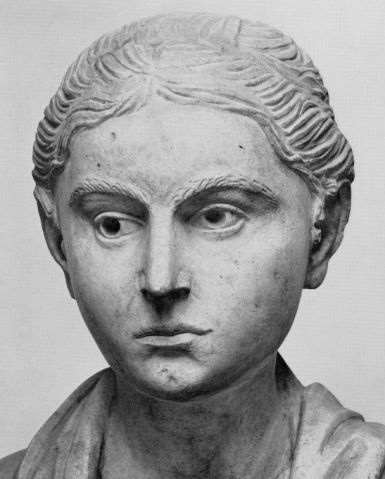
The statue is fully preserved from its head to a more or less rectangular plinth (which appears to be without moulding). The irises were inlaid into round holes.
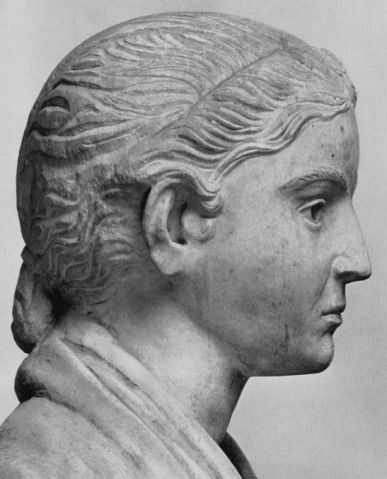
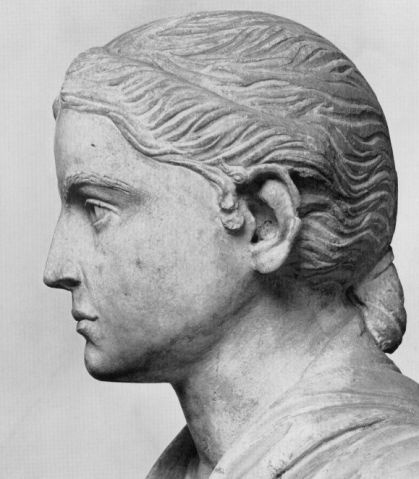
The hair is rendered with a flat chisel. Much of the hair at the back of the head has a flat surface of uniform height which makes it seem stiff and inorganic. The eyebrows are rendered with short and repetitive strokes of a flat chisel.
PROVENANCE
The statue is said to be from lower Egypt. It was first recorded in the Archaeological Museum of Cairo in 1900 where it still is (inv. no. 27478).
DESCRIPTION (Subject)
The portrait statue is the most common himation type used for portrait statues of men in the Roman world. This type shows a male with his right arm folded across his body, caught in the ‘sling’ of his himation. The left arm is held alongside his body. The lower legs are bare as the hem of the himation crosses from above the right ankle to the upper shin of the left leg. The feet in this case are bare. On the outside of the weight-bearing left leg is rectangular block that serves as the statue support. The corner of the himation and its drapery weight hang in front of this support.
The portrait head of the statue wears the hairstyle of a girl. The hair is parted in the centre high on the brow. It is combed back and upwards from the face. This section of hair leaves the ears completely uncovered and terminates (is tucked under) at a regular line that runs around the head above the ears. In front of this line a few longer loose locks run along the brow and, on the right side, end in curls in front of the ears. Behind this line the hair is combed horizontally backwards. A small bun rests on the nape.
The face has a tall rounded brow and eyebrows which are striking both for the heavy and high arch and for their coarse hair. In relationship to the eyebrows and the cheekbones, the eyes are close-set. The nose is straight with a profile that does not break at the root. The mouth is irregular. The lower lip is full and pointing but the upper lip is less shapely on the right side. The jaw line is angular and the chin projecting. The overall effect of the face is not soft.
DATE
The statue was dated to the Augustan period by Graindor 1938 because of what he believed to be an early imperial hairstyle and the ‚dull and cold realism of the face‘ („le morne et froid réalisme du visage“). He did not consider the unusual combination of the inset eyes and emphatic eyebrows nor the problematic incongruity between dress and gender. Interestingly, more recently Grimm calls this the portrait of a boy.
It seems possible that the portrait of this statue has been re-cut from a boy to a girl. The face is full of asymmetries. The upper shell of the ear on both profiles seems strangely short. The locks of hair visible on the back right seem to lack continuity in direction and width. The interest in the eyes and eyebrows suggests to me a date in the later third century or thereafter.
HAIRSTYLE
The hairstyle is that of a girl. It only loosely relates to an early imperial style. It lacks the nodus of the early Julio-Claudian women and yet is more complicated than that of the classically-inspired Julio-Claudian coiffures (for example, that of Antonia the Younger). In its tucked back section of hair framing the brow with locks escaping decoratively in front, it is similar that of the so-called Fausta and related portraits, LSA-573,LSA-1300, and LSA-1541.
Cite: Last Statues of Antiquity, LSA-1560 (J. Lenaghan).