
LSA-1565
Base for statue of empress Eudoxia, wife of Valentinian III. Rome. 439-455
Record details
Photographs
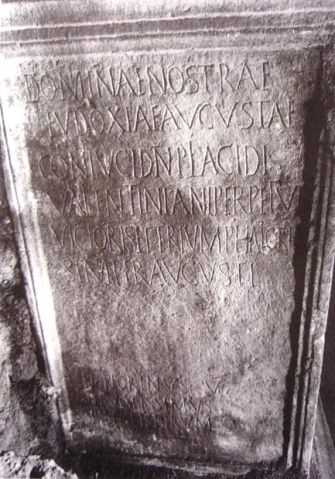
Inscription
Dominae nostrae / Eudoxiae Augustae / coniugi d(omini) n(ostri) Placidi / Valentiniani, perpetui, /(5) victoris et triumphatoris, / semper Augusti. / Flavius Florenus, v(ir) c(larissimus), / devotissimus /(10) pietatis eorum.
Inscription translation
To our lady Eudoxia Augusta, wife of our lord Placidus Valentinianus, perpetual, victorious and triumphant, forever Augustus. Flavius Florenus, of clarissimus rank, most devoted to their piety.
Bibliography
- Corpus Inscriptionum Latinarum; , VI, 40806
- L'Année épigraphique, , 1995, 196
- Santa Maria Scrinari, V., Il Laterano Imperiale, v. 2. Dagli 'horti Domitiae' alla Capella cristiana (Monumenti di Antichità Cristiana), Vatican City 1995, 261-262
- Scrinari S. M. V., 'Contributo all’urbanistica tardo antica sul campo Laterano', Actes du XIe Congrès international d’archéologie chrétienne, Lyon, Vienne, Grenoble, Genève et Aoste 21 - 28 septembre 1986, Rome 1989, 2213
Discussion
INSCRIPTION:
In ten lines. Letter height 4.1-7.7 cm.
Dominae nostrae / Eudoxiae Augustae / coniugi d(omini) n(ostri) Placidi / Valentiniani, perpetui, /(5) victoris et triumphatoris, / semper Augusti. / Flavius Florenus, v(ir) c(larissimus), / devotissimus /(10) pietatis eorum.
'To our lady Eudoxia Augusta, wife of our lord Placidus Valentinianus, perpetual, victorious and triumphant, forever Augustus. Flavius Florenus, of clarissimus rank, most devoted to their piety.'
Flavius Florinus, the awarder, identifies himself as devoted to the piety of the imperial couple, a suitable emphasis for a dedication to a couple famous for their religious zeal and especially for a monument set up in the vicinity of the Lateran basilica.
DESCRIPTION (from Santa Maria Scrinari and photograph):
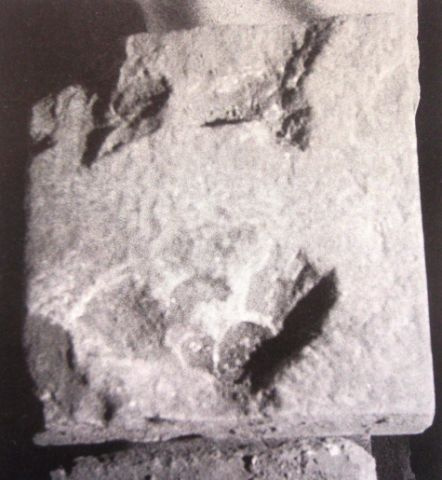
White marble base, in good state of preservation. 179.5 x 90 x 90 cm. Epigraphic field is framed by moulding on all sides. It seems from the photograph that the original surface was cut back, erasing an earlier inscription. The surface of the epigraphic field is deep and not smooth. The top of the base is preserved, albeit partially damaged. It has marks near the edges that, according to Santa Maria Scrinari, correspond to fittings for a bronze statue, but this cannot be confirmed from the photograph.
PROVENANCE AND LOCATION:
The base was discovered in 1977, during works underneath the Ospedale di S. Giovanni Laterano, re-used in the S wall of the early Christian chapel. It is still there (CIL).
HONORAND, AWARDER AND DATE:
The statue was dedicated to the empress Eudoxia, wife of Valentinian III (PLRE II, 410-412 Eudoxia 2). She was the daughter of Theodosius II, and only came to the West after her wedding in 439. The statue must have been dedicated between this date and 455, when she was taken to Carthage as hostage by Geiseric in the Vandal sack, returning to Constantinople afterwards. Nothing else is known of the awarder, Flavius Florinus (and not Florenus, as in CIL), of clarissimus rank.
Discussion references
- Martindale, J. R., The Prosopography of the Later Roman Empire. Vol. II A.D. 395-527, Cambridge 1980, pp. 410-412 (Eudoxia 2)
Cite: Last Statues of Antiquity, LSA-1565 (Carlos Machado).