
LSA-157
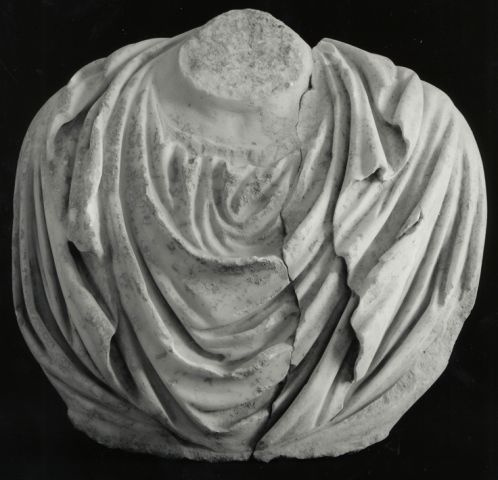
Headless portrait bust of woman wearing three garments. Aphrodisias (Caria). Third to fourth century.
Record details
Photographs
Bibliography
- Smith, R.R.R., S. Dillon, C.H. Hallett, J. Lenaghan, and J. Van Voorhis, Aphrodisias II: Roman Portrait Sculpture at Aphrodisias, Mainz 2006, no. 142
Discussion
DESCRIPTION (Object)
Headless bust. H: 40.5, W: 43.5, D: 13 cm. Fine-grained white marble.
The head, originally made in one piece with the bust, is broken through the base of the neck. The bust is recomposed from two joining fragments: 1) proper right side and neck, and 2) left side.
The back is roughly hollowed out with a large pick. The spine is shallow. There is no dowel hole in the base which is broad and shallow.
PROVENANCE
Excavated in 1967 just northwest of the Bouleuterion. It was built into a late wall and probably comes from the ‘Sculptors’ Workshop’ see LSA-156.
DESCRIPTION (Subject)
The large bust is tall and shallow and has an unusual arrangement of three garments. It wears a heavy himation which serves as a rounded frame. Below this are two further garments, one of which clings to the neck in straight folds and the other sags loosely. The lack of depth, rounded aspect of the himation, lack of dowel for the attachment to a supporting foot, and forward position of the neck suggest that this might have been inserted into a tondo.
DATE
The workmanship of the back, the costume, and the possibility that the bust was inset in a tondo suggest a date in the fourth century. Three garments appear only rarely in portraits of women in the high imperial period. In the late antique period the costume of both men and women featured three elements.
Cite: Last Statues of Antiquity, LSA-157 (J. Lenaghan).