
LSA-1581
Fragment of base for statue, probably of gilded bronze and probably ordered by an emperor. Rome, Forum of Trajan. Mid-Fourth to early Fifth century.
Record details
Photographs
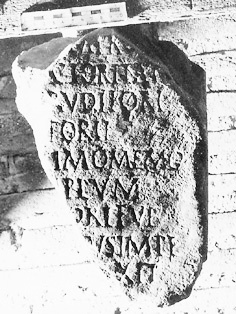
Inscription
------ / [---] mịro [---?] / [---a]uctoritatẹ / [---e]ruditori / [---? comiti sacri consis]torii, / [--- loco celeber]ṛimo memo/[r--- ad exe]ṃplum / [--- statuam auri splend]ore ful/[gentem ---]+us impe/[rator ---]ẹxit / ------.
Inscription translation
To... admirable... with authority... teacher... count in the imperial counsel (?), in the most frequented place… for the imitation… statue shining with the splendour of gold…
Bibliography
- Corpus Inscriptionum Latinarum; , VI, 41347
Discussion
INSCRIPTION:
In nine partially surviving lines. Letter height 2.2. cm.
------ / [---] mịro [---?] / [---a]uctoritatẹ / [---e]ruditori / [---? comiti sacri consis]torii, /(5) [--- loco celeber]ṛimo memo/[r--- ad exe]ṃplum / [--- statuam auri splend]ore ful/[gentem ---]+us impe/[rator ---]ẹxit / ------.
'To... admirable... with authority... teacher... count in the imperial counsel (?), in the most frequented place… for the imitation… statue shining with the splendour of gold… '
Although only partially preserved, the text clearly records the dedication of a statue, almost certainly of gilded bronze, to an important awarder, singled out for, among other things (ll.1-2), his role as a teacher/professor (l. 3). The statue was probably set up by an emperor/emperors. Alföldy suggests supplementing ll.7-8 as '[statuam auri splend]ore ful/[gentem petitu sena]tus', in which case the statue would have been requested by the senate.
The style of the letters and the vocabulary suggest a date in the second half of the fourth century, or the beginning of the fifth century.
DESCRIPTION (CIL and photograph):
Fragment of marble base for statue, 32 x 22 x 21 cm. Only part of the right hand corner survives. There are traces of moulding on the edge of the fragment. The surface of the epigraphic field indicates that an earlier inscription was erased for re-use.
PROVENANCE AND LOCATION:
The fragment was discovered in the Forum of Trajan, an important location for statues of imperial and senatorial officials, as well as intellectuals. Other examples of statues of intellectuals in this area can be found in LSA-319 (Merobaudes), LSA-1355 (Claudian), LSA-2674 (Marius Victorinus), and LSA-2675 (Sidonius Apollinaris). The Forum of Trajan was an important space for intellectual activities in Late Antiquity (Marrou 1932). It is now in the deposit of th basilica Ulpia, inv. 2769 (FT n. 57) (CIL, seen in 1988).
HONORAND, AWARDER AND DATE:
It is impossible to identify the awarder of this statue. However, the importance of the monument and of its location suggest that the emperor (or emperors) referred to in ll.8-9 of the inscription was responsible for the dedication. It is impossible to identify the honorand, except that he was an individual of great personal and intellectual reputation, and that he was probably already dead when the statue was set up (suggested by the reference to his 'memoria' in ll.5-6). He was an eruditor, in other words a teacher, tutor or professor. One possibility would be the famous rhetor Marius Victorinus, who earned great reputation in Rome as tutor of many senators, and who was honoured with a statue in the Forum of Trajan (see LSA-2674).
Discussion references
- Marrou, H.-I., "La vie intellectuelle au forum de Trajan et au forum d'Auguste", Mélanges de l'École Française de Rome, 49 (1), 1932, pp. 97-110
Cite: Last Statues of Antiquity, LSA-1581 (Carlos Machado).