
LSA-1592
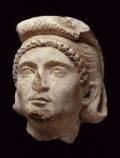
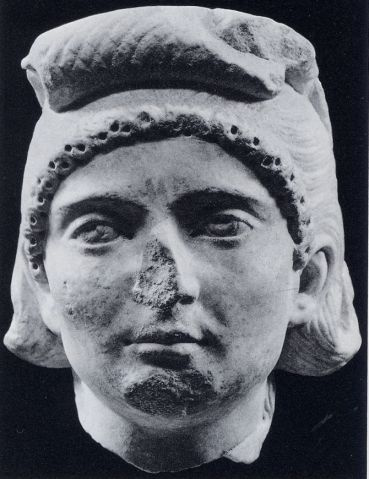
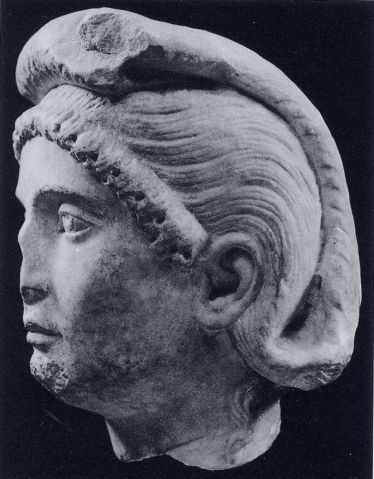
Portrait head of woman with large central braid and curled fringe. From Rome. Late third century.
Record details
Photographs
Bibliography
- Comstock, M.B. and C.C.C. Vermeule, Sculpture in Stone. The Greek, Roman, and Etruscan Collections of the Museum of Fine Arts Boston, Boston 1976, no. 380
Discussion
DESCRIPTION (Object)
Over life-size head. H: 27.5 cm. Pentelic marble
The head has broken unevenly around the base of the neck. The nose, chin, and left edge of the hair roll are broken.
Most of the hair is carefully defined with fine flat chisel work. The curls around the brow are punctuated by drill points. These are made after the full rendering of the hair with flat chisel. There is thick drill channel with marked points that runs from behind the right ear around the neck; it separates the hair which rolls up from the hair that lies on the neck. The eyeballs feature large pupils which are broad, drilled-out U-shapes. The irises are semi-circular engraved lines made with a flat chisel. Two vertical creases above the root of the nose seem to have been added awkwardly to the portrait.
PROVENANCE
From Rome.
DESCRIPTION (Subject)
The portrait head depicts a woman who turns to her right. She has a full face and wears the same variation of a late third century hairstyle as does a portrait now in the Musei Capitolini (LSA-993).
The face is broad with a short rounded chin. The brow is low, and the eyes are relatively small with straight eyebrows. The full cheeks create marked naso-labial folds and indentations at the corners of the mouth. The mouth is small and has bow-shaped lips.
The hair directly over the brow is combed forward in short locks which end in curls. Behind this fringe, the hair is brushed without a part backwards around the ears. At the nape it is twisted upwards in a plait made of numerous braids. This plait is broad (extending the entire width of the brow) and rolls over itself at the brow. A single loose lock falls down the neck on the left side.
DATE
The large central braid that reaches the brow is depicted on imperial portraits first with Ulpia Severina (274-275). The fashion continues into the early fourth century. Here, the central braid is broad and tall and has been combined with a short curled fringe which has been drilled out and which frames the brow in a low arch. This variation seems to post-date the Severina portraits and can be found in two other extant portraits: a head now in Schloss Fassanerie LSA-767 and another in the Capitoline collections (LSA-993).
IDENTIFICATION
The exact hairstyle repeats on the above-mentioned portrait from Rome (LSA-993). The physiognomies are, however, different. Thus, it is impossible to affirm that the two portraits represent the same woman. Certainly, the minor re-working of the fringe of the Boston head, designed to up-date and enliven it, make its hairstyle exactly that that of the Rome portrait; therefore, both may well have been following the same model.
Discussion references
- Bergmann, M., Studien zum römischen Porträt des 3. Jahrhunderts n. Chr., Bonn 1977, 190-92, pls. 55.1 and 56.1
- Weitzmann, K. (ed.), Age of spirituality : late antique and early Christian art, third to seventh century : catalogue of the exhibition at the Metropolitan Museum of Art, November 19, 1977, through February 12, 1978, New York 1979, no. 14
Cite: Last Statues of Antiquity, LSA-1592 (J. Lenaghan).