
LSA-1595
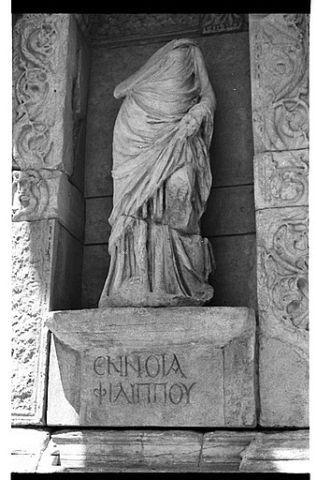
Base for statue of the 'Good Will of Philip' (Ennoia Philippou). Ephesus (Asia). Fifth century.
Record details
Photographs
Inscription
Ἔννοια / Φιλίππου.
Inscription translation
Good will of Philip
Bibliography
- Meriç, R., R. Merkelbach, J. Nollé, and S. Şahin (eds.), Die Inschriften von Ephesos VII,2. Inschriften griechischer Städte aus Kleinasien, vol. 17,2, Bonn 1981, 521-2, no. 5110 (mainly repeats Keil)
- Wilberg, W. et al., Forschungen in Ephesos, Bd. V, t. 1. Die Bibliothek, Vienna 1953, 71-2, no. 10 (J.Keil: c. 400)
Discussion
INSCRIPTION:
In two lines. Ltr H: 8 cm, red paint preserved in letters.
Ἔννοια
Φιλίππου
Good will of Philip
PROVENANCE
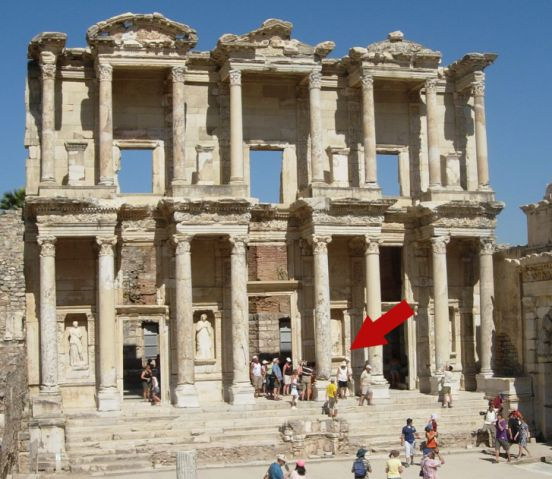
Excavated at the Library of Celsius in 1903. It was found together with its statue, LSA-1596, behind the reliefs of the Nymphaeum in front of the second niche from the north. It is currently on the facade.
DESCRIPTION.
Rectangular base with crown moulding. H: 51, W: 100, D 48 cm. White marble.
The base is well-preserved, and Strocka writes that the upper surface has cuttings for the attachment of a bronze statue.
CONTEXT
On the ground floor of the facade of the Library of Celsus, in niches in the wall, were four female statues mounted on inscribed pedestals. From south to north (left to right), the bases are for the wisdom (sophia) of Celsus, the virtue (arete) of Celsus, the good will (ennoia) of Philip, and the knowledge (episteme) of Celsus. Celsus was the original second-century dedicator of the library; Philip remains unknown.
According to Strocka, cuttings on the tops of all the bases indicate that they originally bore bronze statues. All four statues found with the bases are undeniably of different manufacture and date. The statue of the Ennoia of Philip, LSA-1596, is typical for portraits of the high-imperial period and belongs to the ‘Ceres’ type, the model for which was probably originally associated with Demeter. The statues found in situ were, thus, not the unified group of four set up by Celsus in the early second century AD but a group of disparate pieces assembled at a different moment. It seems logical to associate this moment with the transformation of the library into the back wall of a Nymphaeum and with the Philip mentioned on this base.
DATE
The lettering of this base cannot be before the third century. The alteration of the facade of the Library and the change in its function from Library to Nymphaeum are late and are probably related to an inscription on the facade for Stephanus LSA-487. Stephanus is there thanked for decorative aspects.
Keil wished to see Stephanus and Philip as contemporaries and suggested that Philip was also somehow involved in the refurbishment of the facade, perhaps as the builder.
Discussion references
- Strocka, V. 'The Celsus Library in Ephesus', Ancient libraries in Anatolia : Libraries of Hattusha, Pergamon, Ephesus, Nysa, Ankara 2003, 33-43
Cite: Last Statues of Antiquity, LSA-1595 (J. Lenaghan).