
LSA-1596
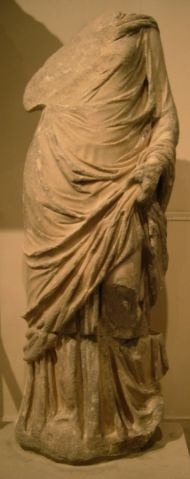
Statue of the 'Good Will of Philip' (Ennoia Philippou) (see LSA-1595). From Ephesus. Fifth century.
Record details
Photographs
Bibliography
- Atalay, E., Weibliche Gewandstatuen des 2. Jahrhunderts n. Chr. aus ephesischen Werkstätten, Vienna 1989
- Wilberg, W. et al., Forschungen in Ephesos, Bd. V, t. 1. Die Bibliothek, Vienna 1953, 53-54, no. 3, fig. 99
Discussion
DESCRIPTION (Object)
Over life-size statue. H: 1.67 cm. Large-grained white marble.
The statue has been restored from two fragments; the line of the break is below the knees. It is missing the head and a large section including the right shoulder, chest, and arm.
PROVENANCE
Excavated at the Library of Celsius between 5 and 7 November in 1903. It was found together with its base, LSA-1595, in the lower gallery in front of the second niche from the north.
DESCRIPTION (Subject)
The over life-size statue shows a woman in one of the three-most popular body types for portrait statues of Roman women, the ‘Ceres’ type (see, for example, LSA-409, LSA-604, and LSA-2592).
DATE
On the basis of its type, proportions, and drapery folds, the statue was made in the first or second century AD. It has been re-used to represent the Ennoia of Philip which dates to the fifth (?) century. At this point the Library facade was re-furbished and fitted out with a nymphaeum in front.
CONTEXT
On the ground floor of the facade of the Library of Celsus, in niches in the wall, were four female statues mounted on pedestals. From south to north (left to right), the bases are for the wisdom (sophia) of Celsus, the virtue (arete) of Celsus, the good will (ennoia) of Philip, and the knowledge (episteme) of Celsus. According to Strocka, cuttings on top of the bases indicate that they originally bore bronze statues. All of the statues found with the bases are undeniably of different manufacture and date. They were not a unified group of four set up by Celsus in the early second century AD but a group of disparate pieces assembled at a different moment.
The statue of Sophia has an ideal face, a costume suitable for a muse, and a moulded plinth. The statue of Arete has an imposing triangular (hellenistic) form, an idealized head that has unusual drilled eyes, and arm bracelets that appear through the clothing; this statue without doubt once represented a woman. The statue of the Ennoia of Philip is typical for portraits of the high-imperial period and belongs to a type that makes reference usually to Persephone or Demeter. The statue of Episteme was a portrait statue on a thick round plinth that had a separately worked head and projecting right arm; this sort of statue in an active stance was commonly used for imperial statues.
Discussion references
- Atalay, E., Weibliche Gewandstatuen des 2. Jahrhunderts n. Chr. aus ephesischen Werkstätten, Vienna 1989, 98, cat. no. 37, fig. 76
- Strocka, V. 'The Celsus Library in Ephesus', Ancient libraries in Anatolia : Libraries of Hattusha, Pergamon, Ephesus, Nysa, Ankara 2003, 41
Cite: Last Statues of Antiquity, LSA-1596 (J. Lenaghan).