
LSA-1597
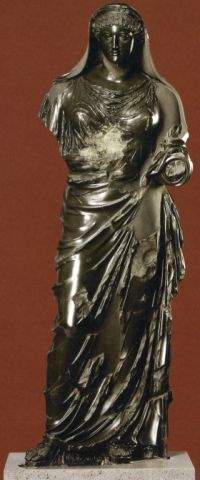
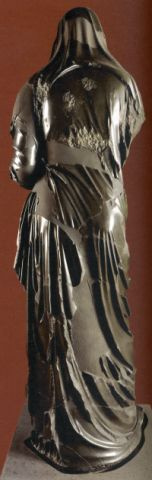
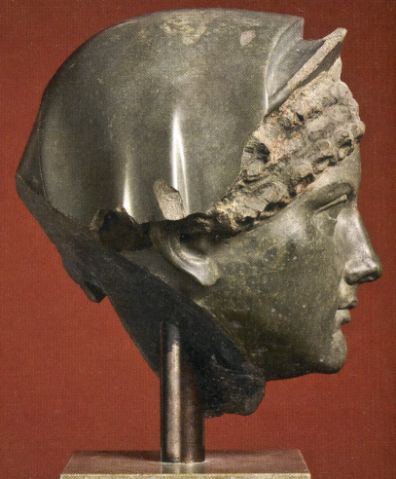
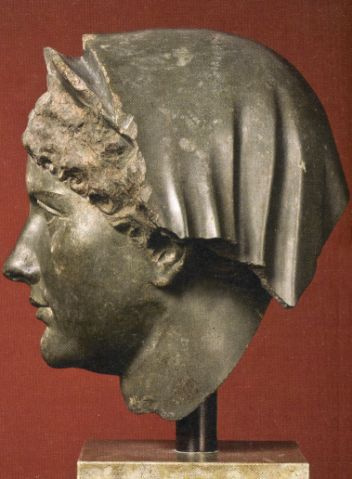
Graywacke portrait statue of Agrippina the Younger re-used for late Empress. From Rome. Fourth to fifth century.
Record details
Photographs
Bibliography
- Moltesen, M. and A.M. Nielsen (eds.), Agrippina Minor. Life and Afterlife - Liv og eftermaele, Copenhagen 2007
Discussion
DESCRIPTION (Object)
Over life-size statue (restored from 41 fragments). H: 212 cm. Dark green beckenstone/greywacke.
The statue was carved in one piece from the feet to the top of the head. It was deliberately destroyed to be re-used as building material in late antiquity or later. Discovered in 41 pieces, it has been restored three times in the modern era, in 1896, in 1939, and in 1993.
Prior to its final destruction, the statue had been battered. The area below the breasts and at the back near the left hip shows signs of being struck with a blunt instrument.
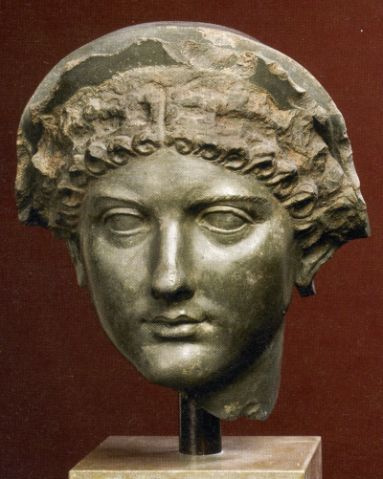
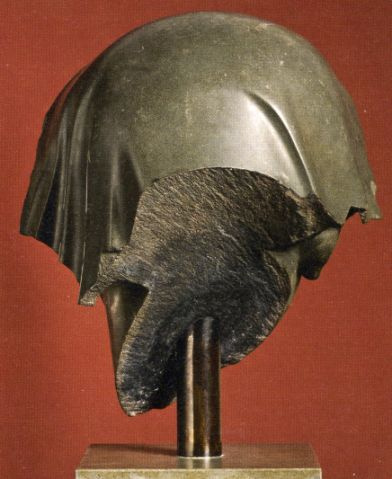
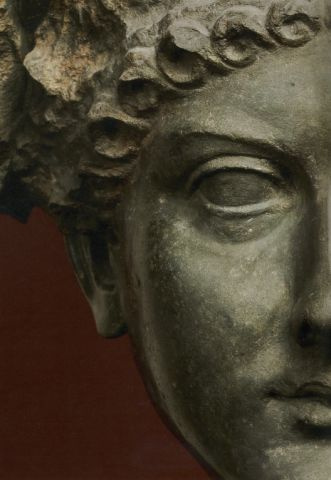
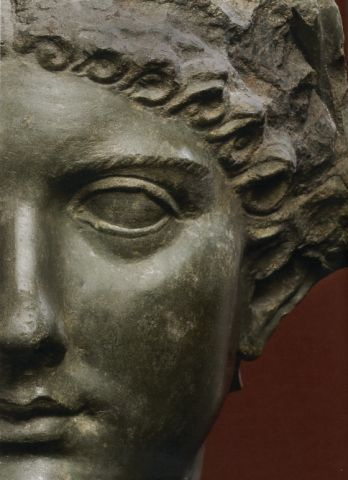
In addition, the portrait head has been re-cut. The hair between the front row of curls and the diadem has been destroyed. The left eyebrow has been given hair [Talamo in Moltesen (ed.) at p. 120] or more probably the right eyebrow has been raised and the outer edge removed [Moltesen in Moltesen (ed.) at p. 139]; the nose narrowed; the mouth made smaller with a resultant irregular upper lip; the area beneath the eyes deepened; the cheeks and area beneath the chin slimmed. Finally, eight holes have been cut into the hair between the brow and the diadem.
PROVENANCE:
The head was part of the Lithuanian count Michel Tyszkiewicz's collection which he had purchased in Rome and brought to his house in Paris. Tyszkiewicz (1828-1895) was a friend of Helbig. Jacobsen acquired the portrait in 1888.
The statue was found under Padiglione F of the Ospedale Militare on the Caelian Hill in Rome. During the laying of foundations of the Hospital in 1885, the statue was discovered built into a late wall which supported an apse. The wall, possibly dating as early as fifth century or as late as medieval, contained three other statues all of which were in coloured marble and all of which were deliberately broken. The statue of Agrippina seems logically to have been connected originally with the Temple of the Divine Claudius in the same area. Others of the statues, may have possibly been originally in Eastern cult buildings or in the extension of the imperial palace made by Commodus on the Caelian. In any case it is likely that they were acquired by Symmachus and incorporated into his domus in the same area.
DESCRIPTION (Object)
The portrait statue, recomposed of numerous fragments, is magnificently carved in a hard, beautifully coloured green Egyptian stone. It is worked without a plinth so that the feet would have been set directly into a base in the manner of a bronze statue.
The weight rests on the left leg; the left hip projects outwards. The right upper arm extends downwards. The forearm is no longer preserved. The left upper arm remains close to the body. The arm bends at the elbow and the left forearm also seems to have projected directly out from the body. The head turns slightly to follow the action of the right arm.
The statue wears an outer garment pulled over the head (the palla), an inner garment with buttons at the shoulders (the tunica), ornately decorated sandals, and a plain diadem below which a jewelled crown has been added. The palla covers the lower body until the feet at the front and touches the ground at the back. It leaves exposed only the area above its crossing under the breasts at the front of the body. It is carved in large naturalistically curving folds that elegantly model the female form beneath. The tunica is visible only around the front of the feet and above the waist. It is rendered in narrow crinkly folds that give the impression of an extremely delicate material.
The pose, which leaves the right arm free to make a gesture, and the costume, which covers the head, make the statue suitable for the representation of a woman in a religious act.
The head depicts a woman with a broad brow and a face that tapers toward the chin. The brow is modelled around the eyebrows which are notably different. The right eyebrow is fine and flaring; the left eyebrow is rendered more three-dimensionally and has hair. The eyes are unmarked but the skin beneath them has been modelled. The nose is fine, and the mouth is small and generally bow-shaped. The right side of the upper lip does not rise as much as the left side. Furthermore the left corner is raised higher than the right. The lower lip pouts over a rounded and projecting chin.
The hair has a central part, on either side of which are curls which gradually increase in size. Behind these curls are traces of two further rows of curls. These two rows have been mainly obliterated and in place of particularly the middle row are four rectangular cuttings on either side of the part. Rising above these tiers of curls is a traditional plain diadem.
DATE
The portrait head follows a type known in c. 15 replicas as the Type IV Agrippina Minor portrait dated to the reign of Nero (AD 54-68). The most identifying element of this type is the hair around the brow which is styled in three tiers of artificial curls The holes cut below the diadem of this portrait head are for a jewelled crown and belong to a second use, a use which would have to date after 325 when Constantine introduced such headgear.
HONORAND AND RE-USE
The re-cutting of the head and statue may have had as many as three different phases for three different honorands. Moltesen believes that it was originally intended to be Agrippina as the wife of Claudius, then Agrippina as the mother of Nero, and then a late-antique Empress. The battery to the body might have occurred when Agrippina suffered a damnatio memoriae. It would have been plastered over when the statue was re-used in late antiquity. With little alteration to the chronological structure or technical content of this hypothesis, one might argue that the original statue was some other Claudian female (Messalina, Drusilla, or Claudia Octavia), then Agrippina, and then the late-antique Empress.
The reason for seeing three phases is that Moltesen doubts that the same hand could have so dexterously altered certain facial details and then so roughly hacked the space for the jewelled diadem. Moreover, the eyeballs were never given markings which, Moltesen believes, is strong confirmation that the alterations were made before the late-antique period.
Moltesen has had the privilege of first-hand viewing of both the original object and the plaster casts. Given the difficulty, however, of carving such a hard stone [note the problems of the modern restorers, see Talamo in Moltesen (ed.) at p. 117] , it might be more economical to reduce the number of re-cuttings and to imagine only an original Julio-Claudian phase and then a late-antique phase. Many of the changes that Moltesen ascribes to a second Julio-Claudian moment are typical in late antiquity: the alteration of the eyebrows, the slimming of the face, and the narrowing of the nose. The different finishes in different areas might relate more to their locations than to the varying capacities of different sculptors. The hacking in the hair could be interpreted as a need to get rid of more stone rather than as incompetence. The entire area might also have been covered by the metal framework of the diadem. Moreover, oftentimes in late antiquity a statue would be re-used with unmarked eyes; presumably paint was used to render the irises.
Cite: Last Statues of Antiquity, LSA-1597 (J. Lenaghan).