
LSA-16
Plaque from base for statue of Diocletian, emperor. Corinth (Achaea). 284-305
Record details
Photographs
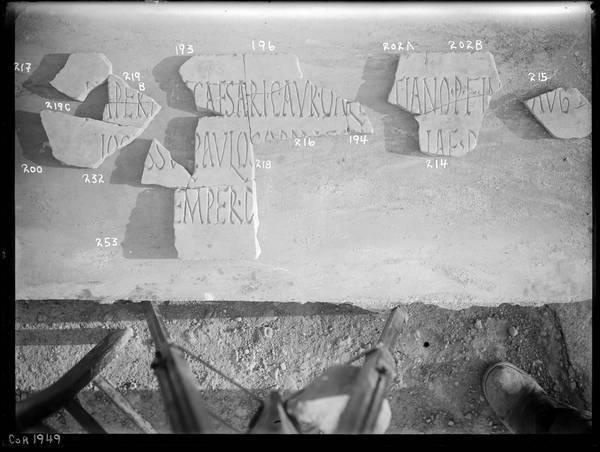
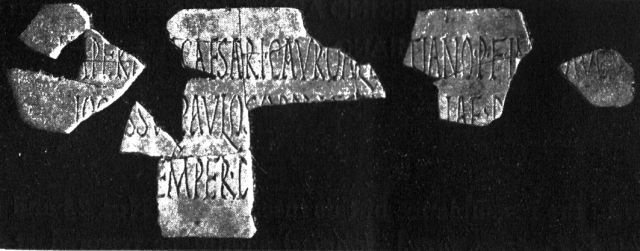
Inscription
Imperạ[tor]ị Caesari C(aio) Aur(elio) Val[erio] Ḍ[iocle]tiano p(io) f(elici) in[victo] Aug(usto) / Ḷục̣ị[u]ṣ Ṣuḷ̣(picius) Paulus ṿ(ir) p̣(erfectissimus) p̣ṛạẹṣ(es) [p]ṛ[ov](inciae) [Ach]ạ̣iae d[icavit] [---] / [---] [s]emper d[evotus --]
Inscription translation
To the emperor and Caesar Caius Aurelius Valerius Diocletianus, the pious fortunate and unconquered Augustus. Lucius Sulpicius Paulus, of perfectissimus rank, governor (praeses) of the province of Achaea, dedicated [this], always devoted ...
Textual evidence
Impera[tori] Caesari C. Aur. Val. [Diocle]tiano p. f. in[victo] Aug. Luci[u]s Sul. Paulus v. p. praes. [p]r[ov] [ach]aiae d. ---------- [s]emper d.
Translation
To the imperator and Caesar C. Aurelius Valerius Diocletianus the pious and fortunate and undefeated Augustus Lucius Sulpicius Paulus, the perfectissimus vir and praeses of the province of Achaia (set up this statue) ... always (devoted)
Bibliography
- Brown West, A., Latin inscriptions, 1896-1926: Corinth VIII, 2, Princeton 1931, Nr. 23
Discussion
INSCRIPTION
In three lines:
Imperạ[tor]ị Caesari C(aio) Aur(elio) Val[erio] Ḍ[iocle]tiano p(io) f(elici) in[victo] Aug(usto) / Ḷục̣ị[u]ṣ Ṣuḷ̣(picius) Paulus ṿ(ir) p̣(erfectissimus) p̣ṛạẹṣ(es) [p]ṛ[ov](inciae) [Ach]ạ̣iae d[icavit] [---] / [---] [s]emper d[evotus --].
'To the emperor and Caesar Caius Aurelius Valerius Diocletianus, the pious fortunate and unconquered Augustus. Lucius Sulpicius Paulus, of perfectissimus rank, governor (praeses) of the province of Achaea, dedicated [this], always devoted ... .'
The lost parts of the last line can confidently be completed as 'n(umini) m(aiestati)q(ue) e(ius) semper d[evotus] (or similar), always devoted to his divine spirit and majesty', the usual closing formula of this period.
DESCRIPTION
The inscription is restored from 17 fragments of a white marble plaque, whose upper and lower edge are partially preserved: H 38, W circa 125, D 1.3-1.8 cm. The plaque must once have covered a statue base made of some other material. The unusual width of our inscription shows that this base was not of the conventional, tall and thin, size.
PROVENANCE AND CURRENT LOCATION
The fragments were excavated in 1902 in the region of the Northwest Stoa, in the centre of Ancient Corinth. Now in the Corinth Museum, with the following inventory numbers: Corinth I-193A-193B-194-196-200-202A-202B-214-215-216-217-218-219A-219B-219C-232-253.
HONORAND, AWARDER AND DATE
The honorand, Diocletian, was Augustus from 284 to 305.
The awarder, Lucius Sulpicius Paulus, was governor (praeses) of Achaea, but is not known from other sources (PLRE I 685, Paulus 11). He was, however, almost certainly also responsible for honorific monuments to Maximian and Galerius (LSA-26 and LSA-50).
FURTHER DISCUSSION
Three fragmentary inscriptions found in the same location, all on plaques and with very similar lettering, to Diocletian (our inscription), Maximian (LSA-26) and Galerius (LSA-50), almost certainly formed part of a single group of statues to the four emperors of the first tetrarchy (only Constantius I is missing from our evidence). If so, the group must have been set up between 293 (the accession of the Caesars) and 305 (the retirement of the Augusti).
Cite: Last Statues of Antiquity, LSA-16 (Ulrich Gehn).