
LSA-1600
Base for re-erected statue (subject unstated). Brixia (Venetia et Histria). Late third to mid fourth century.
Record details
Photographs
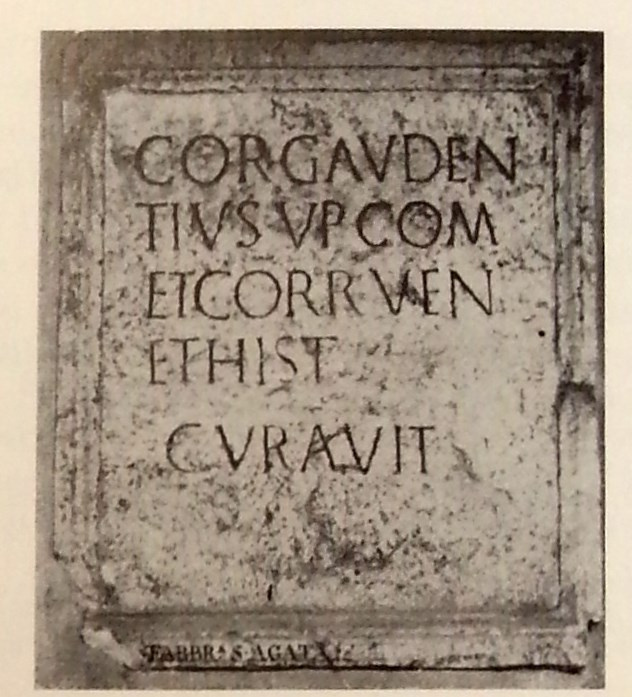
Inscription
Cor(nelius) Gauden/tius, v(ir) p(erfectissimus), com(es) / et corr(ector) Ven(etiae) / et Hist(riae) / curavit.
Inscription translation
Cornelius Gaudentius, of perfectissimus rank, count (comes) and governor (corrector) of Venetia and Histria, took care [of this].
Bibliography
- Corpus Inscriptionum Latinarum; , V, 4327
- Garzetti, A.(ed)., Inscriptiones Italiae Academiae Italicae Consociatae ediderunt. Volumen X, Fasciculus V, Brixia , Rome 1984-1986, (1) p. 72 no. 114
Discussion
INSCRIPTION
In five lines:
Cor(nelius) Gauden/tius, v(ir) p(erfectissimus), com(es) / et corr(ector) Ven(etiae) / et Hist(riae) /(5) curavit.
’Cornelius Gaudentius, of perfectissimus rank, count (comes) and governor (corrector) of Venetia and Histria, took care [of this].’
Letter height 5.7 – 6.5 cm.
DESCRIPTION (from Garzetti 1984, and the published image)
Limestone plaque, H 81, W 70 cm. The epigraphic field is framed.
PROVENANCE AND CURRENT LOCATION
The inscription was first recorded by the scholar and antiquarian Michael Fabricius Ferrarinus in the church of S.Agata in Brescia in the late 15th century.
It is now in the Museo Civico (Brescia, Civici Musei di Arte Storia e Scienze, Capitolium) (without published inv. no.).
HONORAND, AWARER AND DATE
The subject of the associated statue is not recorded in our inscription; it was probably either a mythological figure (a deity or a hero), or an imperial statue (see LSA-1240).
Cornelius Gaudentius, the awarder, was provincial governor (corrector) of Venetia and Histria (PLRE I, 386 Cor(nelius) Gaudentius 8). He was of equestrian (perfectissimus rank), and held the court rank of comes. The province of Venetia et Histria was established in the late-3rd or early 4th century (Chastagnol 1982, 170); this gives a rough terminus post quem for our inscription. By 373 the province was administered by a higher ranking consularis (PLRE I, 1097 Fasti).
FURTHER DISCUSSION
A further similar inscription, set up by the same governor, is known from Brixia (LSA-1601).
The only other known governor of Venetia et Histria with perfectissimus rank (as opposed to the higher, senatorial clarissimus rank usually held by these governors) is Vetulenius Praenestius in 362/3.
Discussion references
- Chastagnol, A., La carrière sénatoriale du Bas-Empire depuis Diocletien, Epigrafia e ordine senatorio, 1. Atti del Colloquio intenazionale AIEGL, Roma 14 - 20 maggio 1981, pp. 167-92, Roma 1982, 170
- Jones, A. H. M. et al., The Prosopography of the Later Roman Empire. Vol. I 260-395, Cambridge et al. 1971 (1975), 386
Cite: Last Statues of Antiquity, LSA-1600 (Carlos Machado and Ulrich Gehn; discussion added by Ulrich Gehn 2/15).