
LSA-1609
Base for statue of Diocletian or Maximian, emperor (later re-used for Constantine I). Forum Germa... (Liguria). 284-305.
Record details
Photographs
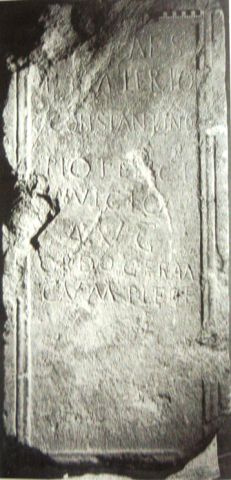
Inscription
Imperatori Caesari / [[C(aio)]] Valerio / [[Diocletiano]], / pio, felici, [i]nvicto / Augusto, / ordo Germa[---] / cum plebe.
Inscription translation
To the emperor Caesar Caius Valerius Diocletianus, pious, fortunate, unconquered Augustus; the council of Germa... ,with the people, [set this up].
Bibliography
- Gastaldi, E. C. and G. Mennella, "Forum Germa[---]", Supplementa Italica, NS 13, Rome 1996, n. 9
- L'Année épigraphique, , 1988, 573
Discussion
INSCRIPTION
In eight lines:
Imperatori Caesari / [[C(aio)]] Valerio / [[Diocletiano]], / pio, felici, [i]nvicto / Augusto, / ordo Germa[---] / cum plebe.
To the emperor Caesar Caius Valerius Diocletianus, pious, fortunate, unconquered Augustus; the council of Germa... ,with the people, [set this up].
Letter height 3.5 – 6 cm.
DESCRIPTION (from Culassi Castaldo and Menella 1996, and the published image)
Rectangular statue base of local stone (Gneiss), H 103.5, W 50, D 43.5 cm; only the shaft is preserved. The upper left and the bottom right corner are broken; at the right side, a portion of the surface has flaked off. The inscription is set within a moulded frame.
The honorand’s name in line 3 was erased in a secondary use of the base for Constantine (see below, 'Honorand, Awarder and Date', and LSA-1610).
PROVENANCE AND CURRENT LOCATION
The inscription was found in the village of Caraglio, province of Cuneo, in the environs of the church of San Lorenzo, in 1974. This is probably the area of a Roman town the name of which is only known in truncated versions so far (perhaps Forum Germanorum, see LSA-1610).
It is now in Cuneo, Museo Civico (without published inv. no.).
HONORAND, AWARDER AND DATE
The honorand (later erased) must have been an imperial predecessor of Constantine bearing the nomen gentile Valerius; this fits Diocletian (Augustus 284-305; full name C. Aurelius Valerius Diocletianus, but often C. Valerius Diocletianus in inscriptions) and Maximian (Augustus 286-305; full name M. (Aurelius) Valerius Maximianus). Mennella 1988, 147-8 suggested that our inscription was probably to Diocletian (see LSA-1610, 'Further Discussion').
The inscription was set up by the civic institutions of Forum Germa(---), city council (ordo, line 7) and people, here styled plebs (line 8).
Discussion references
- Mennella, G., Revisioni epigrafiche in municipi della Liguria nord-occidentale, Mélanges de l'Ecole francaise de Rome (MEFRA), Antiquité, T. 100, 1988, 139-57
Cite: Last Statues of Antiquity, LSA-1609 (Ulrich Gehn & Carlos Machado, discussion added 2/15 (UG)).