
LSA-1619
Base for statue of Galerius, emperor. Luna (Tuscia et Umbria). 293-305. (same base as LSA-1618)
Record details
Photographs
Inscription
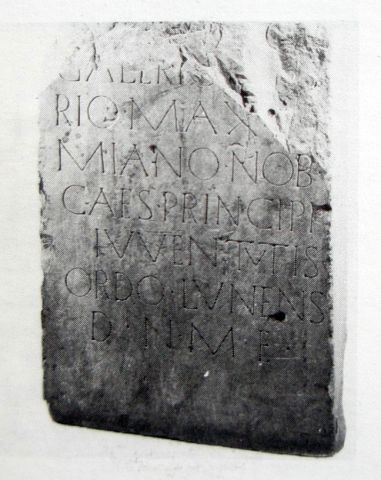
Galerio [Vale]/rio Maxi/miano, nob(ilissimo) Caes(ari), principi / iuventutis, /(5) ordo Lunens(ium) / d(evotus) n(umini) m(aiestatique) e(ius).
Inscription translation
To Galerius Valerius Maximianus, most noble Caesar, prince of youth; the council of Luna, devoted to his divine spirit and majesty, [set this up], .
Bibliography
- Corpus Inscriptionum Latinarum; , XI, 6957c
- Bertinelli, A. and A. Frova, Marmora Lunensia Erratica, Sarzana 1983, pp. 190-195
Discussion
INSCRIPTION
In six lines. Letter height 6 cm.
Galerio [Vale]/rio Maxi/miano, nob(ilissimo) Caes(ari), principi / iuventutis, /(5) ordo Lunens(ium) / d(evotus) n(umini) m(aiestatique) e(ius).
'To Galerius Valerius Maximianus, most noble Caesar, prince of the youth; the council of Luni [set this up], devoted to his divine spirit and majesty.'
DESCRIPTION
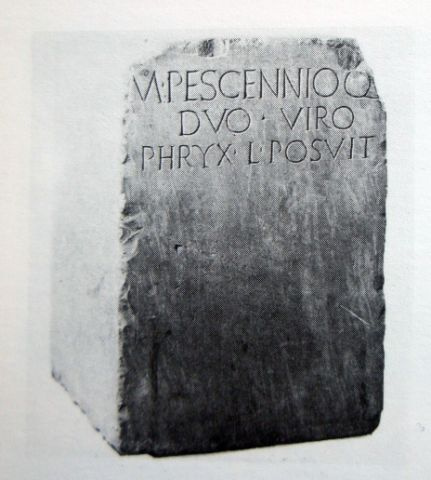
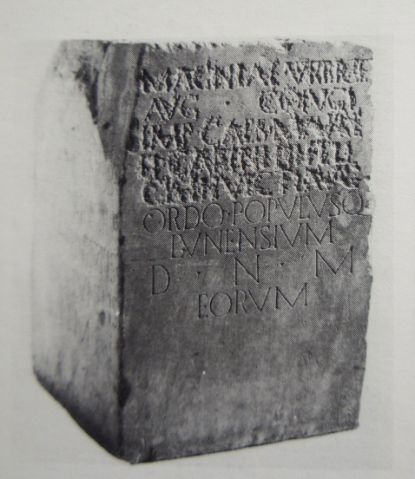
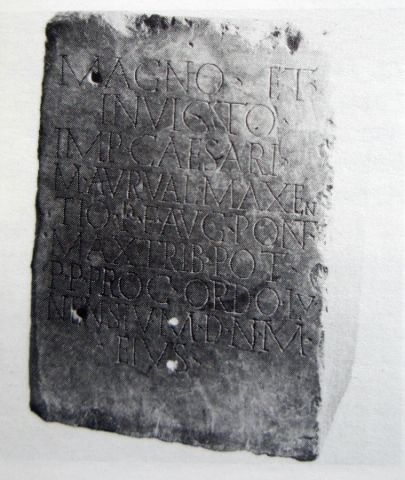
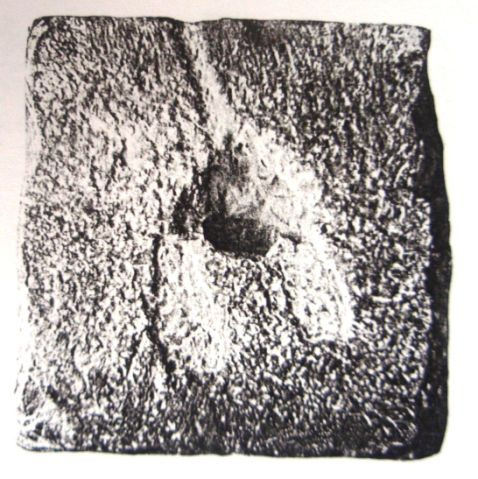
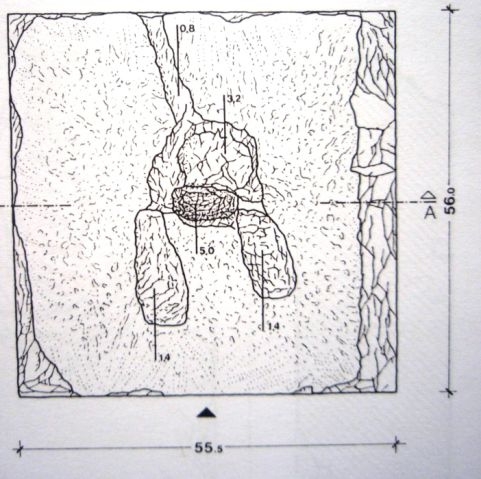
Marble base, re-used on four occasions. 82.5 x 56 x 52 cm. The base was originally used for a dedication to a local magistrate. It was re-used for a dedication (on the back) to Magnia Urbica, wife of the emperor Carinus. This inscription was erased, and our dedication was inscribed, to Galerius. Later, the base was re-used one last time, for a statue of Maxentius (LSA-1618). The top of the base has fitting for the feet of a bronze statue, facing the side with the original dedication (Frova 1984, 22). It also has a square clamp hole, as well as a channel for pouring lead; these are probably related to the later uses of the base, when a plinth was fitted on its top (Frova 1984, 22).
PROVENANCE AND LOCATION
Our base was found out-of-context, re-used as part of a pillar of the basilica of S. Marco, in Sarzana (province of La Spezia) (Podestà 1890, 376-377). Other statue-bases were found on the same occasion, including LSA-1617). As our inscription records, however, these bases came from nearby Luni. Frova 1984, 20 suggests that these bases might have come from the area of the Capitolium, due to their number and importance. Our base is now in La Spezia, at the Archaeological museum.
HONORAND, AWARDER AND DATE
Our base was dedicated to the emperor Galerius while he was a Caesar, between 293 and 305. The base was dedicated by the ordo of Luni.
Discussion references
- Frova, A., "De statuarum basibus", Quaderni del Centro di studi Lunensi, 9, 1984
- Podestà, P., "Sarzana - Nuove scoperte nell'antica Luni", Notizia degli Scavi di Antichità, 1890
Cite: Last Statues of Antiquity, LSA-1619 (Carlos Machado).